On any construction site, mining operation, or industrial facility across Latin America—from the high-altitude mines of Chile to the bustling ports of Brazil—the ability to instantly identify a lifting sling’s capacity can mean the difference between a safe lift and a catastrophic failure. Unlike steel wire ropes or chains, synthetic flat lifting slings do not display their strength through visible thickness alone. Their load capacity is communicated through a carefully standardized system of colors, stripes, and labels.
This guide provides a comprehensive explanation of the lifting sling color code system under EN 1492-1, the relationship between color and rated capacity, and the critical role of the safety factor in ensuring safe lifting operations. We will also address regional compliance requirements under Brazil NR-11, Mexico NOM-151, and Chile NCh 2245.
1. The EN 1492-1 Color Code System: A Universal Language for Lifting
The most influential and widely followed standard for webbing sling color coding comes from the European Norms, specifically EN 1492-1:2000 for flat woven lifting slings. Many countries and regions—including those across Latin America—have adopted this color coding system for safety and identification purposes. Under this standard, polyester slings are assigned specific colors to quickly and easily identify their Working Load Limit (WLL).
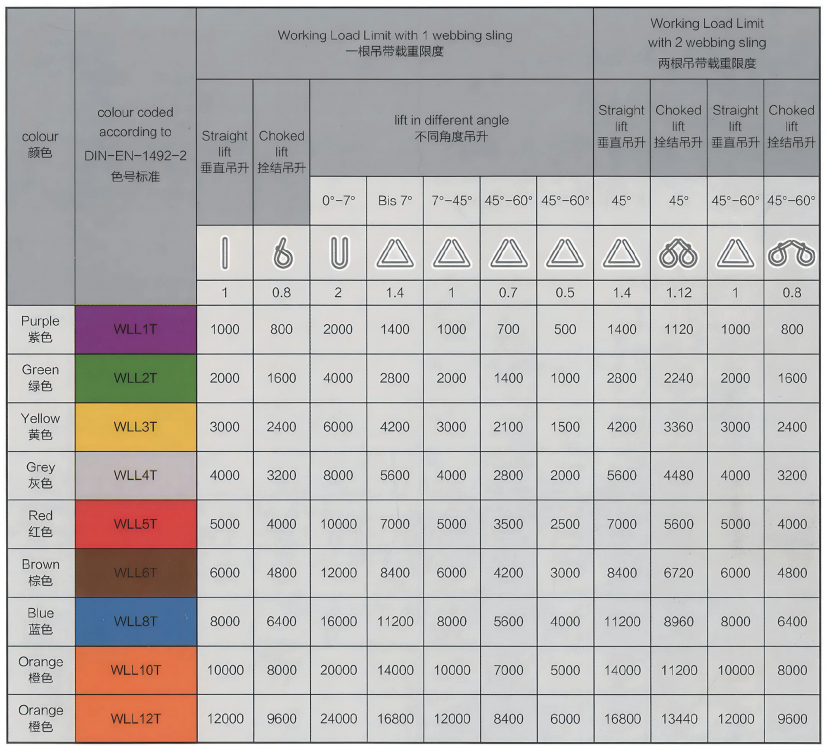
Color-to-Capacity Reference Chart
| Color | WLL (Tons) | WLL (kg) | Application Note |
|---|---|---|---|
| Violet | 1 Ton | 1,000 kg | Light-duty lifting, small components |
| Green | 2 Tons | 2,000 kg | General construction and workshop use |
| Yellow | 3 Tons | 3,000 kg | Medium-capacity lifting |
| Grey | 4 Tons | 4,000 kg | Heavy workshop and light industrial |
| Red | 5 Tons | 5,000 kg | Industrial and construction lifting |
| Brown | 6 Tons | 6,000 kg | Heavy-duty lifting operations |
| Blue | 8 Tons | 8,000 kg | High-capacity industrial lifting |
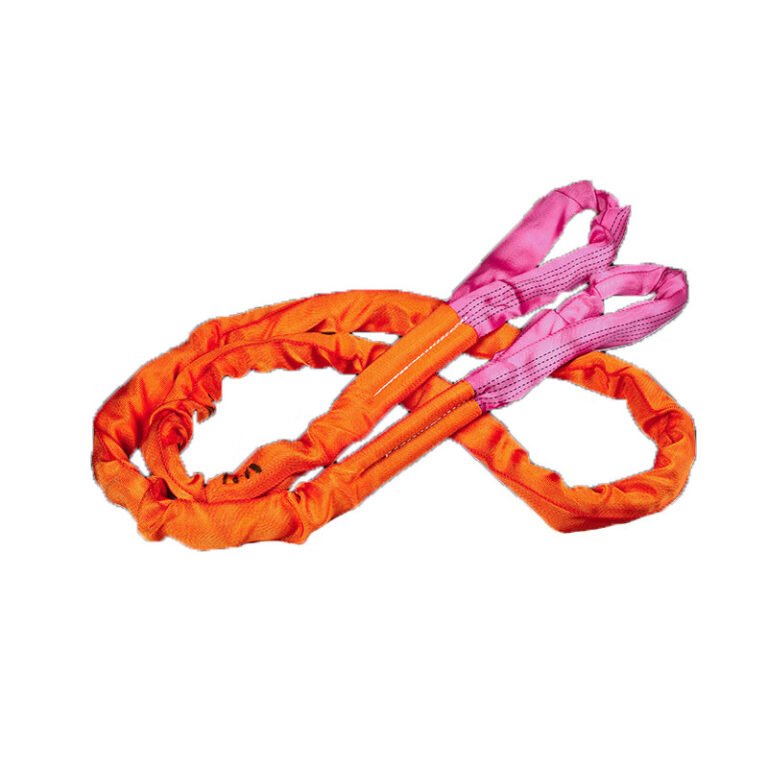
| Orange | 10 Tons and above | 10,000 kg+ | Heavy industrial and infrastructure projects |
Black Stripes: An Additional Marking Method
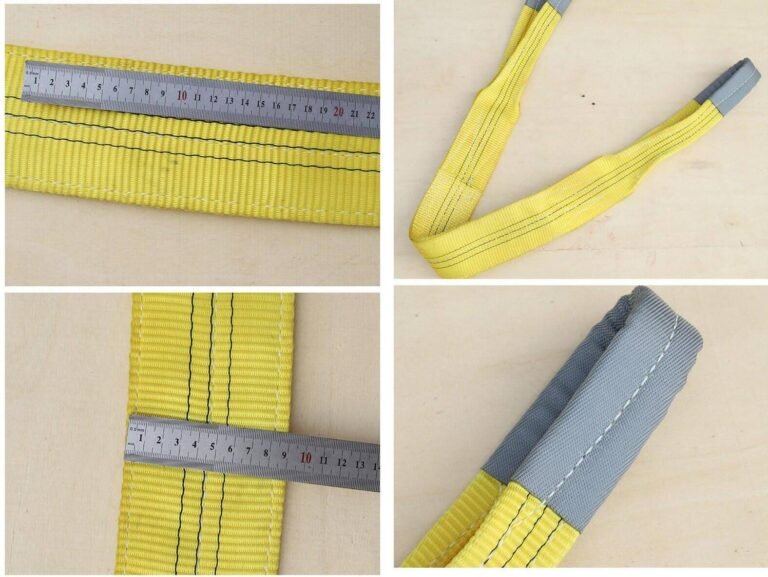
Beyond the primary color coding, many slings feature black stripes woven into the webbing. While this is not required by EN 1492-1, it is a useful solution to facilitate identification. Each black stripe corresponds to 1 ton of capacity.
For example:
- A sling with one black stripe = 1 ton
- A sling with three black stripes = 3 tons
- A sling with six black stripes = 6 tons
Slings with a WLL of 12 tons and above typically do not have black stripes.
The Blue Label: The Definitive Source of Information
While color coding provides quick visual identification, the blue label sewn onto every certified sling is the definitive source of information. This label must contain:
- Manufacturer ID
- Year of manufacture
- Material (e.g., 100% high-tenacity polyester)
- Effective Working Length (EWL)
- Serial number
- European standard reference (EN 1492-1)
- Maximum Working Load (WLL) in both straight pull and other hitch configurations
⚠️ CRITICAL NOTICE: If the identification tag is missing, damaged, or unreadable, the sling must be removed from service immediately. No tag means no lift—regardless of what the color might suggest.
2. Understanding the Safety Factor: The Margin Between Rated and Breaking Strength
The safety factor (also known as the design factor) is the ratio between a sling’s minimum breaking strength and its Working Load Limit (WLL) . It represents the engineering margin of safety built into the product.
How the Safety Factor Works
If a sling has a WLL of 2 tons and a safety factor of 7:1, its minimum breaking strength is:
2 tons × 7 = 14 tons
This means the sling is designed to hold seven times its rated capacity before reaching the point of failure.
The safety factor serves multiple purposes:
- Accommodates dynamic loads and shock loading during lifting operations
- Compensates for wear and tear over the sling’s service life
- Provides a buffer against unexpected load increases or rigging errors
- Accounts for environmental factors such as UV degradation and chemical exposure
Regional Standard Comparison: EN vs. ASME
Different regions and standards mandate different minimum safety factors for synthetic slings:
| Standard | Applicable Region | Minimum Safety Factor | Typical Application |
|---|---|---|---|
| EN 1492-1 / EN 1492-2 | Europe and many international markets | 7:1 | General lifting, construction, manufacturing |
| ASME B30.9 | United States and the Americas | 5:1 | Industrial lifting, rigging operations |
| ISO 4878 | International | 4:1 to 8:1 (varies) | General lifting applications |
EN 1492-1 mandates a safety factor of 7:1 for flat webbing slings. In contrast, ASME B30.9 typically requires a minimum design factor of 5:1. Some manufacturers offer slings with safety factors of 4:1, 6:1, or 8:1 upon request.
🔧 MANDATORY PRACTICE: For projects in Latin America, it is essential to verify which standard applies to your specific operation. Brazil’s NR-11 regulatory standard references ABNT NBR 15637-1 for capacity and resistance, while Chile follows NCh 2245 and Mexico adheres to NOM-151-SSA1. When sourcing an eslinga de poliester for regional projects, always confirm that the sling meets or exceeds the locally required safety factor.
3. Rated Capacity and Hitch Configuration: How Usage Affects WLL
The color code on a sling indicates its WLL for a straight vertical lift (M = 1.0) . When the sling is used in different hitch configurations, the effective capacity changes.
Capacity Multipliers by Hitch Type
| Hitch Configuration | Efficiency Factor (M) | Example: 2T Green Sling |
|---|---|---|
| Straight Lift (Vertical) | 1.0 | 2.0 Tons |
| Choker Hitch | 0.8 | 1.6 Tons |
| Basket Hitch (0°–45° from vertical) | 1.4 | 2.8 Tons |
| Basket Hitch (45°–60° from vertical) | 1.0 | 2.0 Tons |
Note: For basket hitches, the efficiency factor depends on the angle between the vertical axis and the sling leg. The standard formula is:
WLL (at angle) = WLL (Vertical) × Number of Legs × Cos(θ)
Where θ is the angle between the vertical axis and the sling leg.
Example: A 2T green sling used in a basket hitch with 2 legs at a 45° angle from vertical:
2T × 2 × Cos(45°) = 2T × 2 × 0.707 = 2.8T Safe Working Load
⚠️ CRITICAL NOTICE: If the angle from vertical exceeds 60°, the Cos(θ) drops below 0.5. This drastically compromises the structural integrity of the lift, and alternative rigging configurations must be deployed immediately.
4. From Color to Selection: A Practical Guide
Understanding the lifting sling color code is the first step toward safe rigging operations. Here is a practical framework for putting this knowledge to work on your job site.
Step 1: Identify the Load Weight
Calculate the total weight of the load, including any attachments or lifting inserts. Never estimate—use certified weighing equipment or verified engineering documentation.
Step 2: Select the Correct Sling Color
Using the color code chart, select a sling with a WLL that exceeds the calculated load weight. For example:
- Load weight: 2.5 tons → Select a red (5T) or grey (4T) sling, not a yellow (3T) sling
- Load weight: 4.5 tons → Select a red (5T) sling or higher
Step 3: Account for Hitch Configuration
Determine how the sling will be attached to the load. Apply the appropriate efficiency factor:
- Choker hitch: Reduce capacity by 20%
- Basket hitch: Calculate using the angle formula
- Multi-leg configurations: Account for load distribution across all legs
Step 4: Verify the Label
Before each lift, check that the blue label is intact, legible, and matches the color-coded capacity. If there is any discrepancy between the color and the label, trust the label.
Step 5: Inspect the Sling
Perform a pre-use visual inspection:
- Run hands along the entire length to detect cuts, snags, or internal defects
- Check for UV degradation (color fading, chalky surface)
- Look for chemical damage (discoloration, stiff spots, fiber crumbling)
- Inspect all sewn loops for loose, broken, or missing stitches
🔧 MANDATORY PRACTICE: Under EN 1492-1 and ASME B30.9, any cut or damage to the load-bearing edges that exceeds 10% of the sling width is grounds for immediate retirement. Visible red core indicator yarns signal that the sling has reached its structural limit.
Conclusion
The lifting sling color code system under EN 1492-1 provides a simple yet effective method for quickly identifying a flat lifting sling‘s rated capacity. From violet (1T) to orange (10T+), each color communicates critical safety information at a glance.
However, color is only one piece of the puzzle. The safety factor—whether 7:1 under European standards or 5:1 under ASME B30.9—represents the engineering margin that protects workers and equipment during lifting operations. Understanding how hitch configurations affect effective capacity, and knowing when to retire a sling based on inspection findings, completes the picture of safe rigging management.
For operations across Latin America, compliance with local standards—including Brazil NR-11, Mexico NOM-151, and Chile NCh 2245—is essential. Always verify that your eslinga de poliester meets the required safety factor and carries proper certification documentation.
📋 Need a Color Code Quick-Reference Card for Your Crew?
Download our LatAm-Compliant Sling Color Code & Safety Factor Reference Chart—includes EN 1492-1 color codes, WLL tables, angle factor calculations, and pre-use inspection checklists. Designed for shop floor and field crews across Brazil, Mexico, and Chile.
[Download the Color Code Reference Chart Now]