Stand-On vs Walking All-Electric Stacker
When choosing an electric pallet stacker, many customers are unsure whether to select a station-driven all-electric stacker or a walking all-electric stacker.
Although both machines provide electric lifting and pallet handling functions, they are designed for different working environments.
The main differences are:
- Operator position
- Travel distance
- Warehouse size
- Working frequency
- Operating comfort
- Purchase cost
Choosing the right model can improve warehouse efficiency while avoiding unnecessary investment.
The best electric stacker is not always the biggest one — it is the one that matches your actual handling requirements.
Product Overview Comparison
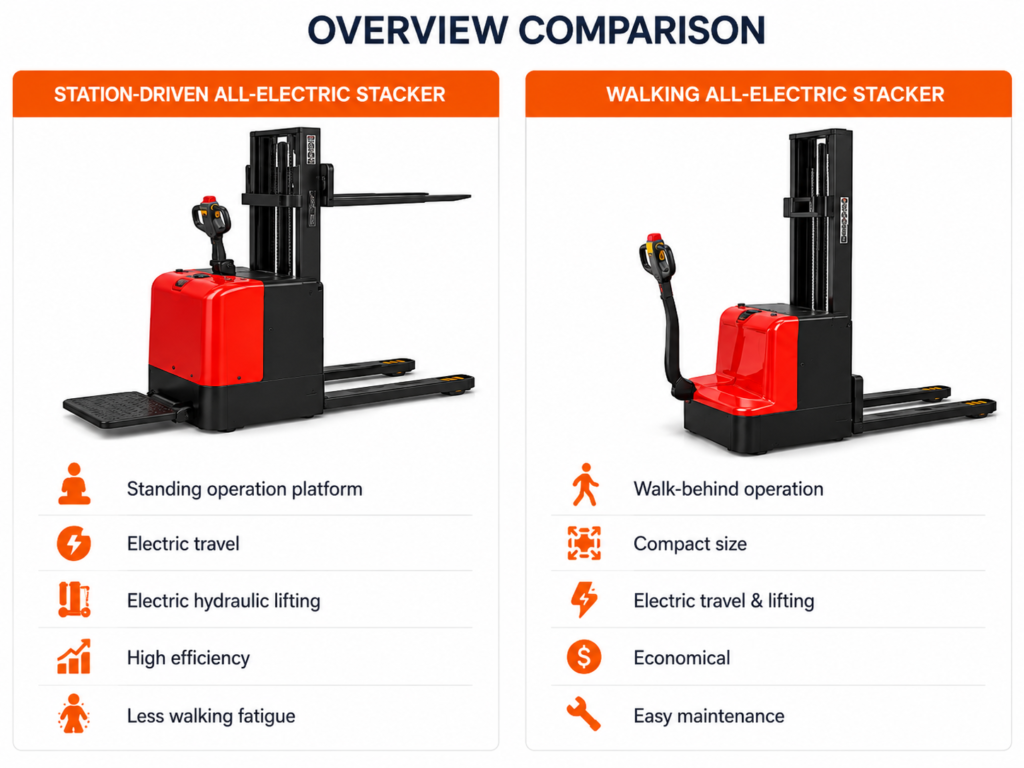
Station-Driven All-Electric Stacker
A station-driven all-electric stacker is designed with an operator standing platform.
The operator travels together with the machine, making it suitable for frequent pallet transportation and longer warehouse routes.
Main features:
✔ Standing operation platform
✔ Electric travel system
✔ Electric hydraulic lifting
✔ Higher working efficiency
✔ Reduced operator walking fatigue
Typical applications:
- Large warehouses
- Distribution centers
- Manufacturing plants
- Frequent pallet transfer operations
Walking All-Electric Stacker
A walking all-electric stacker is operated by walking behind the machine through a control handle.
It provides electric travel and lifting while maintaining a compact structure.
Main features:
✔ Compact size
✔ Flexible operation
✔ Lower investment cost
✔ Suitable for narrow working areas
✔ Easy maintenance
Typical applications:
- Small warehouses
- Workshops
- Production areas
- Short-distance pallet handling
Main Differences Between Stand-On and Walking Electric Stackers
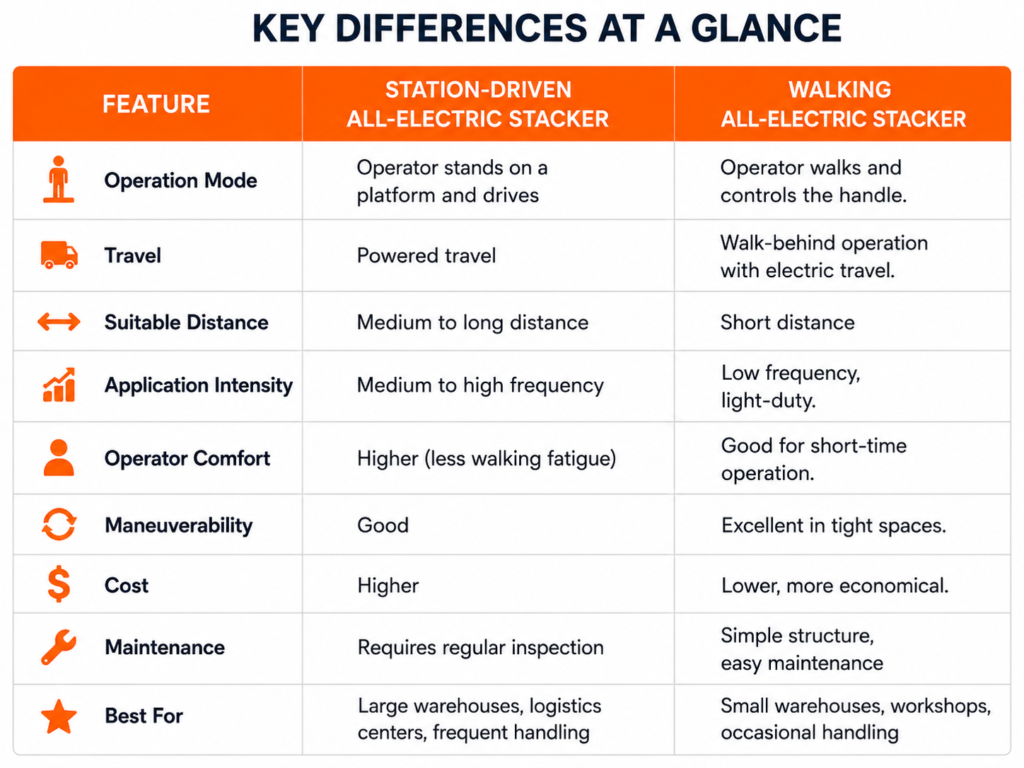
Difference in Operating Method
Stand-On Electric Stacker Operation
The operator stands on the platform and controls the machine during travel.
Advantages:
Less Walking Fatigue
During repeated pallet movement, the operator does not need to walk with the machine.
Higher Productivity
Suitable for:
- Multiple pallet transfers
- Long warehouse routes
- Continuous working cycles
Walking Electric Stacker Operation
The operator controls the machine through the handle while walking.
Advantages:
Better Low-Speed Control
The operator stays close to the load, making pallet positioning easier.
Suitable for:
- Rack positioning
- Small warehouse movement
- Production line material supply
Difference in Application Scenarios
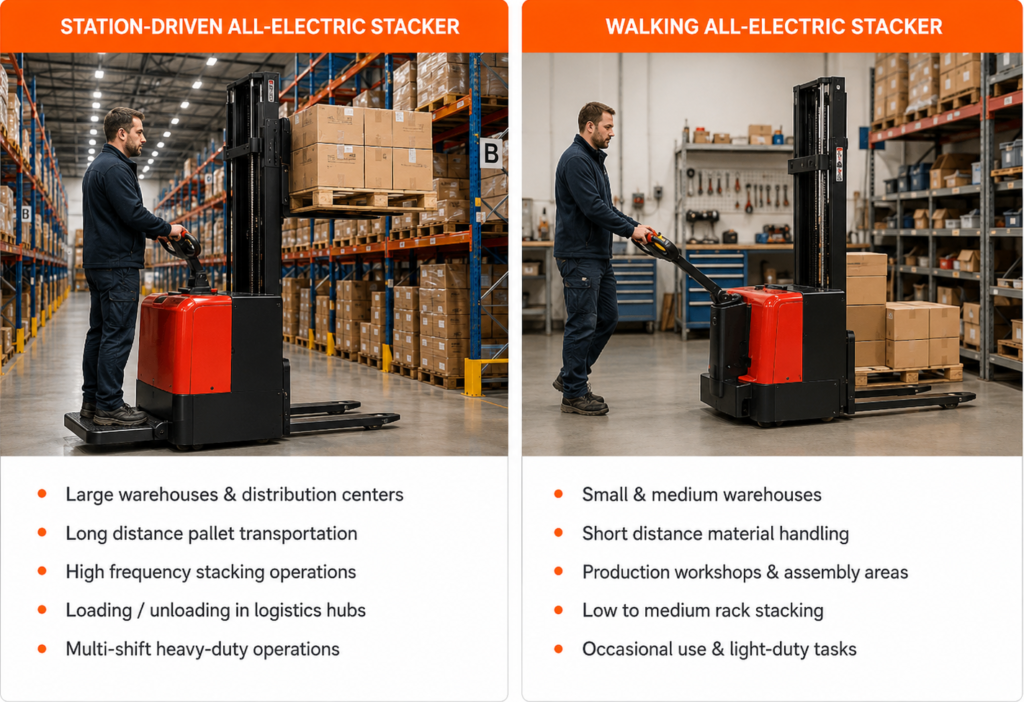
Station-Driven Electric Stacker Applications
Best suited for:
Large Warehouses
Large storage areas require frequent movement between locations.
Logistics Centers
High-frequency pallet handling requires improved efficiency.
Manufacturing Facilities
Suitable for moving materials between production and storage areas.
Distribution Operations
Good choice where operators spend a large amount of time travelling.
Walking All-Electric Stacker Applications
Best suited for:
Small and Medium Warehouses
Compact dimensions allow easier operation.
Factory Workshops
Suitable for material movement beside production lines.
Storage Rooms
Ideal for occasional pallet stacking.
Limited Space Areas
Better maneuverability in narrow environments.
Difference in Operator Comfort
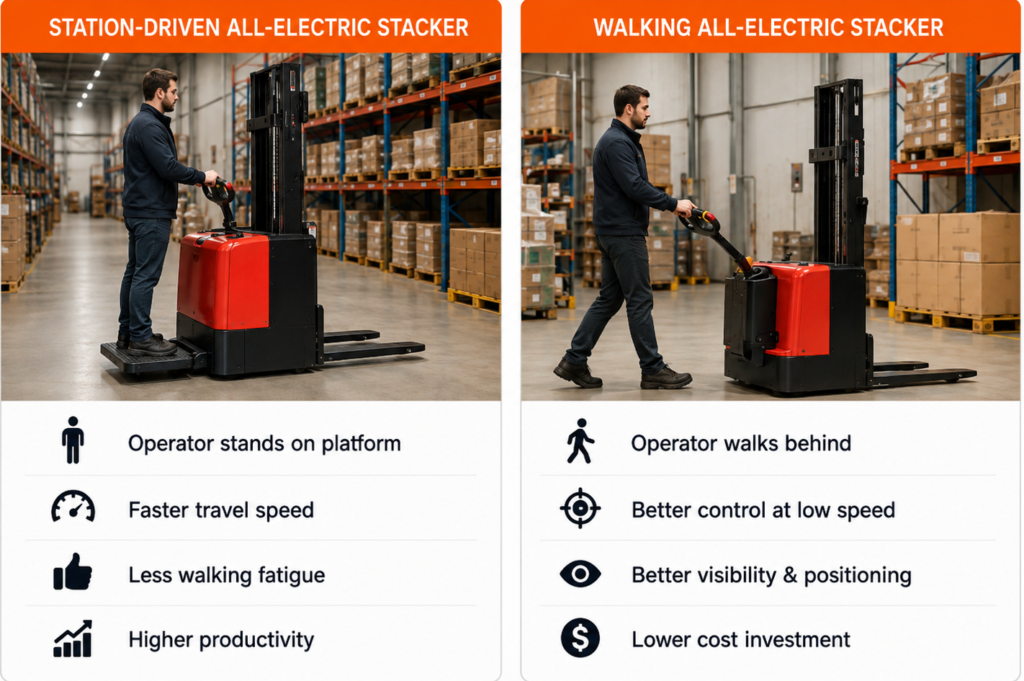
Stand-On Model
Advantages:
✔ Reduced physical movement
✔ Better for long working hours
✔ Improved operator comfor
Walking Model
Advantages:
✔ Simple operation
✔ Better visibility
✔ Easier load positioning
Quick Selection Guide
Choose Station-Driven All-Electric Stacker If:
✅ Large warehouse
✅ Frequent pallet movement
✅ Long travel distance
✅ Higher productivity requirement
✅ Operator comfort is important
Choose Walking All-Electric Stacker If:
✅ Small warehouse
✅ Short-distance handling
✅ Limited space
✅ Lower purchase budget
✅ Occasional stacking work
Related links:OSHA Industrial Truck Standard、battery maintenance guidelines