On a typical construction site across Latin America—whether it is a high-rise development in São Paulo, a bridge project in Chile, or an industrial facility in Mexico—the safe and efficient lifting of precast concrete elements is a daily operational challenge. Unlike steel beams or fabricated machinery, precast concrete panels, hollow-core slabs, and structural columns present a unique set of handling requirements: they are heavy, brittle, surface-sensitive, and often feature sharp or abrasive edges that can quickly destroy inferior rigging gear.
The EB webbing sling—a flat, high-strength polyester lifting strap—has emerged as the industry’s preferred solution for these demanding applications. This guide examines why webbing slings for construction lifting have become indispensable on job sites, how to select the right EB flat webbing sling for precast concrete operations, and the critical safety protocols that protect both personnel and product integrity.
1. Understanding the EB Webbing Sling: Design, Materials, and Standards
What Is an EB Webbing Sling?
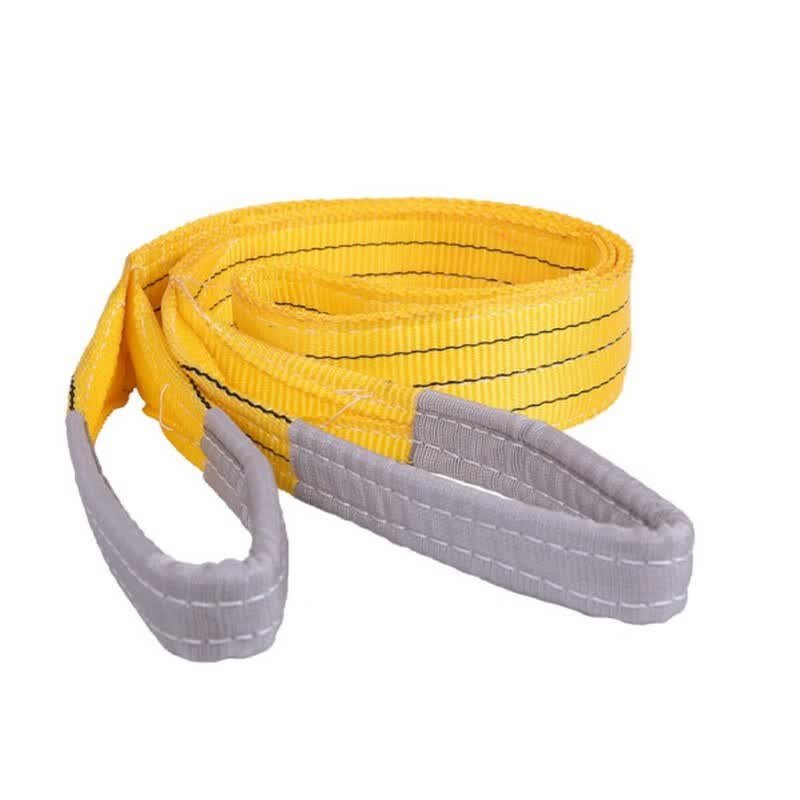
The EB (Endless / Eye-and-Eye type with reinforced loops) webbing sling is a flat, woven synthetic lifting strap manufactured from 100% high-tenacity polyester (PES) filaments. Its flat, wide bearing surface distributes the load evenly across the contact area, significantly reducing surface pressure and preventing damage to the lifted object. The sling features reinforced eyes or loops at both ends, which can be attached directly to a crane hook or rigging hardware.
Key Technical Specifications
EB webbing slings are available across a broad performance spectrum:
| Parameter | Typical Range |
|---|---|
| Load Capacity | 0 – 50 tons |
| Length Range | 1 – 100 meters |
| Material | 100% high-tenacity polyester (PES) |
| Safety Factor | 4:1 to 8:1 (typically 6:1 or 7:1 for construction) |
| Operating Temperature | -40°C to 100°C |
| Elongation at Break | ≤ 7% – 12% |
Standard Compliance
All certified EB webbing slings are manufactured in accordance with EN 1492-1:2000 (Textile slings – Safety – Part 1: Flat woven webbing slings). This standard specifies the safety factors, working load limits, and testing requirements for flat woven webbing slings intended for general-purpose lifting operations.
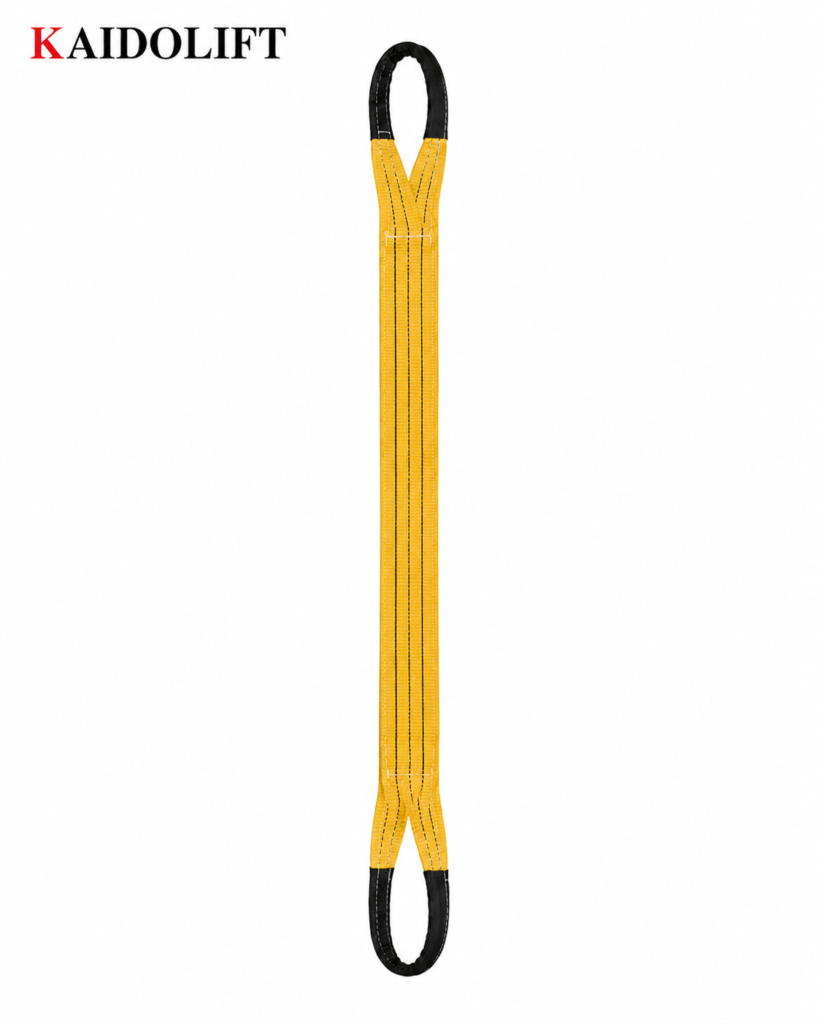
Webbing Sling EB (Eslinga Plana) | 1T to 30T Flat Lifting Sling
Heavy-duty EB Webbing Sling certified to DIN-EN 1492-1 and 2006/42/EC. Made from 100% high-tensile polyester with safety factors up to 8:1. Wide, smooth flat lifting sling for LATAM logistics and industrial rigging.
Under EN 1492-1, slings are color-coded for instant load identification:
- Violet: 1 Ton
- Green: 2 Tons
- Yellow: 3 Tons
- Grey: 4 Tons
- Red: 5 Tons
- Brown: 6 Tons
- Blue: 8 Tons
- Orange: 10 Tons
Additionally, many EB slings feature tonnage stripes, with each stripe representing a load capacity of 1 ton, enabling quick visual verification on the job site.
Why Polyester?
For precast concrete and construction lifting, polyester webbing slings offer distinct advantages over nylon or polypropylene alternatives:
- Low Moisture Absorption (<0.4%): Polyester retains full strength when wet—critical for outdoor job sites exposed to rain or high humidity.
- UV Resistance: UV-stabilized polyester maintains durability and structural integrity in prolonged sunlight exposure.
- Chemical Resistance: Polyester resists most industrial acids and oils commonly found on construction sites.
- Low Elongation: Minimal stretch ensures precise load control during positioning maneuvers.
2. EB Webbing Sling Applications in Precast Concrete Lifting
Precast concrete elements—walls, columns, beams, hollow-core slabs, and panels—are cast off-site and transported to the construction site for installation. The lifting and handling of these elements require rigging equipment that can manage heavy loads without compromising the finished concrete surface.
Why EB Slings Are the Preferred Choice
1. Surface Protection
The flat, wide bearing surface of an EB flat webbing sling distributes the load across a broad contact area, minimizing point pressure and preventing surface damage to the concrete. Unlike wire rope slings, which can “bite in” and ruin finished edges, polyester webbing slings protect the integrity of the precast element.
2. Non-Marring Properties
EB slings are manufactured without metal components that could scratch or chip concrete surfaces. This makes them ideal for lifting finished architectural panels, polished concrete elements, and precast components with exposed aggregate or decorative finishes.
3. Flexibility and Adaptability
The lightweight, flexible nature of EB webbing slings allows them to conform to the shape of the load, providing secure contact even with irregularly shaped precast elements. This flexibility is particularly valuable when lifting complex geometries such as curved panels, double-tee sections, or precast columns with embedded inserts.
Typical Precast Lifting Scenarios
| Application | Sling Configuration | Key Consideration |
|---|---|---|
| Wall Panels | Vertical or basket hitch | Ensure sling angles do not exceed 60° from vertical |
| Hollow-Core Slabs | Basket hitch with spreader beam | Use edge protection at contact points |
| Columns and Beams | Choker or basket hitch | Verify WLL derating for choker configuration |
| Architectural Panels | Vertical lift with protective sleeves | Non-marring properties are critical |
| Prestressed Elements | Multiple-point lift | Calculate load distribution across all lifting points |
⚠️ CRITICAL NOTICE: For the edge lifting of thin precast panels, vertical rigging is strongly recommended to minimize the force exerted on the panel edge. Shallow sling angles can significantly increase the load on the lifting device and the panel itself.
3. Construction Site Lifting: Practical Considerations
Beyond precast concrete manufacturing plants, EB webbing slings are extensively used on construction sites for hoisting steel beams, prefabricated structures, concrete panels, and heavy building materials.
Common Construction Applications
- Steel Beam Hoisting: The non-abrasive surface of polyester webbing prevents damage to painted or coated steel members.
- Prefabricated Structure Installation: EB slings provide the flexibility needed to handle complex prefabricated assemblies.
- Material Handling: From concrete blocks to rebar bundles, EB slings offer a versatile lifting solution across the job site.
- Wind Turbine Installations: The flexibility of EB slings makes them ideal for handling irregularly shaped components such as turbine blades and tower sections.
Selecting the Right EB Sling for the Job
When specifying an EB webbing sling for construction lifting, consider the following factors:
1. Load Weight and WLL
Calculate the total weight of the load, including any lifting inserts or attachments. Select a sling with a Working Load Limit (WLL) that exceeds the calculated load weight, accounting for the derating factors of the chosen hitch configuration.
2. Effective Working Length
The effective length of the sling must accommodate the distance between the crane hook and the load’s connection points. Remember that the sling length directly affects the horizontal angle—a sling that is too short creates steep angles that exponentially increase tension on the webbing.
3. Hitch Configuration and Angle Factors
The rated WLL of an EB sling applies only to a straight vertical lift. Different hitch configurations reduce the effective capacity:
| Lifting Mode | Efficiency Factor (M) |
|---|---|
| Straight Lift (Vertical) | 1.0 |
| Choker Hitch | 0.8 |
| Basket Lift (0°–45° from vertical) | 1.4 |
| Basket Lift (45°–60° from vertical) | 1.0 |
Example: A 2T EB sling used in a basket hitch at a 45° angle from vertical has an effective capacity of: 2T × 2 (legs) × Cos(45°) = 2T × 2 × 0.707 = 2.8T Safe Working Load.
⚠️ CRITICAL NOTICE: If the angle from vertical exceeds 60°, the Cos(θ) drops below 0.5. This drastically compromises the structural integrity of the lift, and alternative rigging configurations must be deployed immediately.
4. Edge Protection: The Non-Negotiable Safety Protocol
Precast concrete elements and steel beams often feature sharp edges, rough surfaces, or abrasive finishes that can damage or sever synthetic webbing slings. The polyester webbing sling is highly sensitive to sharp edges and abrasive contact.
The Risk
A sharp concrete edge or steel corner can cut through the outer stitching of a webbing sling, compromising its structural integrity and reducing the actual WLL by 50% or more—regardless of the printed safety factor.
Protection Solutions
1. Corner Protectors and Edge Guards
Corner protectors are designed to prevent sharp edge damage during lifting by distributing pressure evenly and keeping the sling from directly contacting the load’s sharp corners. These are essential accessories for repetitive lifting operations involving payloads with sharp or abrasive edges.
2. Anti-Abrasion Sleeves
Woven fabric sleeves provide protection when the sling is exposed to wide abrasive surfaces such as concrete. These sleeves extend the service life of the sling in demanding construction applications.
3. Reinforced Edge Construction
Some premium EB slings feature specially woven edge protection and reinforced loops that provide resistance to abrasion and damage. Advanced products such as the Cert-Edge™ sling have been independently tested to be 67% more resistant to edge abrasion and 30% more resistant to edge cutting than standard webbing.
🔧 MANDATORY PRACTICE: Whenever lifting precast concrete elements or steel members with sharp or abrasive edges, edge protection (corner protectors or wear sleeves) is not optional—it is mandatory. Factoring this derating into your initial selection process is the hallmark of a mature safety culture.
5. Inspection and Maintenance for Construction Applications
The demanding environment of a construction site accelerates wear on rigging equipment. Regular inspection and proper maintenance are essential to ensure the continued safe operation of EB webbing slings.
Pre-Use Inspection Checklist
Before each lift, inspect the sling for:
- Cuts, nicks, or fraying: Any transverse or longitudinal damage to the load-bearing edges compromises the safety factor.
- Chemical degradation: Look for discoloration, stiff spots, or fibers that crumble when rubbed—indicators of chemical attack.
- Heat damage: Melted fiber clusters, glazed surfaces, or weld splatter burns permanently weaken the fabric structure.
- Tag legibility: If the identification tag is missing or unreadable, remove the sling from service immediately.
- Stitching integrity: Examine the load-bearing splice areas for loose or broken stitches.
Storage Best Practices
To extend the service life of EB webbing slings:
- Store in a well-ventilated, dry environment away from direct sunlight.
- Hang slings on corrosion-resistant, non-metallic pegs.
- Keep slings clear of ground contact, welding stations, and chemical storage areas.
- Protect slings from UV degradation when stored outdoors for extended periods.
Conclusion
The EB webbing sling has proven itself as the go-to lifting solution for precast concrete and construction applications across Latin America and beyond. Its combination of high strength-to-weight ratio, surface protection capabilities, flexibility, and compliance with international standards such as EN 1492-1 makes it an indispensable tool for modern construction operations.
By diligently evaluating load weight, selecting the appropriate length and hitch configuration, and—most critically—implementing robust edge protection protocols, site supervisors and safety officers can ensure every lift is executed safely and efficiently. Remember: the success of a lift depends not only on the strength of the sling but on the rigor of the selection process and the discipline of the inspection routine.
📋 Need an On-Site Sizing Quick-Card for Your Crew?
Download our LatAm-Compliant EB Webbing Sling Reference Chart—includes color codes, angle factor tables, WLL derating calculations, and pre-use inspection checklists. Designed for shop floor and field crews across Brazil (NR-11), Mexico (NOM-151), and Chile (NCh 2245).
[Download the EB Sling Reference Chart Now]