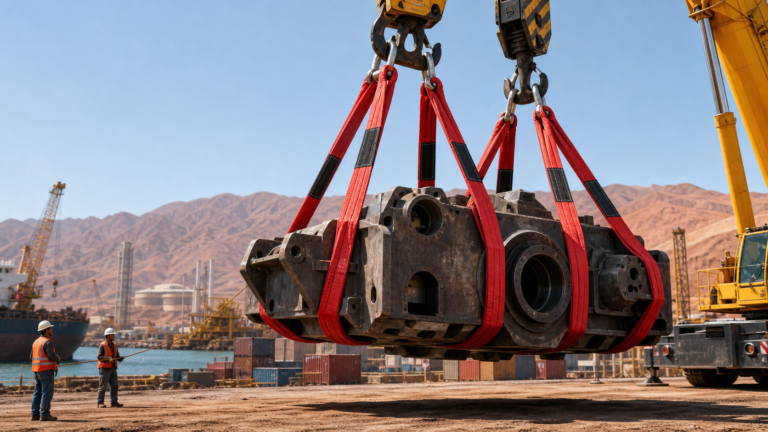
For rigging professionals across Latin America—from the construction sites of Mexico City to the mining operations in Chile’s Atacama region—the choice between flat webbing slings and round synthetic slings is more than a matter of preference. It is a technical decision that directly impacts load security, equipment longevity, and job site safety.
Both types of soft lifting slings offer significant advantages over steel wire rope or chain alternatives: they are lightweight, flexible, non-marring, and easy to handle. However, their distinct design characteristics, load-bearing mechanisms, and performance profiles make each type better suited to specific applications.
This guide provides a comprehensive technical comparison of webbing sling vs round sling to help engineering teams, procurement officers, and rigging supervisors make informed decisions aligned with their operational requirements and safety mandates under EN 1492-1, EN 1492-2, ASME B30.9, and LatAm regulations including Brazil NR-11, Mexico NOM-151, and Chile NCh 2245.
1. Understanding the Two Types: Design and Construction
What Is a Webbing Sling?
A flat webbing sling (also known as a flat lifting sling or polyester webbing sling) is manufactured by weaving high-tenacity polyester yarns into a flat, rectangular profile. The sling consists of a load-bearing core of parallel warp yarns, enclosed by a woven outer jacket that protects the core from abrasion and environmental damage.
Under EN 1492-1, flat woven webbing slings are defined as slings made from flat woven webbing, which is placed in one or more layers and sewn together to form the lifting device.
Key Characteristics:
- Flat, rectangular cross-section
- Wide load-bearing surface
- Sewn eyes (loop ends) at both ends
- Load-bearing core protected by a woven jacket
- Available as endless (endless round sling) or eye-and-eye types
Design Detail: The sling is typically made from 100% high-tenacity polyester, which provides excellent resistance to moisture, UV degradation, and most industrial chemicals. The wide bearing surface distributes the load across a larger contact area, reducing surface pressure and protecting delicate or finished surfaces.
What Is a Round Sling?
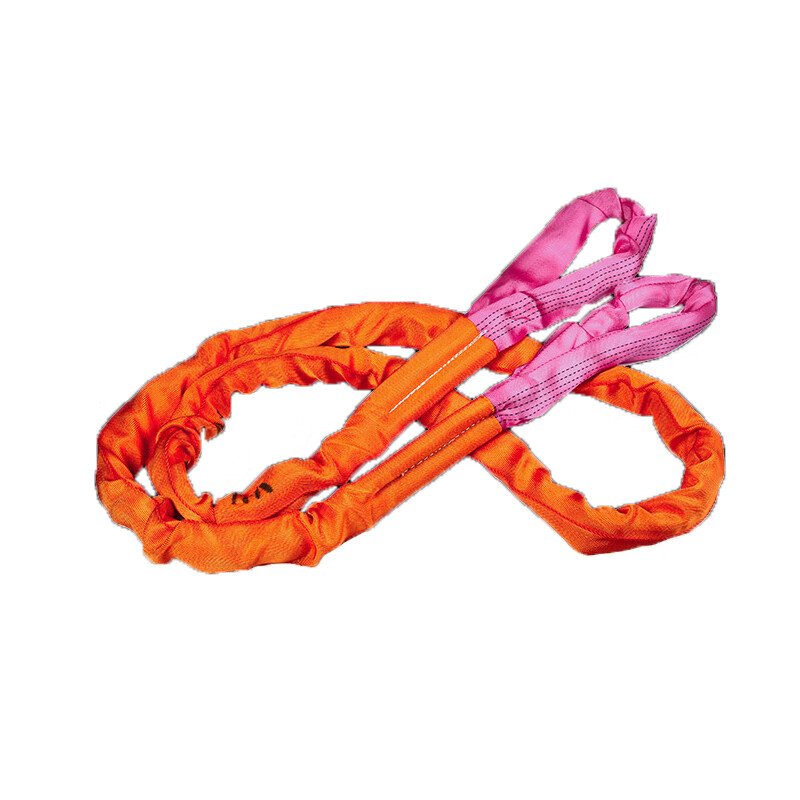
A round synthetic sling (also referred to as an endless round sling or round sling) is a continuous loop of high-tenacity polyester yarns enclosed within a tubular, abrasion-resistant outer jacket or “cover.” The core consists of multiple continuous strands of polyester yarn that run parallel to one another, forming a compact, circular cross-section.
Under EN 1492-2, round slings are defined as textile slings made from synthetic fibers, with the load-bearing core consisting of continuous fibers running parallel to each other, enclosed in a protective cover.
Key Characteristics:
- Circular cross-section
- High load capacity in a compact package
- Continuous loop (endless) design
- Protective outer cover (can be removed for inspection)
- More flexible than flat slings in multi-leg configurations
Design Detail: The strength of a round sling comes from the continuous polyester yarns that run uninterrupted throughout the loop. The outer cover protects the core yarns from mechanical damage and environmental exposure, while also providing a surface for identification labels and capacity markings.
Comparison at a Glance
| Feature | Webbing Sling (EN 1492-1) | Round Sling (EN 1492-2) |
|---|---|---|
| Cross-Section | Flat, rectangular | Round, circular |
| Load Distribution | Wide contact area | Compact, focused contact |
| Core Construction | Parallel warp yarns | Continuous polyester strands |
| Outer Protection | Woven jacket | Removable/tubular cover |
| Standard | EN 1492-1 | EN 1492-2 |
| Typical Safety Factor | 6:1 or 7:1 | 6:1 or 7:1 |
2. Performance Comparison: Strengths and Limitations
Understanding the relative strengths and weaknesses of each sling type is essential for correct application.
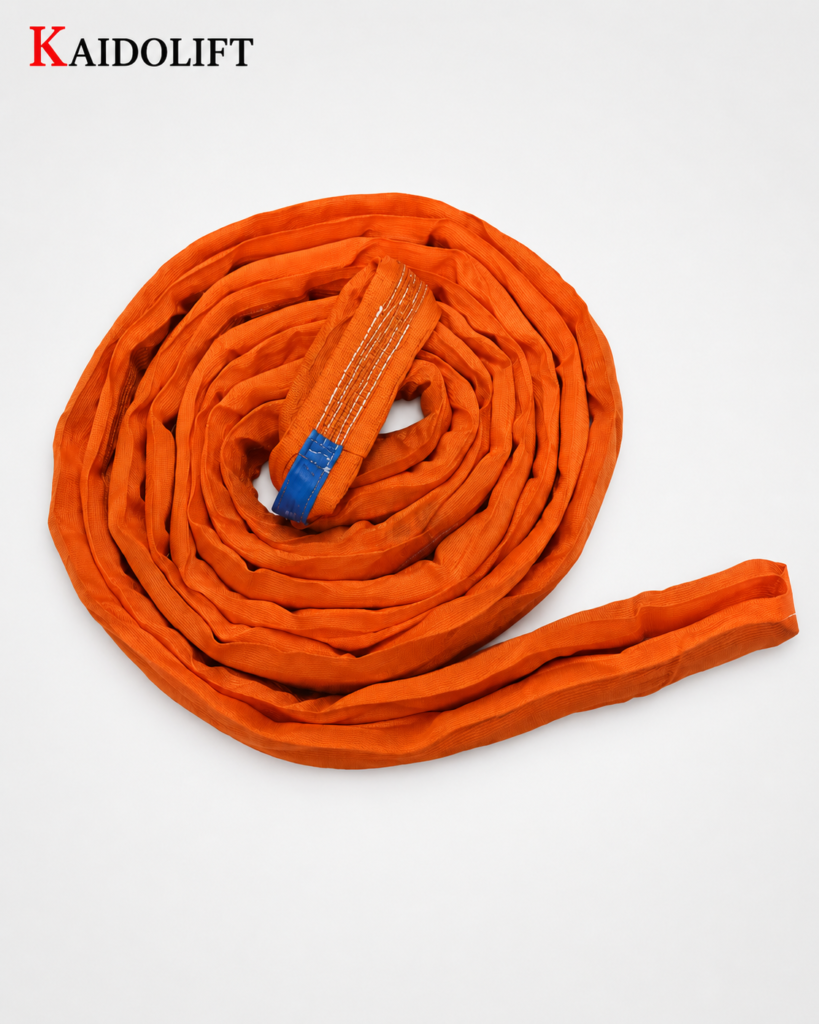
EA Round Sling (Eslinga Redonda) | 1T to 12T Polyester Lifting Sling
Webbing Slings: Strengths and Limitations
Strengths:
- Superior Surface Protection: The wide, flat bearing surface minimizes point pressure, making webbing slings ideal for lifting finished surfaces, precast concrete, and delicate loads.
- Abrasion Resistance: Flat slings, particularly those made from woven webbing, offer excellent resistance to cutting and abrasion compared to round slings.
- Versatility: Available in both eye-and-eye and endless configurations, webbing slings can accommodate a wide range of hitch configurations.
- Easy Visual Inspection: Flat, woven structure makes it easier to identify cuts, abrasions, and wear patterns during pre-use inspections.
- Cost-Effective: Generally more affordable than round slings for equivalent capacities in the lower to medium load range.
- Better Edge Resistance: The wide, flat construction inherently resists cutting at edges better than round slings.
Limitations:
- Bulkier: Flat slings take up more storage space and can be heavier to handle than round slings of equivalent capacity.
- Less Flexible in Tight Spaces: The wide profile can make it difficult to thread through narrow lifting points or tight clearances.
- Limited Elongation: Low stretch properties provide load stability but offer less shock absorption compared to round slings.
- Potential for Twisting: Flat slings can twist under load if not properly aligned, which can reduce effective capacity and damage the sling.
Round Slings: Strengths and Limitations
Strengths:
- High Strength-to-Weight Ratio: Round slings offer exceptional load capacity in a compact, lightweight package.
- Exceptional Flexibility: The circular cross-section allows round slings to conform easily to the load’s shape and bend around tight radii.
- Space Efficiency: Compact design saves storage space and simplifies handling.
- Shock Absorption: The parallel yarn construction provides some elasticity, helping to absorb dynamic loads and shock loading during lifting operations.
- Multi-Leg Versatility: Round slings excel in multi-leg lifting arrangements where flexibility and adjustability are required.
- Inspection-Friendly: The removable outer cover allows for thorough inspection of the load-bearing core yarns.
Limitations:
- Lower Abrasion Resistance: The outer cover is more susceptible to abrasion damage than the woven jacket of a flat sling.
- Poorer Edge Resistance: The round cross-section concentrates pressure at points of contact with sharp edges, increasing the risk of cutting or damage.
- Risk of Internal Damage: Damage to the internal core may not be visible during external inspection, making regular cover removal essential.
- Higher Cost: Round slings are typically more expensive than flat slings for equivalent capacities.
- Friction Sensitivity: The round profile creates more friction when passing around tight corners, which can generate heat and accelerate wear.
3. Application Scenarios: When to Use Each Type
The decision between a flat lifting sling and a round sling should be based on the specific demands of the lift, including load characteristics, working environment, and operational constraints.
When to Choose a Webbing Sling
1. Lifting Surfaces That Must Be Protected
The wide bearing surface of a flat polyester webbing sling distributes the load evenly, preventing point pressure that could damage finished surfaces. Use a webbing sling for:
- Precast concrete panels and architectural elements
- Finished steel beams with painted or coated surfaces
- Polished stone or marble blocks
- Machinery with delicate finishes or sensitive components
- Lifting of high-quality cosmetic surfaces
🔧 MANDATORY PRACTICE: For lifting thin precast panels or architectural elements with finished surfaces, vertical rigging is strongly recommended to minimize force on the panel edge and surface damage.
2. Environments with Sharp or Abrasive Edges
Flat slings inherently resist cutting at edges better than round slings. However, edge protection (corner protectors or wear sleeves) is still essential for loads with sharp or abrasive edges. Use a webbing sling for:
- Loads with sharp concrete edges
- Steel beams or plates with burrs or rough edges
- Heavy machinery with exposed bolt heads or protrusions
- Metal castings with irregular surfaces
3. Straight-Lift and Vertical Hitch Applications
For vertical lifting where the sling remains straight and aligned with the load, the wide bearing surface of a webbing sling provides excellent stability and load control. Use a webbing sling for:
- Single-point vertical lifts
- Direct vertical attachment to crane hooks
- Lifting with spreader beams
- Lifting with fixed-length slings
4. Applications Requiring Visual Inspection Confidence
The woven structure of a flat sling makes cuts, abrasions, and wear patterns easy to identify during pre-use inspection. Use a webbing sling where:
- Inspection frequency is high (daily pre-shift inspections)
- The sling is subject to frequent visual checks
- A wide range of personnel are responsible for inspections
When to Choose a Round Sling
1. Multi-Leg Lifting Arrangements
The flexibility of round slings makes them ideal for complex multi-leg configurations where slings must bend, twist, and adapt to the load’s geometry. Use a round sling for:
- Four-leg lifting sets with adjustable lengths
- Lifting irregularly shaped loads with multiple connection points
- Situations where slings must be routed through tight spaces
- Applications requiring slings to pass over sharp corners (with edge protection)
2. Space-Constrained Lifting Operations
The compact, circular cross-section of round slings allows them to work effectively in confined spaces where flat slings would be too bulky. Use a round sling for:
- Tight clearance between the load and surrounding structures
- Lifting through narrow openings or slots
- Applications where storage space is limited
- On-site operations where portability is important
3. Loads Requiring Flexibility and Conformability
The continuous strand design of round slings allows them to conform to irregular load shapes, ensuring secure contact and even load distribution. Use a round sling for:
- Lifting irregularly shaped steel castings
- Handling complex prefabricated assemblies
- Lifting loads with curved or contoured surfaces
- Applications where slings must wrap around non-uniform geometries
4. Shock Loading or Dynamic Lifting
Round slings provide some degree of shock absorption due to their continuous yarn construction, making them better suited for applications involving impact or dynamic loading. Use a round sling for:
- Lifting operations involving sudden load applications
- Crane operations with moderate dynamic effects
- Situations where load swing is unavoidable
Decision Matrix: Selecting the Right Sling
| Application | Webbing Sling | Round Sling |
|---|---|---|
| Finished concrete panels | ✓ Preferred | ⚠️ Use with care (requires edge protection) |
| Steel beams (painted) | ✓ Preferred | ✓ Suitable |
| Unfinished steel/rough edges | ✓ Good (with edge protection) | ⚠️ Use with edge protection |
| Multi-leg lifting arrangements | ⚠️ Possible but bulky | ✓ Preferred |
| Tight clearance/confined spaces | ⚠️ Bulky profile | ✓ Preferred |
| Surface protection (cosmetic loads) | ✓ Preferred | ⚠️ Higher contact pressure |
| Shock loading/dynamic lifts | ⚠️ Limited shock absorption | ✓ Preferred |
| High-temperature applications (<100°C) | ✓ Suitable | ✓ Suitable |
| High abrasion environments | ✓ Good | ⚠️ Cover susceptible to abrasion |
| Frequent inspection required | ✓ Easily inspected | ⚠️ Requires cover removal for core inspection |
4. Inspection and Maintenance Considerations
Both sling types require regular inspection and proper maintenance. However, their different construction methods mean that inspection procedures differ significantly.
Webbing Sling Inspection
Pre-Use Check:
- Run hands along the entire length to detect cuts, snags, or internal defects
- Check the surface for cuts, nicks, tears, or abrasive wear
- Inspect all sewn loops for loose, broken, or missing stitches
- Verify identification tags are legible and securely attached
- Look for signs of UV degradation (color fading, chalky surface)
- Check for chemical damage (discoloration, stiff spots, fiber crumbling)
⚠️ CRITICAL NOTICE: Under EN 1492-1, any cut or damage to the load-bearing edges (where the warp yarns are concentrated) that exceeds 10% of the sling width is grounds for immediate retirement. Visible red core indicator yarns signal that the sling has reached its structural limit.
Round Sling Inspection
Pre-Use Check (External):
- Inspect the outer cover for cuts, snags, abrasions, or fraying
- Check for melting, glazing, or weld splatter damage
- Verify identification tags are legible and securely attached
- Look for stiff or brittle sections indicating chemical or heat damage
Periodic Inspection (Internal Core):
The protective cover must be removed periodically to inspect the internal core yarns. Under EN 1492-2, the “red core indicator” system helps identify when the internal yarns have been damaged:
- No red visible: No damage to core yarns (or damage not yet at threshold)
- Red visible in one zone: Core yarns are damaged; remove from service
- Red visible across full width/length: Significant core damage; immediate retirement required
End-of-Life Threshold:
- If the red core indicator yarn is visible in any zone of the sling, it must be removed from service immediately
- This applies regardless of the condition of the outer cover
Storage Best Practices (Both Types)
- Store in a well-ventilated, dry location away from direct sunlight
- Hang slings on corrosion-resistant, non-metallic pegs
- Keep clear of ground contact, welding stations, and chemical storage areas
- Do not store near heat sources or direct sunlight (UV degradation)
- Ensure storage areas are protected from the elements when possible
5. Lifting Angle and Capacity Calculations
Regardless of sling type, the angle at which the sling is used affects its effective capacity.
The Standard Formula:
For any hitch configuration where the sling is set at an angle, the Safe Working Load (SWL) is calculated as:
SWL = WLL (Vertical) × Number of Legs × Cos(θ)
Where θ is the angle between the vertical axis and the sling leg.
Example: A 2T round sling used in a basket hitch with 2 legs, at a 45° angle from vertical:
2T × 2 × Cos(45°) = 2T × 2 × 0.707 = 2.8T Safe Working Load
⚠️ CRITICAL NOTICE: If the angle from vertical exceeds 60°, the Cos(θ) drops below 0.5. This drastically compromises the structural integrity of the lift, and alternative rigging configurations must be deployed immediately.
For choker hitches, the WLL is reduced to 80% of the vertical capacity, regardless of angle.
Conclusion
Selecting the right soft lifting sling for your operation requires a clear understanding of the load characteristics, working environment, and lifting configuration.
Choose a webbing sling (flat lifting sling) when:
- Surface protection is critical (finished concrete, coated steel, delicate machinery)
- Loads have sharp or abrasive edges
- You need easy visual inspection without cover removal
- You require a stable, non-torquing lifting surface
- The application is a single-point straight lift or vertical hitch
Choose a round sling when:
- The lifting arrangement involves multiple legs or complex geometries
- Space and clearance are limited
- Flexibility and conformability are required
- Shock loading or dynamic effects are a concern
Both flat synthetic slings and round slings are indispensable tools in modern lifting operations. By understanding their distinct characteristics and applying the appropriate safety protocols—including proper rigging angles and mandatory edge protection—you can ensure safe, efficient, and compliant lifting across your construction and industrial sites.
📋 Need Help Selecting the Right Sling for Your Application?
Our engineering team provides free, no-obligation sling selection assistance for construction, mining, and industrial operations across Latin America. We can help you:
- Compare flat vs round sling options for your specific load
- Verify NR-11 / NOM-151 / NCh 2245 compliance
- Provide edge protection recommendations and quotes
- Supply fully certified slings with documentation
[Contact Our Rigging Engineers Now] to request a sling selection consultation or receive our LatAm Sizing Quick-Card (PDF) with WLL formulas and angle tables for both sling types.