In workshops, construction sites, and industrial facilities across Latin America—from the manufacturing plants of Monterrey to the mining operations of Chile’s Atacama and the shipyards of Brazil—the manual chain hoist remains one of the most essential and versatile tools for lifting and positioning heavy loads. Its simplicity, reliability, and independence from electrical power make it indispensable in environments where powered lifting equipment is impractical or unavailable.
However, selecting the right manual chain hoist for a specific application requires careful consideration of multiple factors. Load capacity, lifting height, headroom clearance, chain length, and worksite conditions all influence the performance and safety of the hoist. A poorly selected hoist can lead to inefficiency, operator fatigue, equipment damage, or even catastrophic failure.
This guide provides a comprehensive framework for manual chain hoist selection, covering key specifications, application considerations, safety standards including ASME B30.16, EN 13157, and regional LatAm requirements such as Brazil NR-11, Mexico NOM-151, and Chile NCh 2245.
1. Understanding the Manual Chain Hoist
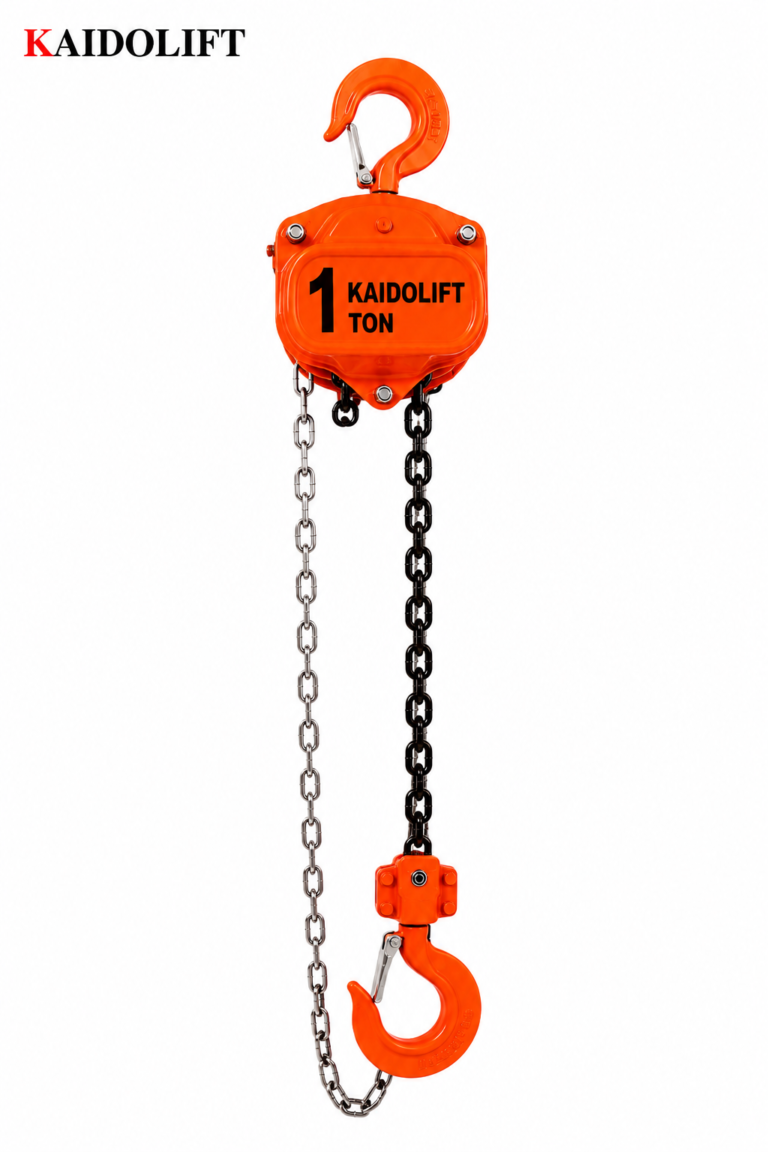
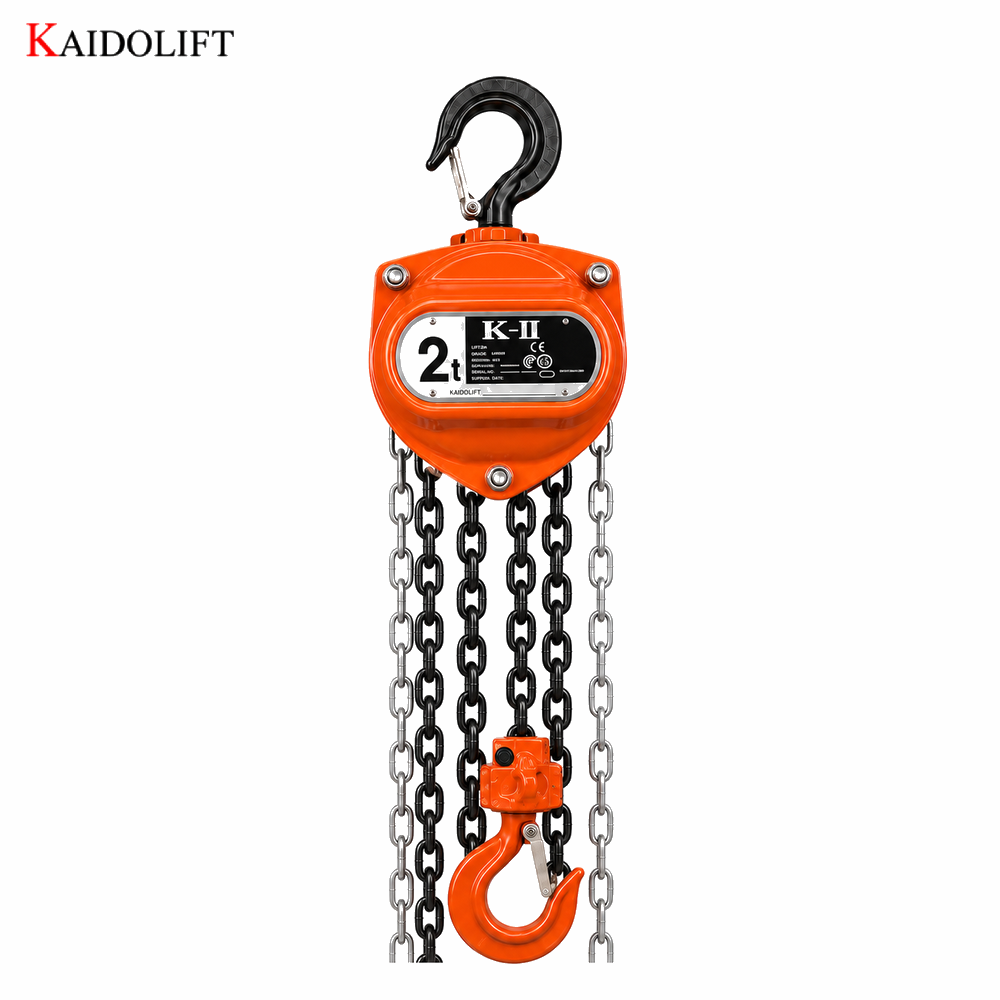
A manual chain hoist—also known as a chain block or hand chain hoist—is a mechanical lifting device that uses a hand-operated chain to lift, lower, or suspend a load. It consists of a compact housing containing a gear train, a load chain, a hand chain, and a hook at both the top (for suspension) and bottom (for load attachment).
How It Works
The operator pulls the hand chain in a continuous loop. This action rotates a drive gear inside the hoist housing, which engages a reduction gear train. The reduction gear train rotates the load sheave, which moves the load chain up or down, raising or lowering the load.
The gear train provides a significant mechanical advantage: a relatively small pulling force on the hand chain translates into a much larger lifting force at the load hook. The exact mechanical advantage depends on the gear ratio, but typical ratios range from 20:1 to 100:1.
Core Components
| Component | Function |
|---|---|
| Hand Chain | The chain the operator pulls to lift or lower the load |
| Load Chain | The chain that moves up and down to raise/lower the hook |
| Gear Train | Provides mechanical advantage |
| Brake System | Holds the load in position when the operator stops pulling |
| Hooks | Top hook for suspension; bottom hook for load attachment |
| Housing | Protective casing containing the gear mechanism |
Types of Manual Chain Hoists
Standard Spur-Gear Chain Hoists
The most common type, using spur gears for the reduction mechanism. These are ideal for general-purpose lifting across most industrial applications.
Lever-Operated Hoists
Operated by moving a handle back and forth rather than pulling a chain. These offer precise positioning and are often used in tight spaces.
Low-Headroom Hoists
Designed with a compact profile for applications where vertical space above the lifting point is limited.
Corrosion-Resistant Hoists
Manufactured with stainless steel or specially coated components for use in marine, chemical, or food processing environments.
2. Key Selection Factors
Load Capacity
The most fundamental selection criterion is the maximum load weight the hoist will be required to lift. Manual chain hoists are available in capacities ranging from 0.25 tons (250 kg) to 50 tons and beyond.
Common Capacity Ratings:
| Capacity (Tons) | Typical Applications |
|---|---|
| 0.25 – 0.5 T | Light maintenance, small workshops, assembly work |
| 1 – 2 T | General industrial use, machine shops, warehouses |
| 3 – 5 T | Heavy manufacturing, construction, mining maintenance |
| 10 – 20 T | Heavy industrial, shipbuilding, large equipment handling |
| 25 T+ | Specialized heavy lifts, power generation, infrastructure |
🔧 MANDATORY PRACTICE: Always select a hoist with a rated capacity that exceeds the maximum load weight. Consider future needs: if loads are likely to increase, selecting a hoist with a slightly higher capacity can provide long-term flexibility.
Lifting Height and Headroom Clearance
Lifting height is the maximum distance the load hook can travel from its lowest to its highest position. This is determined by the length of the load chain—the longer the chain, the greater the lifting height.
Headroom clearance is the minimum vertical distance required from the hoist suspension point to the floor or obstacle below.
Key considerations:
- Measure the distance from the suspension point to the lowest required hook position
- Add the height of the load and rigging
- Ensure sufficient clearance for the hoist housing, chain, and load at full lift
- Consider the hoist’s headroom dimension (the distance from the suspension point to the bottom of the hoist housing)
⚠️ CRITICAL NOTICE: The load chain must not be fully extended to the point where the chain end stop contacts the hoist housing. This can cause jamming or chain breakage. Always maintain a safety margin of at least one chain link at full extension.
Chain Length and Fall Ratio
The hand chain length determines the operator’s reach and the position of the hand chain loop. Standard hand chains are typically 1.5 to 3 meters long, but longer options are available for applications where the operator must stand at a distance.
Fall ratio refers to the number of times the operator must pull the hand chain to lift the load one meter. A higher fall ratio means more hand chain pulls per meter of lift, which translates to greater mechanical advantage but slower lifting speed. Low-headroom hoists with offset chain designs have different fall ratios that must be considered for applications requiring precise speed control.
| Fall Ratio | Mechanical Advantage | Lifting Speed | Best For |
|---|---|---|---|
| Low (e.g., 1:1) | Lower advantage | Faster lifting | Light loads, frequent cycling |
| High (e.g., 8:1) | Higher advantage | Slower lifting | Heavy loads, intermittent use |
Hook Types and Suspension Options
Manual chain hoists offer various hook and suspension configurations:
- Top Hook: Standard suspension from a trolley, beam clamp, or fixed point
- Top Eye: For connection to a shackle or existing rigging
- Lug Suspension: Flange-mounted for permanent installations
- Trolley-Mounted: For movement along a beam or runway
Bottom hooks are typically swivel hooks that allow the load to rotate freely, reducing the risk of twisting the load chain. Some hoists feature hook latches for added security.
Gear Ratio and Pull Force
The gear ratio determines the mechanical advantage of the hoist—how much force the operator must exert to lift the rated load. A higher gear ratio means less pulling force but more hand chain pulls. Standard pull force for hand chain hoists is typically between 20–35 kg (44–77 lbs) for their rated load.
For operators who will use the hoist frequently, selecting a hoist with a lower required pull force can significantly reduce fatigue and improve productivity.
3. Worksite Conditions and Application Factors
Beyond the basic specifications, the worksite environment significantly impacts the selection of a manual chain hoist.
Environmental Conditions
Indoor vs. Outdoor Use
Standard manual chain hoists are suitable for indoor environments. For outdoor applications, consider corrosion-resistant options or weather protection.
Temperature Extremes
Most manual chain hoists operate effectively in temperatures ranging from -10°C to 50°C. For extreme cold or heat, specialized hoists with appropriate lubrication and materials are available.
Corrosive Environments
Chemical plants, marine applications, and food processing facilities require hoists with corrosion-resistant coatings or stainless steel construction. Standard hoists with painted finishes are not suitable for these environments.
Dust and Contaminants
Heavy dust, dirt, or abrasive particles can accelerate wear on chains and gears. Hoists with sealed housings and protective covers are recommended for these conditions.
Hazardous/Explosive Environments
In environments with flammable gases, vapors, or dust, spark-resistant hoists are required. These use non-sparking materials (bronze, copper-beryllium) and are often ATEX-certified. Manual chain hoists are inherently safer than electric hoists in hazardous environments because they have no electrical components that could generate sparks.
Suspension and Mounting Considerations
Fixed Suspension:
The hoist hangs from a fixed point. The simplest and most common configuration, used for single-point lifting operations.
Trolley-Mounted Suspension:
The hoist is mounted on a trolley that travels along an I-beam or track. This allows the hoist to move horizontally, covering a larger workspace. Trolleys may be geared (with a chain-drive for movement) or ung geared (pushed manually).
Beam Clamp Suspension:
The hoist is attached directly to an I-beam or structural steel using a beam clamp. This provides a portable and temporary lifting point.
Application-Specific Considerations
Lifting Frequency
High-frequency lifting operations require more durable hoists with higher-quality components, such as double-reduction gearing and hardened load chains.
Precision Positioning
For applications requiring precise load positioning, lever-operated hoists offer finer control than standard chain hoists. For precision lifting applications, models with variable-speed operation or low-headroom designs may be preferred.
Operator Ergonomics
Consider the operator’s height, reach, and available working space. Hand chain loops should be positioned for comfortable operation without excessive stretching or awkward postures.
Multiple-Point Lifts
When using two or more hoists to lift a single load, ensure that each hoist has sufficient capacity for its share of the load and that the lift is coordinated to maintain the load level.
4. Safety Standards and Regional Compliance
International Standards
| Standard | Title | Key Requirements |
|---|---|---|
| ASME B30.16 | Underhung and Overhead Hand Chain Hoists | Design, construction, inspection, and testing requirements for manual chain hoists |
| EN 13157 | Safety of manually controlled load lifting equipment | Covers design, manufacture, and testing of hand chain hoists |
| OSHA 29 CFR 1910.179 | Overhead and gantry cranes | General requirements for hoist and crane operations |
ASME B30.16 requires that:
- Each hoist be marked with the manufacturer’s name, rated load capacity, and model number
- Hoists be inspected before each use and periodically
- Load limiting devices be maintained and tested periodically
- Damaged hoists be removed from service immediately
Regional Standards: Latin America
| Region | Standard | Key Requirements |
|---|---|---|
| Brazil | NR-11 (Annex 1) | Equipment must be designed and constructed to provide safety. Training is obligatory for all operators. Inspection records must be maintained and available for inspection. |
| Mexico | NOM-151-SSA1 | Establishes safety requirements for lifting and material handling equipment |
| Chile | NCh 2245 | Defines technical specifications for industrial lifting equipment |
⚠️ CRITICAL NOTICE: Under NR-11, all material handling equipment must be kept in perfect working condition. Employers are responsible for ensuring that operators are trained and qualified, and that equipment is regularly inspected and maintained. Operators must receive both theoretical and practical instruction.
5. Inspection and Maintenance
Regular inspection and maintenance are essential for the safe operation of manual chain hoists.
Pre-Use Inspection (Before Each Use)
- Inspect the hoist for visible damage: cracks, deformations, corrosion
- Check the load chain for elongation, wear, or damage
- Verify the hand chain is free from kinks or damage
- Test the brake system: the hoist must hold the load when pulling stops
- Ensure the hooks are not bent, stretched, or cracked
- Check the hook latch (if equipped) is functional
- Verify labels and markings are legible
🔧 MANDATORY PRACTICE: Never use a hoist that exhibits signs of damage or wear. If in doubt, remove from service and have it inspected by a qualified technician.
Periodic Inspection
Monthly:
- Lubricate chains and gears as specified by the manufacturer
- Inspect for wear on the load chain and hand chain
- Check the brake system for proper operation
Annual:
- Comprehensive inspection by a qualified competent person
- Disassemble and inspect internal components if required
- Load test (typically 125% of rated capacity) to verify performance
- Document all findings in the periodic rigging log
Load Chain Elongation
Load chain elongation is a critical wear indicator. A chain that has stretched more than 3% of its original length must be replaced immediately.
How to measure:
- Mark 11 consecutive links
- Measure the distance from the first to the 11th link in a relaxed state
- Compare to the manufacturer’s tolerance (typically within 0.5% to 3%)
Removal from Service Criteria
According to ASME B30.16, remove the hoist from service immediately if:
- The rated load capacity marking is missing or illegible
- The load chain is elongated, cracked, or has broken links
- The brake system fails to hold the load
- Hooks are bent, stretched, or have cracks
- The housing or gears are damaged
- Any component is missing or defective
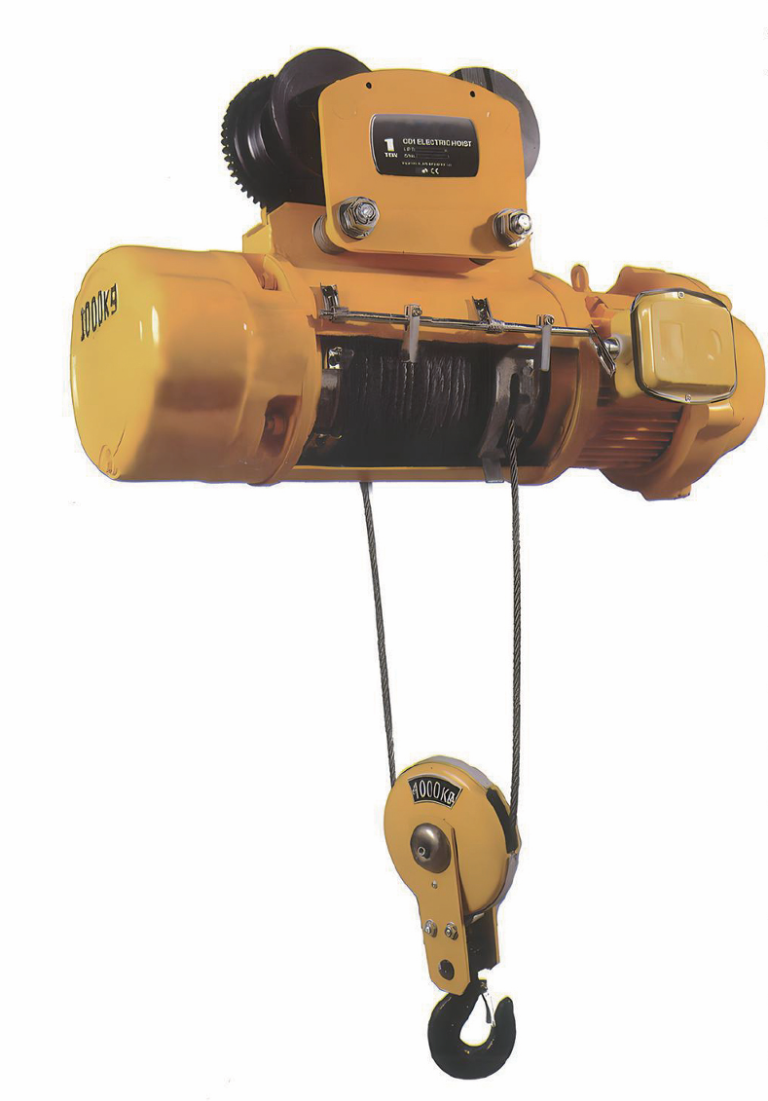
6. Manual Chain Hoist vs. Powered Hoist: When to Choose Manual
| Feature | Manual Chain Hoist | Powered Hoist (Electric/Pneumatic) |
|---|---|---|
| Cost | Lower acquisition cost | Higher investment |
| Operator Training | Minimal training required | Requires formal training |
| Power Source | None—human power only | Requires electricity or compressed air |
| Maintenance | Simple, low maintenance | More complex, higher cost |
| Portability | Highly portable | Less portable; requires power access |
| Lifting Speed | Slow; operator-speed dependent | Fast; motor-driven |
| Safety in Hazardous Areas | Inherently safe (no sparks) | Requires explosion-proof versions |
| Best For | Infrequent use, remote locations, hazardous environments, small loads | High-frequency lifting, large loads, production environments |
Conclusion
Selecting the right manual chain hoist requires a systematic evaluation of capacity, lifting height, chain length, and worksite conditions. By understanding the key specifications and application factors—and by complying with international standards such as ASME B30.16, EN 13157, and regional requirements like Brazil NR-11, Mexico NOM-151, and Chile NCh 2245—you can ensure safe, efficient, and reliable lifting operations.
When selecting a manual chain hoist, consider:
- Load weight—match the WLL to your heaviest loads
- Lifting height and headroom—ensure it reaches your required lift height
- Environmental conditions—corrosion, temperature, hazardous atmosphere
- Suspension method—fixed, trolley-mounted, or beam clamp
- Maintenance access—ensure routine inspection and lubrication are feasible
For operations across Latin America, compliance with regional standards is not optional. Ensure that hoists are properly marked, regularly inspected, and operators are adequately trained. When in doubt, consult the manufacturer’s documentation and follow all safety guidelines.
📋 Need Help Selecting the Right Manual Chain Hoist for Your Operation?
Our material handling team provides free, no-obligation hoist selection assistance for workshops, construction sites, and industrial facilities across Latin America. We can help you:
- Match the right manual chain hoist to your load capacity, lifting height, and worksite conditions
- Compare standard, low-headroom, and corrosion-resistant options
- Verify ASME B30.16 compliance and NR-11 / NOM-151 / NCh 2245 alignment
- Provide inspection checklists and operator training guidance
[Request Hoist Selection Assistance Now] or download our LatAm-Compliant Manual Chain Hoist Selection Guide (PDF) with capacity tables, dimension reference charts, and maintenance schedules.