A maintenance crew needs to lift a 1.5‑ton pump motor out of a basement pit — but the access hatch is only 600 mm wide. A standard chain block won’t fit. Another team on the same site needs to pull a 2‑ton generator 15 metres across a concrete floor to its final position, with no power source available. Two different jobs. Two different tools. One wrong choice and the job stops — or worse, someone gets hurt.
This is the daily reality of manual hoist selection. Three tools — the chain block (HSZ‑A) , the lever hoist (HSH‑VL) , and the wire rope pulling hoist (HHBS) — all operate without electricity. All are portable. All are built for lifting and pulling. But they are not interchangeable.
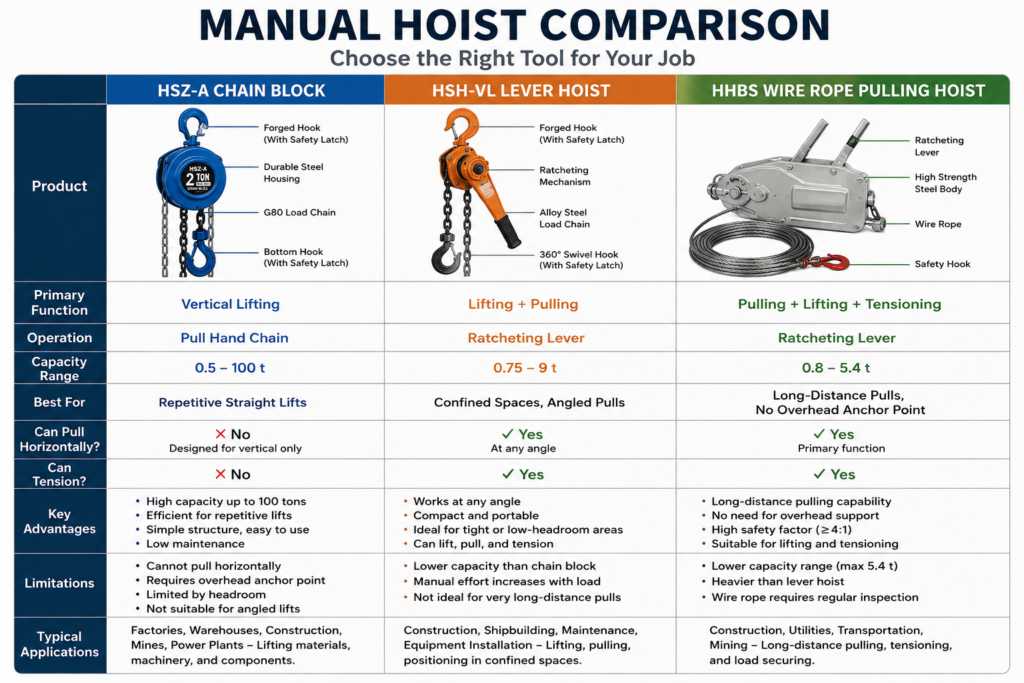
This article compares the three manual hoist types side by side: what each does best, where each fails, and how to choose the right one for your job — with real specifications, application guidance, and hard safety rules.
The Three Tools at a Glance
| Feature | Chain Block (HSZ‑A) | Lever Hoist (HSH‑VL) | Wire Rope Pulling Hoist (HHBS) |
|---|---|---|---|
| Primary function | Vertical lifting | Lifting + pulling | Pulling + lifting + tensioning |
| Load medium | Load chain (G80) | Load chain (alloy steel) | Wire rope |
| Operation | Pull hand chain | Ratcheting lever | Ratcheting lever |
| Capacity range | 0.5 – 100 t | 0.75 – 9 t | 0.8 – 5.4 t |
| Best for | Repetitive straight lifts | Confined spaces, angled pulls | Long-distance pulls, no anchor point overhead |
| Can it pull horizontally? | No — designed for vertical only | Yes — at any angle | Yes — primary function |
| Can it tension? | No | Yes | Yes |
HSZ‑A Chain Block: The Vertical Workhorse
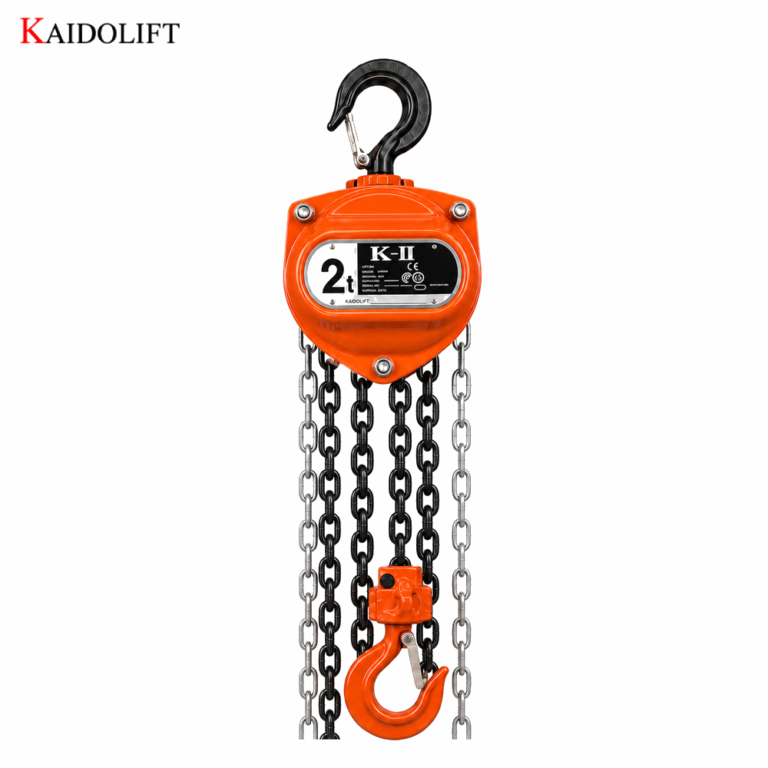
What it is: A manual chain block — also called a chain hoist or chain fall — uses a hand chain to drive a gear train that lifts or lowers a load vertically. Pull one side of the hand chain to raise the load; pull the other to lower it.
Key specifications (HSZ‑A series) :
| Model | Capacity | Standard Lift | Load Chain | Net Weight |
|---|---|---|---|---|
| HSZ‑A 0.5t | 0.5 t | 2.5 – 3 m | G80 manganese steel | ~8 kg |
| HSZ‑A 1t | 1.0 t | 3 – 10 m | G80 manganese steel | ~12 kg |
| HSZ‑A 2t | 2.0 t | 2.5 – 3 m | G80 manganese steel | ~16 kg |
| HSZ‑A 3t | 3.0 t | 3 m | G80 manganese steel | ~22 kg |
| HSZ‑A up to 100t | 100 t | Custom | G80 manganese steel | — |
HSZ‑A chain blocks are built with 800 MPa high‑tensile load chains and forged hooks designed for gradual lifting to prevent overload.
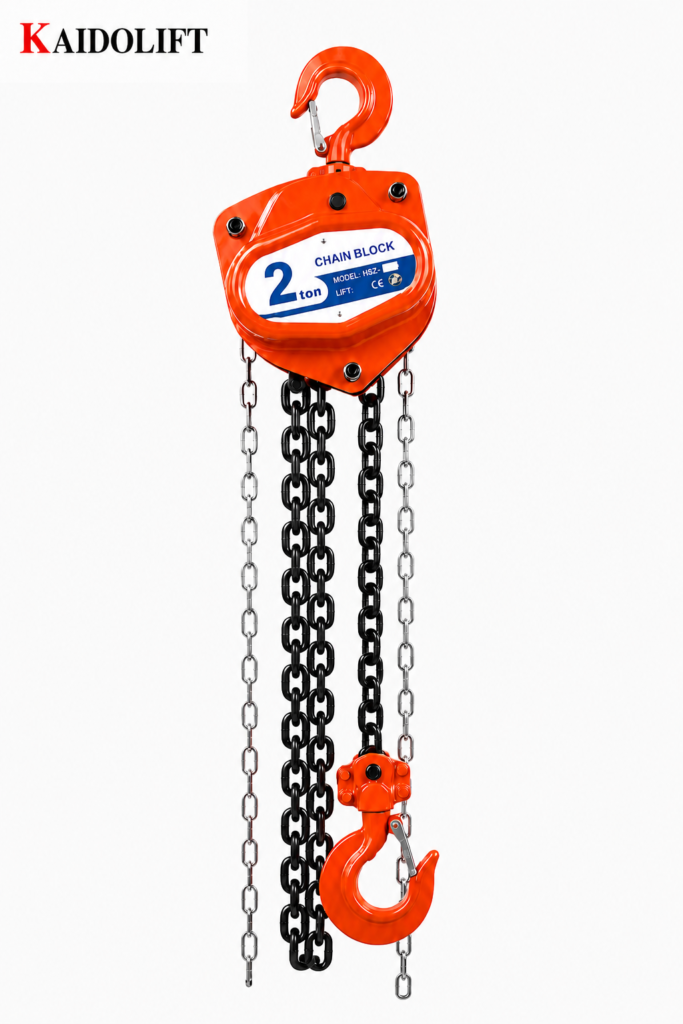
HSZ-A Chain Block | Manual Chain Hoists
HSZ-A Chain Block is a heavy-duty manual chain hoist designed for industrial lifting, equipment installation and material handling. Available from 0.5 ton to 20 tons, with 30 ton and 50 ton heavy-duty options upon request.
Where it excels:
- Repetitive vertical lifts — pulling a hand chain is less tiring over many cycles than working a ratcheting lever
- High capacity — available up to 100 tons, far beyond lever or wire rope hoists
- Simple operation — no complex mechanism; anyone can learn in minutes
- Low maintenance — fewer moving parts than lever hoists
Where it fails:
- Cannot pull horizontally — the load chain is not designed for side loading or dragging
- Requires an overhead anchor point — the hoist hangs from a hook or trolley above the load
- Limited by headroom — the hoist body and chain take up vertical space
- Not suitable for angled lifts — the chain must hang straight
Typical applications: Factories, warehouses, construction sites, mines, and power plants for lifting materials, machinery, and components from a fixed overhead point.
HSH‑VL Lever Hoist: The Versatile All‑Angler
What it is: A lever hoist — often called a “come‑along” — uses a ratcheting lever to advance or release a load chain. Move the lever forward to take up chain; move it backward to release. The operator can work from any angle — vertical, horizontal, or anywhere in between.
Key specifications (HSH‑VL series) :
| Model | Capacity | Min. Hook‑to‑Hook | Lever Force (full load) | Net Weight |
|---|---|---|---|---|
| VL‑075 | 0.75 t | 310 mm | 145 N | ~6 kg |
| VL‑100 | 1.0 t | 310 mm | 150 N | ~8 kg |
| VL‑150 | 1.5 t | 350 mm | 210 N | ~11 kg |
| VL‑300 | 3.0 t | 470 mm | 325 N | ~17 kg |
| VL‑600 | 6.0 t | 590 mm | 345 N | ~28 kg |
| VL‑900 | 9.0 t | 740 mm | 357 N | ~47 kg |
The HSH‑VL uses an alloy steel body and a short lever with a rubber grip for operator comfort. The load chain is high‑strength alloy steel, and the hooks are heat‑treated forging.
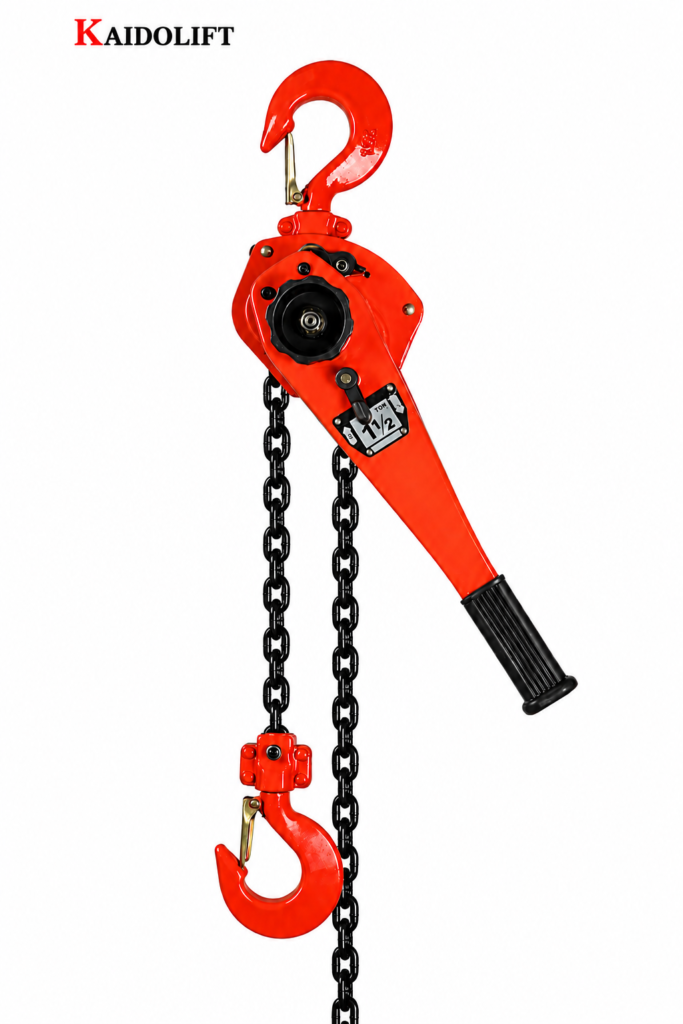
HSH-VL Lever Block Manual Chain Hoist | Heavy Duty Industrial Lifting Applications
HSH-VL Lever Block is a lightweight and heavy-duty manual chain hoist designed for lifting, pulling and positioning operations. Featuring alloy load chain, forged hooks and optimized gear transmission, it provides reliable performance for industrial applications from 0.8 ton to 9 ton.
Where it excels:
- Multi‑directional work — lifts, pulls, drags, and tensions loads in any position
- Confined spaces — the compact body and short lever fit where a chain block cannot
- Precise positioning — each lever stroke moves the load a small, controlled distance
- No overhead anchor needed — can be anchored at ground level for horizontal pulls
Where it fails:
- Lower maximum capacity — tops out at 9 tons
- More complex mechanism — ratchet and pawl system requires more maintenance
- Chain length limits travel — standard lift heights are limited by the chain length supplied
- Tiring over long distances — each stroke moves the chain a short distance; long pulls require many repetitions
Typical applications: Equipment installation in pits and cable trenches, pipe alignment, machinery positioning, overhead maintenance in tight spaces, and any job requiring both lifting and pulling.
HHBS Wire Rope Pulling Hoist: The Long‑Distance Puller
What it is: A wire rope pulling hoist — sometimes called a Tirfor hoist or cable puller — uses a ratcheting lever to advance a wire rope through a gripping mechanism. The rope passes through the hoist body; each lever stroke pulls a set distance of rope through. It can lift, pull, or tension — but its real strength is long‑distance pulling.
Key specifications (HHBS series) :
| Model | Capacity | Stroke per Lever Cycle | Rope Diameter | Net Weight |
|---|---|---|---|---|
| HHBS 0.8 | 0.8 t | 52 mm | 8 mm | 6 kg |
| HHBS 1.0 | 1.0 t | ≥52 mm | 8 mm | 6 kg |
| HHBS 1.6 | 1.6 t | ≥55 mm | 11 mm | 12 kg |
| HHBS 3.2 | 3.2 t | ≥28 mm | 16 mm | 23 kg |
The HHBS uses a high‑strength aluminium alloy housing and a wire rope with high breaking load and abrasion resistance. The rope length is customisable — standard 10 m or 20 m, with longer lengths available on request.
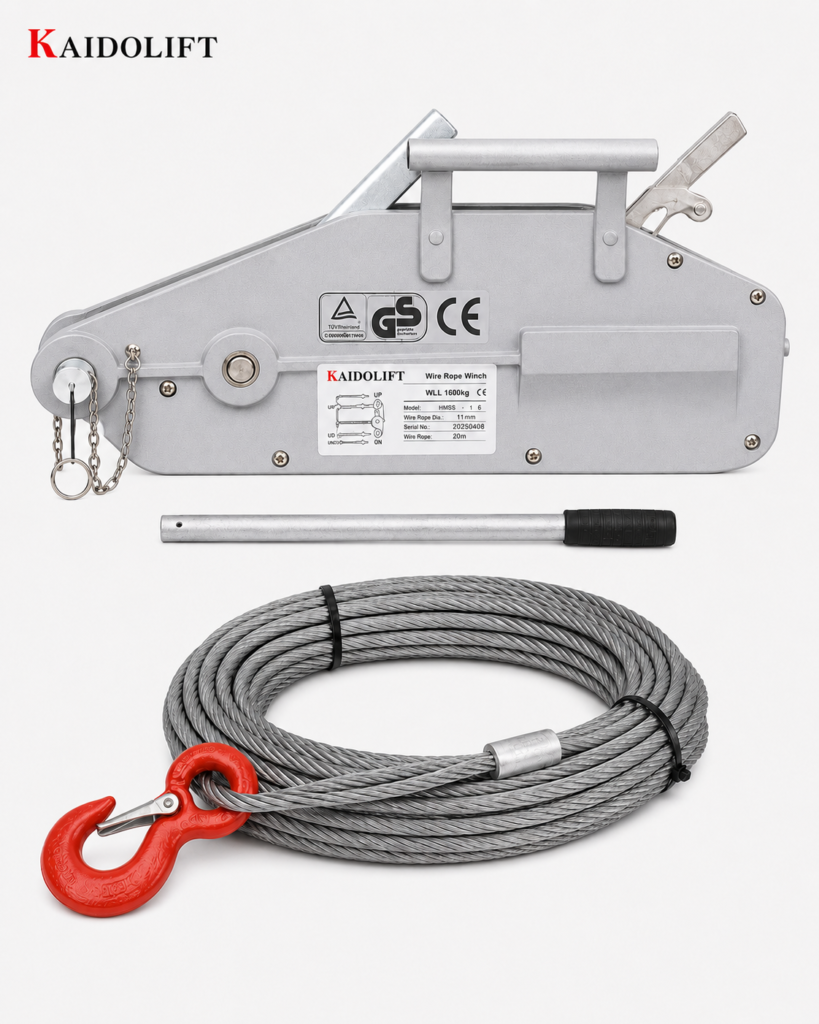
HHBS Wire Rope Pulling Hoist (Tirfor) | 0.8T to 3.2T Manual Lever Hoist
Premium HHBS Wire Rope Pulling Hoist with 10m/20m steel cable. This heavy-duty manual lever hoist offers 0.8T to 3.2T capacity for pulling, lifting, and tensioning. Ideal for LATAM mining and forestry. Get a factory wholesale quote.
Where it excels:
- Long‑distance pulls — wire rope can be 20 metres or more; no chain length limitation
- No overhead anchor needed — anchor the hoist body at ground level and pull horizontally
- Lightweight — the 0.8‑ton model weighs only 6 kg
- Tensioning — can hold tension on a load or structure
- Angled pulls — works at any angle, just like a lever hoist
Where it fails:
- Wire rope management — rope must be kept clean and inspected for broken wires
- Not for repetitive lifting — better for pulling than for repeated vertical lifts
- Rope wear — wire rope abrades more quickly than chain when dragged over edges
- Requires dedicated rope — must use the rope supplied with the hoist; cannot substitute
Typical applications: Vehicle recovery, pipeline pulling, cable laying, equipment dragging across floors, disaster response, and any job requiring a long horizontal pull without power.
Side‑by‑Side: Lifting vs. Pulling
The most common mistake is assuming any manual hoist can do both jobs equally well. They cannot.
| Task | Best Tool | Why |
|---|---|---|
| Lifting a load straight up from an overhead beam | Chain block (HSZ‑A) | Efficient over many cycles; simple operation; high capacity available |
| Lifting in tight headroom with no room for chain | Lever hoist (HSH‑VL) | Compact body; short hook‑to‑hook distance |
| Pulling a load horizontally across a floor | Wire rope puller (HHBS) | Long rope; ground‑level anchoring; designed for pulling |
| Pulling a load horizontally in tight quarters | Lever hoist (HSH‑VL) | Short chain; compact; precise control |
| Tensioning a cable or structure | Lever hoist or wire rope puller | Both can hold tension |
| Lifting heavy loads (over 9 tons) | Chain block only | Lever and wire rope hoists max out at 9 t and 5.4 t respectively |
Critical point: A chain block is not a pulling tool. Using a chain block for horizontal pulling creates side loading on the chain and sprocket, which can cause chain failure and sudden load drop. Never use a chain block for horizontal pulling.
Selection Guide: Ask These Questions
Before choosing any manual hoist, work through these questions:
1. What is the load weight?
- Under 0.8 t → all three options work; choose based on task
- 0.8 – 5 t → lever hoist or wire rope puller (check capacity)
- 5 – 9 t → lever hoist (HSH‑VL up to 9 t) or chain block
- Over 9 t → chain block only
2. What is the movement direction?
- Straight up and down → chain block
- Any angle, including horizontal → lever hoist
- Long horizontal pull → wire rope puller
3. Is there an overhead anchor?
- Yes, solid beam or hook → chain block or lever hoist (hanging)
- No, only ground‑level anchor → wire rope puller or lever hoist (anchored at ground)
4. How much headroom is available?
- Plenty → chain block
- Tight (under 500 mm hook‑to‑hook) → lever hoist
5. How far does the load need to move?
- Under 3 metres → any option
- Over 3 metres → wire rope puller (rope length customisable)
6. How many lifts per shift?
- Many repetitive lifts → chain block (less tiring over many cycles)
- Occasional lifts or pulls → lever hoist or wire rope puller
Safety Boundaries — Apply to All Three
Prohibitions that apply to every manual hoist:
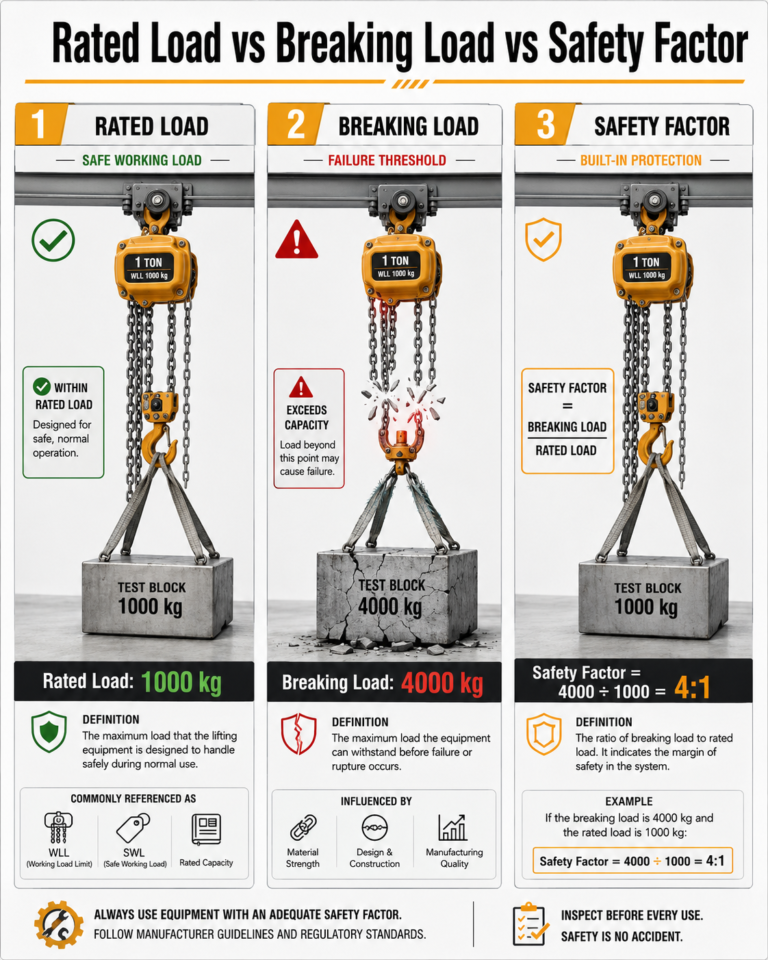
- NEVER exceed the Working Load Limit (WLL) — this is non‑negotiable
- NEVER stand or work under a suspended load
- NEVER use any manual hoist for personnel lifting
- NEVER operate with damaged chain, rope, or hooks
- NEVER allow more than one person to operate the lever or hand chain
- NEVER use in explosive atmospheres unless specifically rated for that environment
Tool‑specific prohibitions:
| Tool | Prohibition |
|---|---|
| Chain block (HSZ‑A) | NEVER use for horizontal pulling; NEVER allow side loading on the chain |
| Lever hoist (HSH‑VL) | NEVER use if the ratchet or pawl is worn; NEVER operate with a bent lever |
| Wire rope puller (HHBS) | NEVER use a damaged or kinked rope; NEVER substitute with a different rope; NEVER allow the rope to run over sharp edges without protection |
Inspection and Maintenance
Daily checks for all three:
- Inspect the load medium (chain or rope) for wear, damage, or elongation
- Check hooks for deformation, cracks, or damaged safety latches
- Test the brake or ratchet mechanism with a small load before full operation
- Listen for unusual sounds during operation
Chain block specific:
- Under NCh 2245, chain elongation exceeding 3% requires immediate replacement
- Check that the hand chain runs freely through the wheel
- Verify the load chain is not twisted or kinked
Lever hoist specific:
- Check the ratchet and pawl for wear — if the lever does not hold position, stop immediately
- Keep the brake clean and dry — oil or grease on the brake causes slipping
- Inspect the lever for bending or cracks
Wire rope puller specific:
- Inspect the entire length of wire rope for broken wires, kinks, or corrosion
- Check the gripping jaws for wear — if they slip, replace immediately
- Keep the rope clean — dirt accelerates wear
- Do not use oil or grease to lubricate the mechanism
Regulatory References
- ASME B30.21 — applies to manually lever‑operated chain, wire rope, and web strap hoists used for lifting, pulling, and tensioning
- ANSI/ASME B30.16 — applies to hand chain hoists (chain blocks)
- Brazil NR‑11 — requires documented inspection records for lifting equipment
- Mexico NOM‑151 — inspection and testing record requirements
- Chile NCh 2245 — periodic load testing and chain wear standards (elongation >3% = replacement)
Always refer to the current official versions of these standards.
Key Takeaways
- Chain block (HSZ‑A) : vertical lifting only, up to 100 t, simplest operation, requires overhead anchor
- Lever hoist (HSH‑VL) : lifts and pulls at any angle, up to 9 t, compact body for tight spaces
- Wire rope puller (HHBS) : long‑distance pulling and tensioning, up to 5.4 t, lightweight, no overhead anchor needed
- Never use a chain block for horizontal pulling — side loading causes chain failure
- Match the tool to the task — vertical = chain block, multi‑angle = lever hoist, long pull = wire rope puller
- Daily inspection is mandatory — chain/rope wear, hooks, brakes, ratchets
- Chain elongation >3% = replace immediately (NCh 2245)
- NEVER exceed WLL; NEVER lift personnel; NEVER stand under a load
- Comply with ASME B30.21 / B30.16 and local regulations (NR‑11, NOM‑151, NCh 2245)
📥 Further Reading: Need the Manual Hoist Selection & Comparison Guide PDF? [Click here to download]() — includes full specification tables for HSZ‑A, HSH‑VL, and HHBS series, a side‑by‑side comparison matrix, daily inspection checklists, and a summary of Latin American compliance requirements.