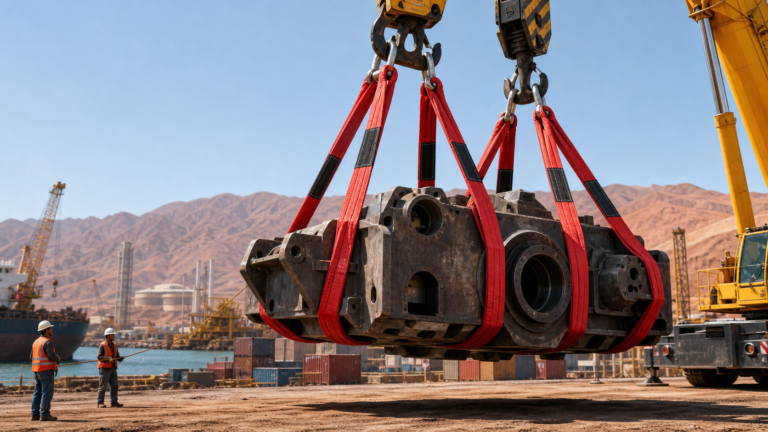
A steel fabrication plant runs three shifts, seven days a week. Each shift lifts and positions 3‑ton beams across a 50‑metre bay. The existing hoist lifts at 2 m/min — each beam takes nearly three minutes to reach working height. Over a 24‑hour day, that adds up to hours of lost production. The maintenance manager has one question: “Is there a hoist that can handle this duty cycle without burning out?”
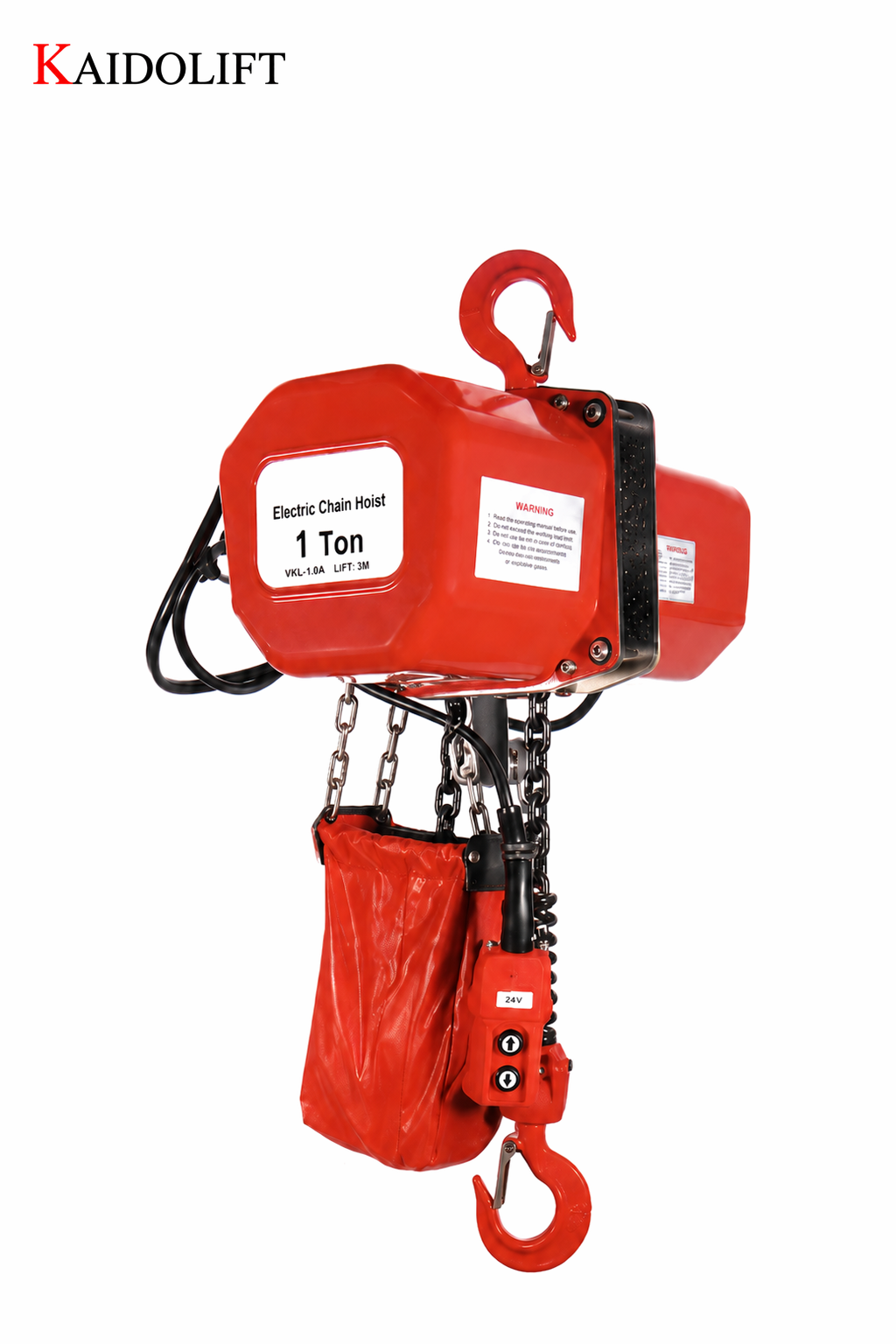
The VKL electric chain hoist was built to answer that question. It is a heavy duty electric chain hoist designed for continuous industrial use — with lifting speeds up to 7 m/min, capacities from 0.5 to 5 tons, and a dual braking system that keeps loads secure through thousands of cycles. This article covers the VKL’s key advantages, real application scenarios, and the safety rules that must be followed in any factory lifting environment.
What Makes the VKL a Heavy-Duty Hoist?
The VKL series is not a modified light‑duty hoist. It is engineered from the ground up for the demands of production environments:
- High‑strength aluminium alloy housing — dissipates heat efficiently during continuous operation
- Dual braking system — combines magnetic and motor brakes for redundant stopping power
- Over‑temperature motor protection — prevents burnout in high‑cycle applications
- Load‑limiting device — protects against overload before damage occurs
- 24V low‑voltage pendant control — operator safety as standard
- CE certified — meets rigorous safety standards
VKL Series Specifications
| Model | Capacity | Standard Lift | Motor Power | Chain Falls | Chain Diameter | Lift Speed | Net Weight |
|---|---|---|---|---|---|---|---|
| VKL‑0.5A | 0.5 t | 3 m | 0.8 kW | 1 | 7.1 mm | 7.0 m/min | 50 kg |
| VKL‑1.0A | 1.0 t | 3 m | 1.6 kW | 1 | 7.1 mm | 7.0 m/min | 55 kg |
| VKL‑2.0A | 2.0 t | 3 m | 1.6 kW | 2 | 7.1 mm | 3.5 m/min | 60 kg |
| VKL‑3.0A | 3.0 t | 3 m | 1.6 kW | 3 | 7.1 mm | 2.3 m/min | 65 kg |
| VKL‑5.0A | 5.0 t | 3 m | 3.0 kW | 3 | 9.0 mm | 2.6 m/min | 85 kg |
Data source: VKL series product specifications
The Five Key Advantages
1. Speed That Drives Productivity
The VKL‑0.5A and VKL‑1.0A lift at 7 m/min — nearly double the speed of many standard workshop hoists. In a production environment with 80 lifts per shift, that speed difference saves over an hour of cycle time per day.
For a 5 ton chain hoist application like the VKL‑5.0A, the speed drops to 2.6 m/min — a deliberate trade‑off. Heavier loads require slower, more controlled lifting to reduce stress on the chain and motor. The VKL series gives you the right speed for the load you are lifting.
2. Multiple Chain Falls for Load Stability
The number of chain falls increases with capacity:
- 0.5–1.0 t: single chain (1 fall)
- 2.0 t: two chain falls
- 3.0–5.0 t: three chain falls
Multiple chain falls distribute the load across more chain lines, reducing wear on individual links and improving load stability during lifting. For a 3‑ton beam, three falls mean each chain line carries only one ton — a significant safety margin.
3. Dual Braking System for Positive Load Control
The VKL’s dual brake system combines:
- Magnetic brake — engages immediately when power is cut
- Motor brake — provides mechanical holding force
This redundancy means that even if one brake system fails, the other holds the load. In factory lifting environments where loads hang over workstations or personnel paths, this is not a luxury — it is a necessity.
4. Overload Protection That Prevents Damage
The VKL includes a load‑limiting device that stops the hoist if the load exceeds the rated capacity. This is not a suggestion — it is a hard stop. The hoist will not lift an overloaded condition. This protects the motor, gears, chain, and hook from the stress of overloading.
5. Built for Continuous Duty
The VKL is not a hoist you use once a week. It is built for:
- High‑cycle production — starts and stops throughout the shift
- Continuous operation — the aluminium housing dissipates heat effectively
- Demanding environments — CE certified for industrial use
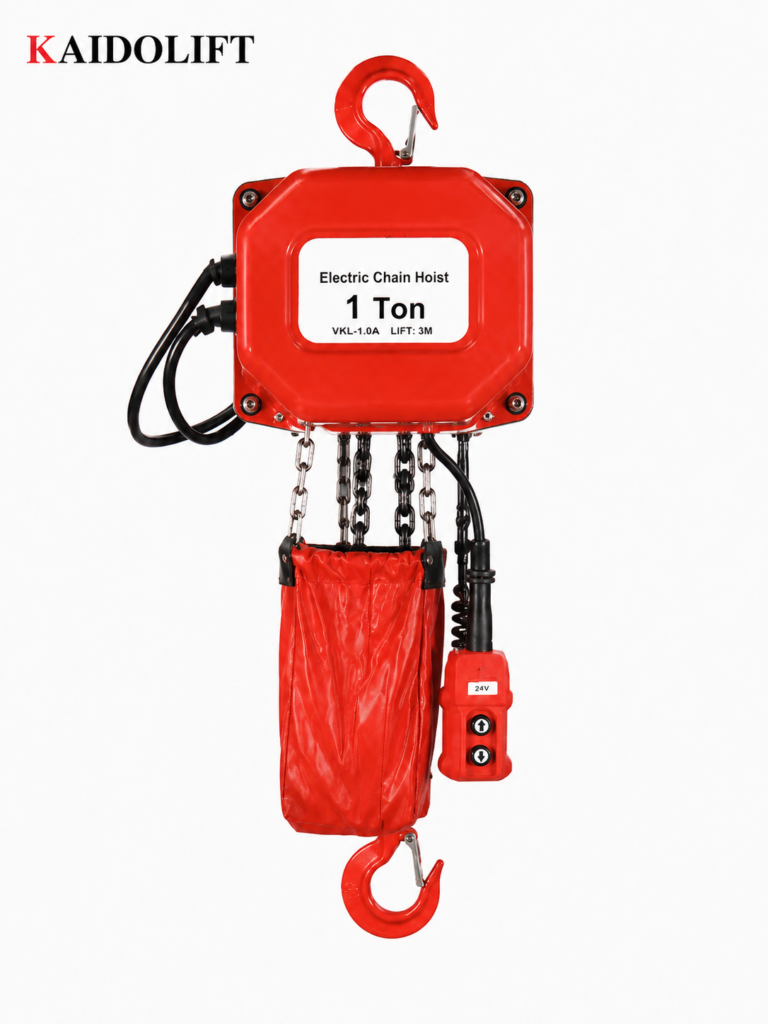
VKL Electric Chain Hoist (Polipasto Eléctrico de Cadena) | 0.5T to 5T Industrial Grade Overload Tested Material Handling Hoist
Explore the high-durability VKL Electric Chain Hoist (Tecle Eléctrico). Features standard 3m lift, flexible 1/2/3 chain fall lines, pure copper motor, and capacities up to 5 Ton. Complete technical dimensions with extra meter chain load metrics for professional LATAM distributors.
Heavy-Duty Lifting Applications
Steel Fabrication and Structural Assembly
Lifting and positioning steel beams, columns, and plate sections across a fabrication bay. The VKL‑3.0A handles 3‑ton beams at 2.3 m/min — slow enough for precise positioning, fast enough to keep production moving. The three‑chain configuration keeps the load level during lifting, preventing the beam from tilting and damaging the hook or chain.
Foundry and Casting Handling
Moving castings from cooling racks to machining lines. The VKL‑5.0A lifts 5‑ton castings with three chain falls for balanced lifting. The over‑temperature protection is critical here — foundries are hot environments, and motors need extra protection against overheating.
Warehouse and Logistics
Loading and unloading heavy pallets, machinery, and equipment in high‑bay warehouses. The VKL‑2.0A at 3.5 m/min provides a good balance of speed and capacity for 2‑ton loads. Trolley mounting options allow the hoist to move along beams, covering multiple bays.
Machine Tool Maintenance
Installing and removing heavy machine components — motors, gearboxes, press rams. The controlled speed of the VKL‑3.0A at 2.3 m/min gives maintenance crews the precision they need when aligning expensive equipment.
Mounting Options
The VKL can be configured in three mounting styles:
| Mounting Type | Description | Best For |
|---|---|---|
| Hook‑mounted | Fixed single‑point suspension | Single workstation, vertical lifts only |
| Manual trolley | Hand‑pushed along beam | Occasional horizontal repositioning |
| Electric trolley | Motor‑driven horizontal travel | Frequent movement along production lines |
For factory lifting applications with multiple workstations along a production line, the electric trolley option is recommended. Trolley speeds typically range from 5 to 12 m/min.
Operating Procedures for Heavy-Duty Environments
Before first use:
- Verify the hoist is mounted to a structure that can support the full rated capacity
- Check that the power supply matches the hoist specifications (single‑phase or three‑phase options available)
- Test the limit switch at both upper and lower travel limits
- Test the load‑limiting device with a representative load
- Test the emergency stop on the 24V pendant control
During production operation:
- Use smooth starts and stops — avoid jerky movements
- Let the brake hold the load — do not rely on the motor to hold position
- Use the 24V pendant control — keep clear of the load path
- Monitor the hoist for unusual noise or heat — stop immediately if either occurs
Safety Boundaries — Prohibitions
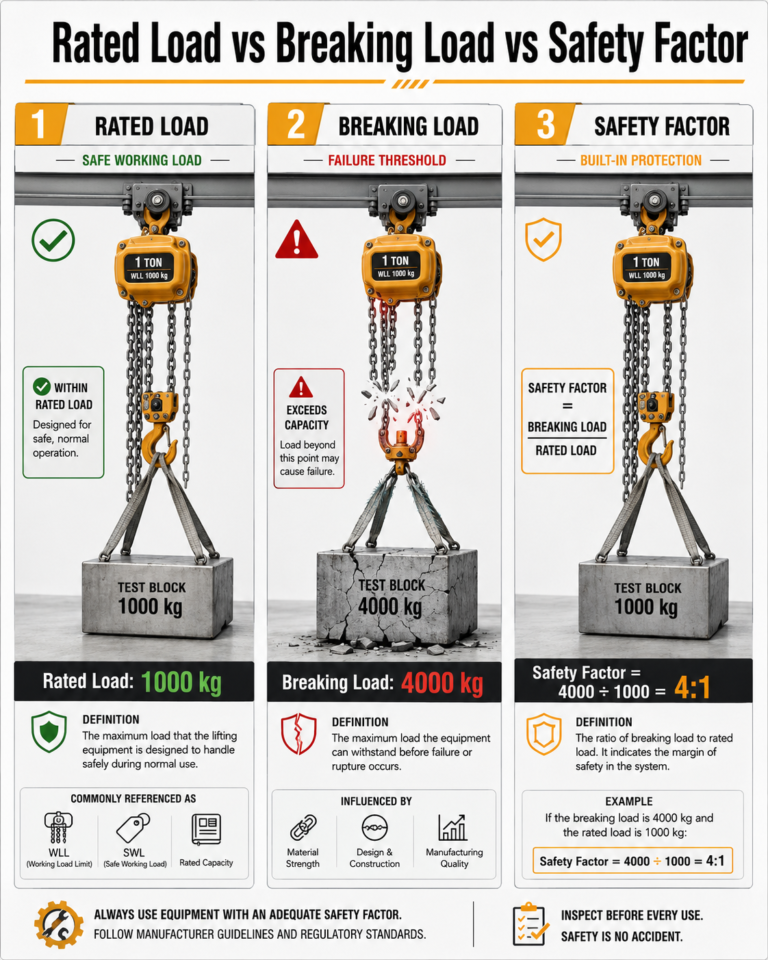
- NEVER exceed the rated Working Load Limit (WLL) — the load‑limiting device is a backup, not an invitation to test the limit
- NEVER stand or work under a suspended load
- NEVER use the VKL for personnel lifting
- NEVER operate with a twisted, kinked, or worn chain
- NEVER bypass the limit switch or load‑limiting device
- NEVER operate the hoist in explosive atmospheres unless specifically rated for that environment
- NEVER allow untrained personnel to operate the hoist
Chain safety: Under NCh 2245, chain elongation exceeding 3% requires immediate replacement. On a 5 ton chain hoist like the VKL‑5.0A operating multiple shifts per day, chain wear should be measured weekly.
Daily Inspection Checklist
Production hoists work hard. Daily inspection is not optional — it prevents unplanned downtime and safety incidents.
- [ ] Inspect the load chain for visible wear, elongation, twists, or gouges
- [ ] Check the hook for deformation, cracks, or a damaged safety latch
- [ ] Listen for unusual noise from the motor or gearbox during operation
- [ ] Test the brake with a small load — hold the load mid‑travel for 30 seconds
- [ ] Test the limit switch by running the hook to the upper and lower stops
- [ ] Check the pendant cable for cuts or fraying — replace if damaged
- [ ] Verify the emergency stop button functions correctly
- [ ] Check the motor housing for excessive heat after operation
Weekly maintenance:
- Clean the chain and apply light lubricant
- Inspect the motor cooling fan for dust buildup — the aluminium housing relies on airflow for heat dissipation
- Check gearbox oil level (if applicable)
- Inspect trolley wheels and track for wear (if trolley‑mounted)
Regulatory References
- ASME B30.21 — applies to manually lever‑operated chain hoists; many principles extend to electric chain hoists
- FEM 9.511 / 9.683 — defines hoist duty classifications (the VKL’s continuous‑duty design aligns with higher FEM duty groups)
- Brazil NR‑11 — documented inspection records required for lifting equipment
- Mexico NOM‑151 — inspection and testing record requirements
- Chile NCh 2245 — periodic load testing and chain wear standards (elongation >3% = replacement)
Always refer to the current official versions of these standards.
Key Takeaways
- VKL series covers 0.5 to 5 tons with lifting speeds from 2.3 to 7.0 m/min
- Dual braking system (magnetic + motor brakes) provides redundant load holding
- Multiple chain falls (1, 2, or 3) distribute load and reduce chain wear
- Load‑limiting device prevents overload — never bypass it
- 24V low‑voltage pendant control is standard for operator safety
- Aluminium housing dissipates heat for continuous operation
- Daily inspection is mandatory — chain wear, hook condition, brake test, limit switch
- NEVER exceed rated capacity; NEVER lift personnel; NEVER stand under a load
- Chain elongation >3% requires immediate replacement (NCh 2245)
- Comply with ASME B30.21, FEM classifications, and local regulations (NR‑11, NOM‑151, NCh 2245)
📥 Further Reading: Need the VKL Electric Chain Hoist Selection & Heavy-Duty Application Guide PDF? [Click here to download]() — includes full specification tables, duty cycle calculation worksheets, mounting configuration matrix, daily inspection checklist, and a summary of Latin American compliance requirements.