An automotive parts plant runs three press lines producing 1200 stamped components per shift. Each line requires a 1.5-ton die change every 45 minutes. The old hoists lift at 3.5 m/min — each die change takes 4 minutes. Over 16 hours, that adds up to nearly two hours of lost production. The plant manager calculates the bottleneck and asks a simple question: “Can we cut that time in half?”
The answer is yes — with the right production line hoist. The HHSY electric chain hoist is designed specifically for high-frequency, repetitive lifting in manufacturing environments. Its “A” series delivers lifting speeds up to 7.8 m/min, while the “B” series handles heavier loads with multiple chain falls. This article shows how HHSY hoists solve real production line and workshop problems — with specifications, selection guidance, and safety rules you can apply immediately.
Why Production Lines Overwork Standard Hoists
A typical workshop hoist is built for occasional use — a lift here, a maintenance job there. Put it on a production line doing 50 lifts per shift, and problems surface quickly:
Speed kills productivity — At 3.5 m/min, a 6-metre lift takes nearly two minutes. On a line with 80 lifts per shift, that is over two hours of waiting time.
Frequent starts overheat motors — Standard motors are not rated for the stop-start cycle of production work. Thermal protection trips, and the line stops.
Heavy hoists fatigue operators — A hoist that weighs 50 kg is difficult to position precisely, especially when operators handle it dozens of times per shift.
Multiple workstations need flexibility — Production lines often require lifting at several points along the line, not just one fixed location.
The HHSY series addresses each of these directly.
HHSY Series: Designed for Production Environments
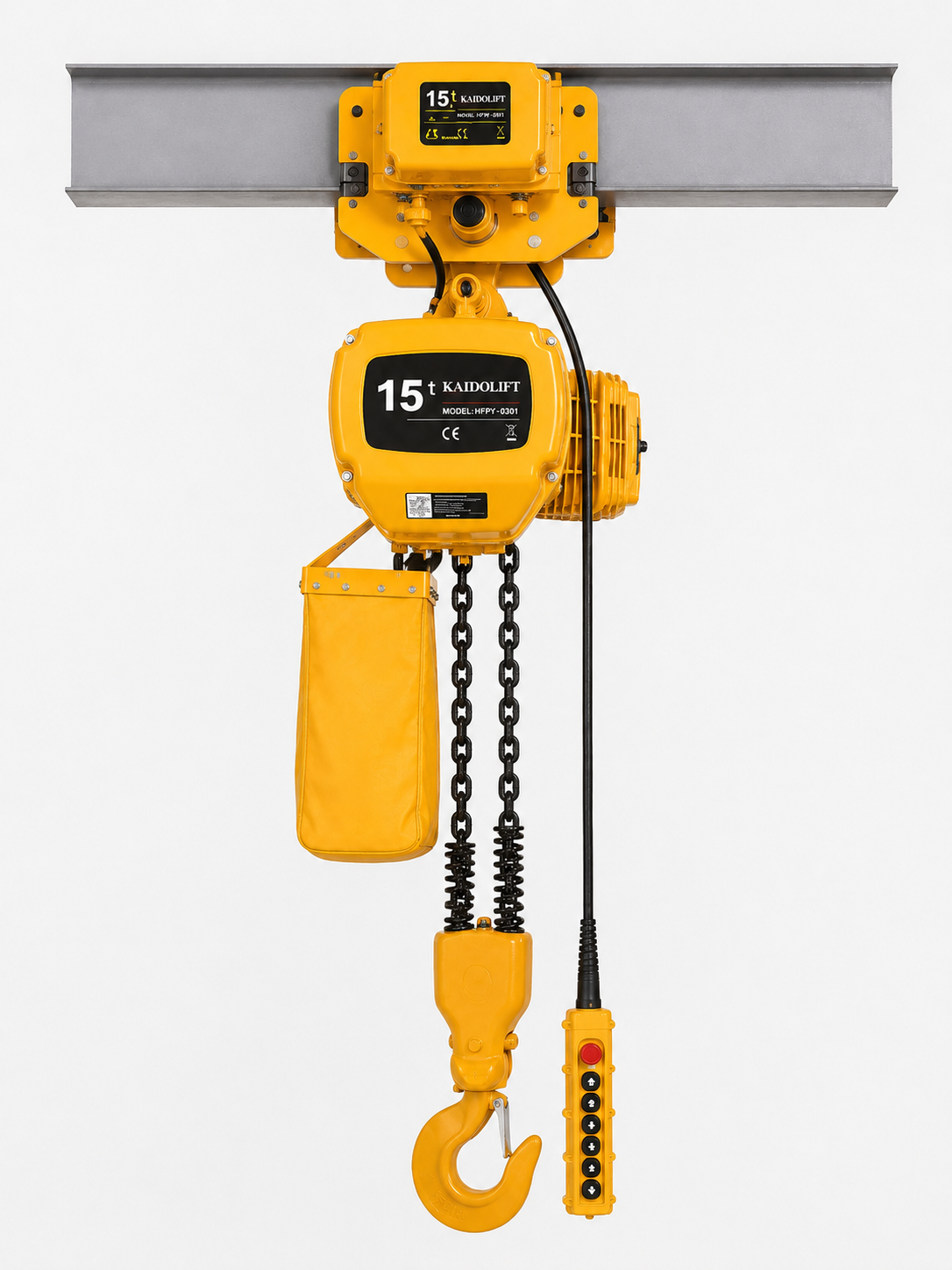
The HHSY electric chain hoist is an industrial electric hoist built for the demands of repetitive, high-cycle work. It is available in two speed configurations:
| Model | Capacity | Lift Speed | Motor Power | Chain Falls | Net Weight |
|---|---|---|---|---|---|
| HHSY‑0.5A | 0.5 t | 7.8 m/min | 1.1 kW | 1 | 36 kg |
| HHSY‑1.0A | 1.0 t | 6.8 m/min | 1.5 kW | 1 | 48 kg |
| HHSY‑2.0A | 2.0 t | 6.8 m/min | 1.5 kW | 1 | 52 kg |
| HHSY‑1.0B | 1.0 t | 3.9 m/min | 1.5 kW | 2 | 52 kg |
| HHSY‑2.0B | 2.0 t | 3.4 m/min | 1.5 kW | 2 | 55 kg |
| HHSY‑3.0B | 3.0 t | 5.8 m/min | 3.0 kW | 2 | 85 kg |
| HHSY‑5.0B | 5.0 t | 2.8 m/min | 3.0 kW | 2 | 113 kg |
Data source: HHSY series product specifications
Key design features:
- High-speed “A” series (6.8‑7.8 m/min) — cuts cycle times by up to 50% compared to standard hoists
- Heavy-duty “B” series — uses 2-chain or 3-chain configurations for loads up to 5 tons
- Double braking system — mechanical and electromagnetic brakes for positive holding
- 24V low-voltage pendant control — safe, operator‑friendly
- Compact body — minimises headroom requirements in low-clearance workshops
- Lightweight alloy housing — easier for operators to position and handle
Three Production Line Applications
1. Die Handling in Stamping Presses
The HHSY‑1.0A at 6.8 m/min cuts die change time from 4 minutes to just over 2 minutes per change. On a line with 18 die changes per shift, that saves over 30 minutes of production time per day — enough to run an extra batch of parts.
The 24V pendant control allows the operator to position the die precisely over the press bed. The smooth start-stop characteristic of the motor brake prevents load swing, a common problem when positioning heavy tooling.
2. Material Feeding Along Assembly Lines
Production lines often require workstation lifting at multiple points — raw materials at one end, sub‑assemblies in the middle, finished goods at the other end. A single fixed hoist cannot cover the line. The HHSY can be trolley-mounted on a monorail or bridge crane, allowing the operator to move loads along the line with manual push or electric trolley options.
For a 30-metre assembly line, a trolley-mounted HHSY‑0.5A covers the entire length. The operator lifts components from a pallet, travels to the workstation, and lowers the load — all in a single smooth operation.
3. Maintenance and Machine Servicing
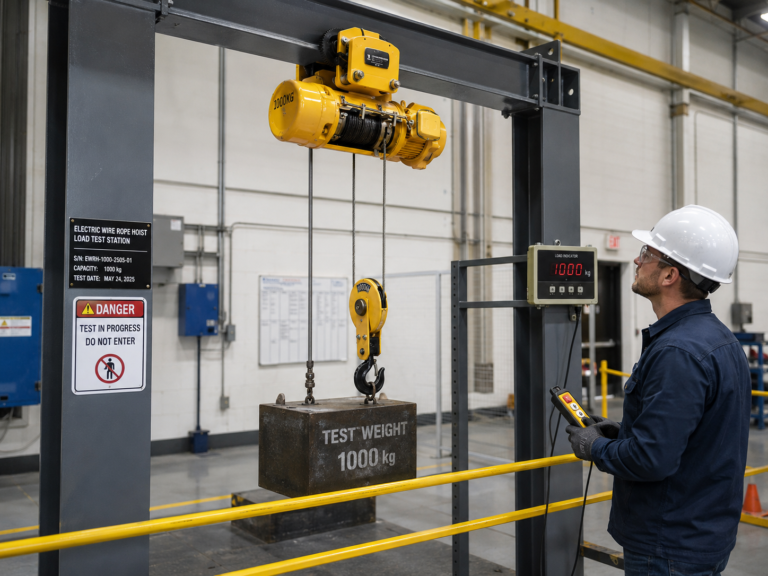
Even the most automated workshops need a production line hoist for maintenance. When a press needs a new motor or a conveyor roller requires replacement, the HHSY‑5.0B provides the capacity and controlled speed needed for heavy maintenance lifts. The 2‑chain configuration ensures the load is balanced during lifting, preventing damage to expensive equipment.
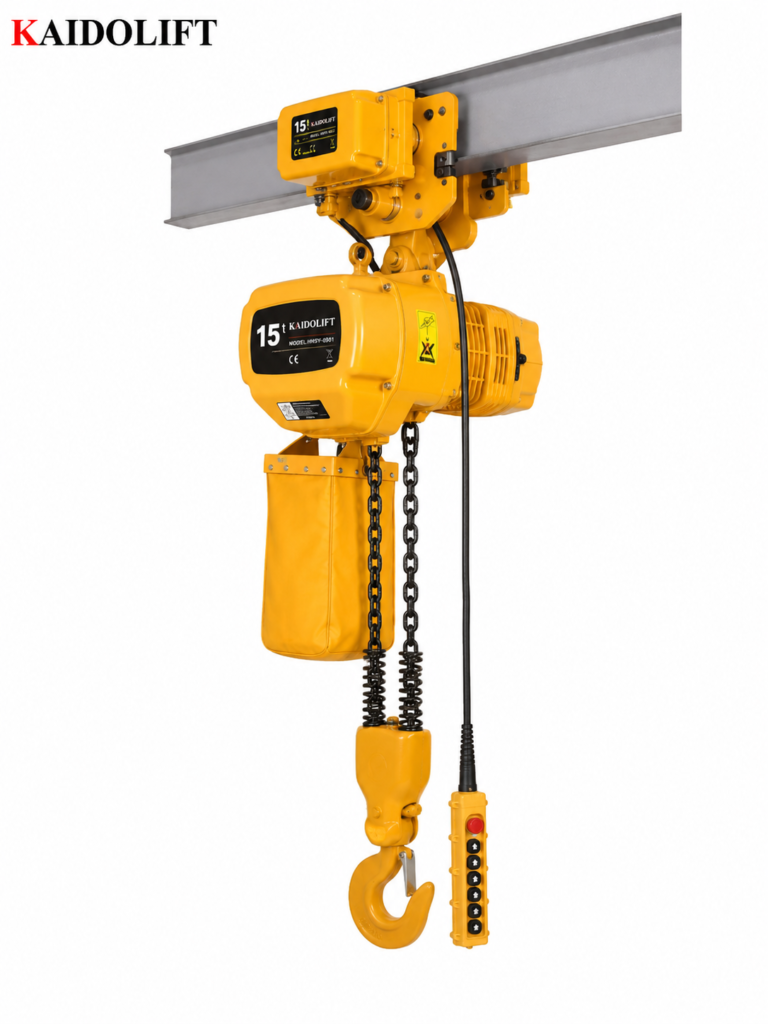
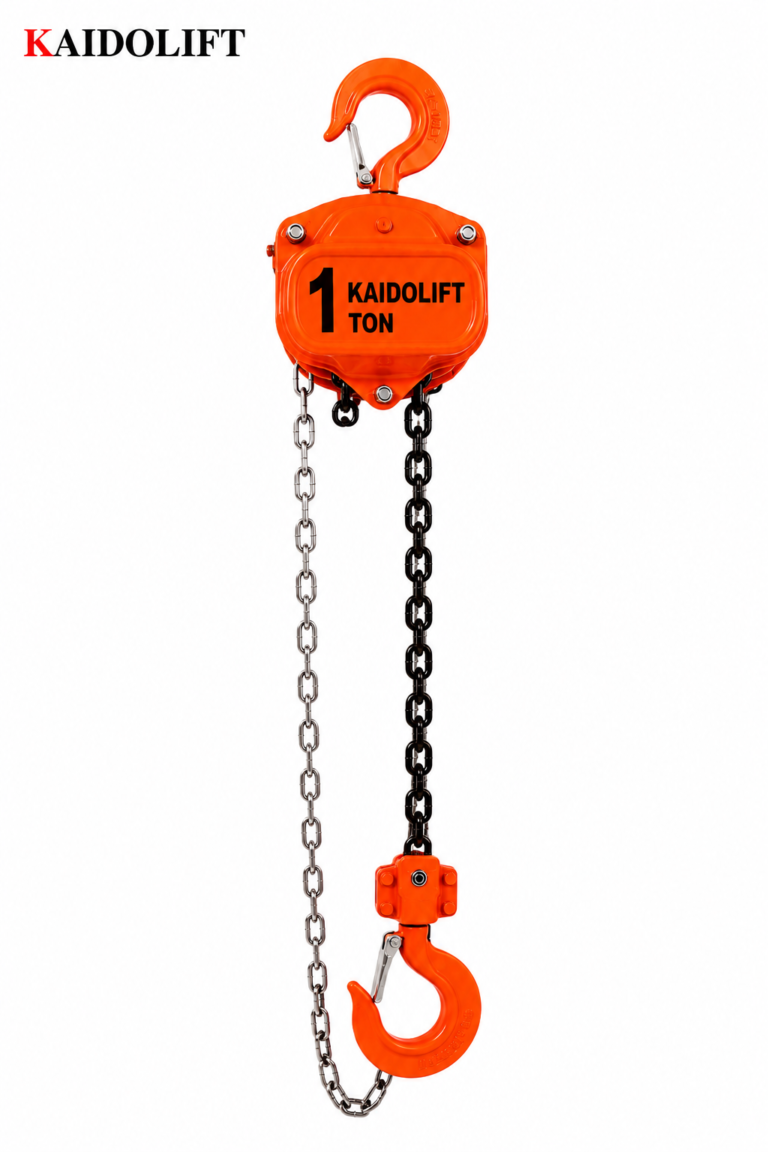
HHSY Electric Chain Hoist (Polipasto Eléctrico de Cadena) | 0.5T to 5T Heavy Duty Industrial Lifting Hoist with Customizable Lift Height
Premium HHSY Electric Chain Hoists (HHSY-A single chain / HHSY-B dual chain). Features standard 3m lift, 0.5-5 Ton capacity, up to 7.8 m/min lifting speed. Full technical specs with extra meter chain weight for professional LATAM buyers. Get factory direct quote!
Mounting Options for Workshop Flexibility
The HHSY can be configured in three mounting styles:
| Mounting Type | Description | Best For |
|---|---|---|
| Hook‑mounted | Fixed single-point suspension | Single workstation, vertical lifts only |
| Manual trolley | Hand‑pushed along beam | Occasional horizontal repositioning |
| Electric trolley | Motor‑driven horizontal travel | Frequent movement along production lines |
The electric trolley option is particularly valuable on production lines where loads must move between multiple stations. Trolley speeds typically range from 5 to 12 m/min, balancing speed with control.
Operating Procedures for Production Environments
Before first use on a line:
- Verify the hoist is securely mounted to the beam or trolley
- Check power supply matches specifications (standard: 380V/50Hz three‑phase)
- Test the limit switch to ensure it stops the hoist at the correct upper and lower positions
- Test the emergency stop button on the pendant control
- Run a trial lift with a representative load to verify speed and braking performance
During production operation:
- Use the pendant control with both hands — keep clear of the load path
- Start each lift smoothly — avoid jerky starts that stress the chain and motor
- Do not “inch” the hoist unnecessarily — frequent micro‑movements overheat the motor
- Let the brake hold the load — do not rely on the motor to hold position
Safety Boundaries — Prohibitions
- NEVER exceed the Working Load Limit (WLL) — even by a small margin
- NEVER stand or work under a suspended load
- NEVER use the HHSY for personnel lifting
- NEVER operate with a twisted, kinked, or worn chain — inspect before each shift
- NEVER bypass the limit switch or overload protection
- NEVER operate the hoist in explosive or flammable atmospheres
- NEVER allow untrained personnel to operate the hoist
Chain safety: Under NCh 2245, chain elongation exceeding 3% requires immediate replacement. Measure chain elongation periodically — this is especially important on production lines where the chain cycles hundreds of times per week.
Daily Inspection Checklist for Production Lines
Production line hoists work hard. Daily inspection is not optional — it is required to prevent unplanned downtime and safety incidents.
- [ ] Inspect the load chain for visible wear, elongation, twists, or gouges
- [ ] Check the hook for deformation, cracks, or a damaged safety latch
- [ ] Listen for unusual noise from the motor or gearbox during operation
- [ ] Test the brake with a small load — hold the load mid‑travel for 30 seconds
- [ ] Test the limit switch by running the hook to the upper and lower stops
- [ ] Check the pendant cable for cuts or fraying — replace if damaged
- [ ] Verify the emergency stop button functions correctly
Weekly maintenance:
- Clean the chain and apply light lubricant
- Inspect the motor cooling fan for dust buildup
- Check gearbox oil level (if applicable)
- Inspect trolley wheels and track for wear
Regulatory References
- ASME B30.21 — construction, installation, operation, inspection, and maintenance of manually lever‑operated chain hoists; principles extend to electric hoists
- FEM 9.511 / 9.683 — hoist duty classifications (1Am through 4m)
- Brazil NR‑11 — documented inspection records required
- Mexico NOM‑151 — inspection records and periodic testing
- Chile NCh 2245 — periodic load testing and chain wear standards
Always refer to the current official versions of these standards.
Key Takeaways
- HHSY “A” series delivers high speed (6.8‑7.8 m/min) for productivity‑focused production lines
- HHSY “B” series uses multiple chain falls for loads up to 5 tons at controlled speeds
- Double braking system and 24V pendant control are standard for operator safety
- Trolley mounting (manual or electric) extends coverage along production lines
- Daily inspection is mandatory — chain wear, hook condition, brake test, and limit switch
- NEVER exceed rated capacity; NEVER lift personnel; NEVER stand under a load
- Chain elongation >3% requires immediate replacement (NCh 2245)
- Comply with ASME B30.21, FEM classifications, and local regulations (NR‑11, NOM‑151, NCh 2245)