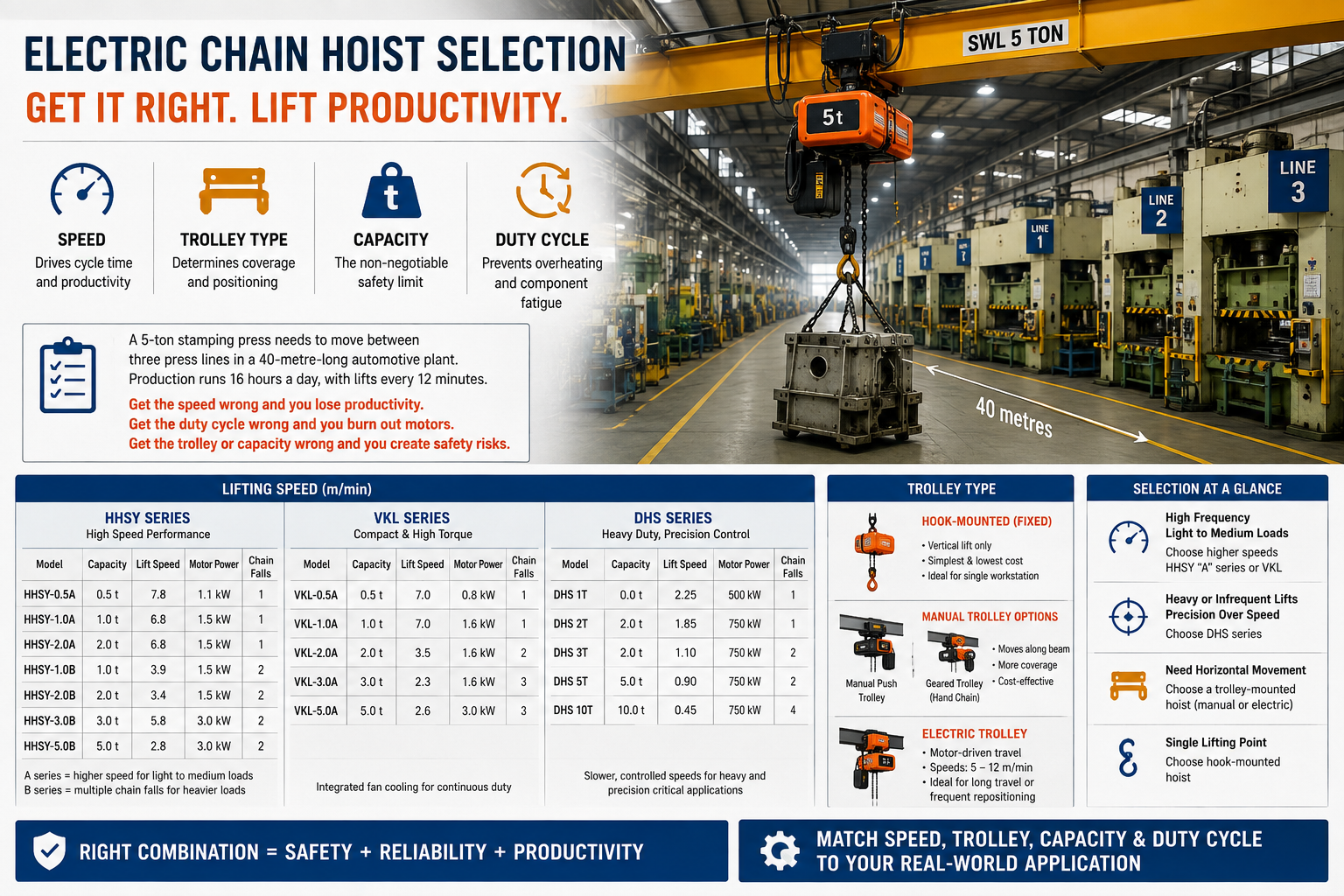
A 5‑ton stamping press needs to move between three press lines in a 40‑metre‑long automotive plant. Production runs 16 hours a day, with lifts every 12 minutes. A standard hoist with a 4 m/min lifting speed would create a bottleneck. An undersized motor would overheat before the second shift ends.
This is the reality of electric chain hoist selection. Get the speed wrong and you lose productivity. Get the duty cycle wrong and you burn out motors. Get the trolley or capacity wrong and you create safety risks.
The HHSY, VKL, and DHS series electric chain hoists cover a range of configurations to match these demands. But choosing the right one means understanding four interlinked variables: speed, trolley type, capacity, and duty cycle. This article walks through each, with real specifications, calculation examples, industry cases, and actionable selection criteria.
The Four Selection Variables — and Why They Matter Together
Most buyers focus on capacity first. That is a mistake. An electric chain hoist is a system — the motor, gearbox, chain, brake, and trolley all work together. Choosing one component without considering the others leads to poor performance or premature failure.
Here is what each variable controls:
| Variable | What It Determines | Why It Matters |
|---|---|---|
| Lifting Speed | How fast the load moves vertically | Directly impacts cycle time and productivity |
| Trolley Type | How the hoist moves horizontally (or not) | Determines coverage area and positioning precision |
| Capacity | Maximum load the hoist can lift | The non‑negotiable safety limit |
| Duty Cycle | How long and how often the hoist can run | Prevents motor overheating and component fatigue |
Selecting these in isolation is like choosing a truck engine without checking the transmission. Here is how to get them right — together.
Lifting Speed: The Productivity Driver
Lifting speed is measured in metres per minute (m/min). Faster speeds reduce cycle times but require more motor power and generate more heat.
HHSY series offers two speed families:
| Model | Capacity | Lift Speed | Motor Power | Chain Falls |
|---|---|---|---|---|
| HHSY‑0.5A | 0.5 t | 7.8 m/min | 1.1 kW | 1 |
| HHSY‑1.0A | 1.0 t | 6.8 m/min | 1.5 kW | 1 |
| HHSY‑2.0A | 2.0 t | 6.8 m/min | 1.5 kW | 1 |
| HHSY‑1.0B | 1.0 t | 3.9 m/min | 1.5 kW | 2 |
| HHSY‑2.0B | 2.0 t | 3.4 m/min | 1.5 kW | 2 |
| HHSY‑3.0B | 3.0 t | 5.8 m/min | 3.0 kW | 2 |
| HHSY‑5.0B | 5.0 t | 2.8 m/min | 3.0 kW | 2 |
The “A” series prioritises speed; the “B” series uses multiple chain falls for heavier loads at slower speeds. For a workshop lifting 1‑ton loads repeatedly, the HHSY‑1.0A at 6.8 m/min will outperform the 1.0B at 3.9 m/min — but the B series handles heavier loads with better chain wear characteristics.
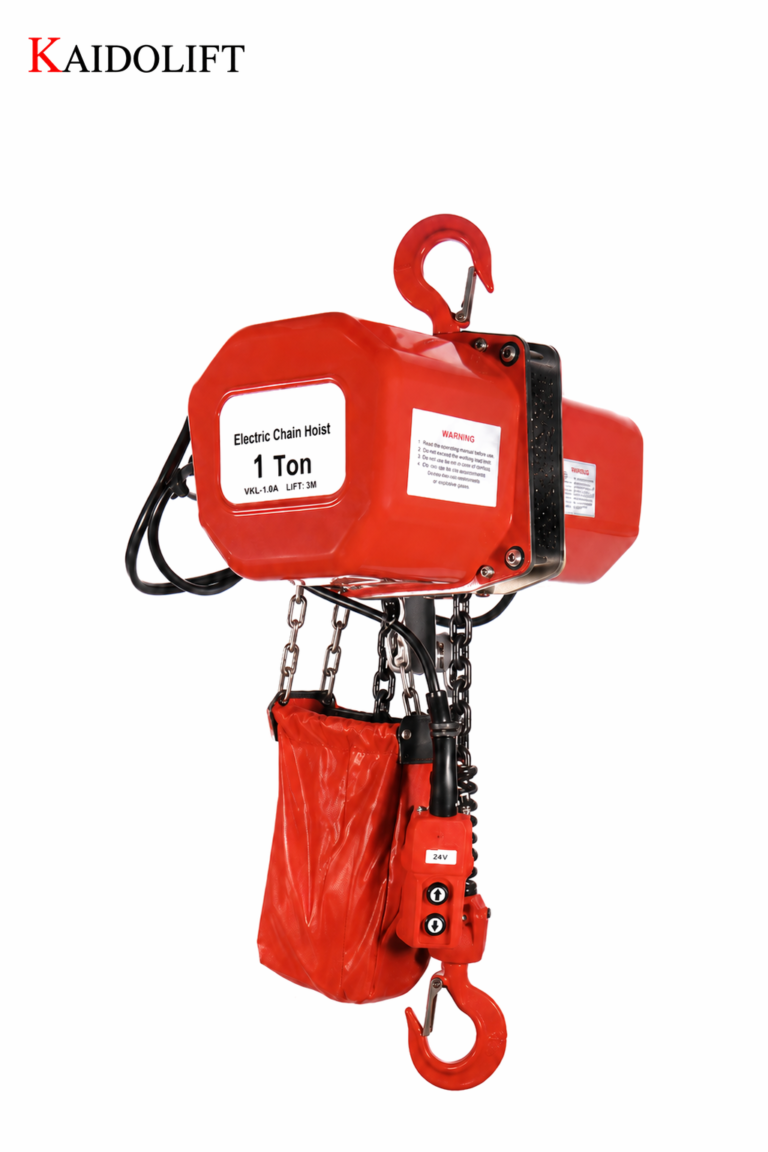
VKL series offers comparable speeds with a compact, high‑torque chain hoist motor featuring integrated fan cooling:
| Model | Capacity | Lift Speed | Motor Power | Chain Falls |
|---|---|---|---|---|
| VKL‑0.5A | 0.5 t | 7.0 m/min | 0.8 kW | 1 |
| VKL‑1.0A | 1.0 t | 7.0 m/min | 1.6 kW | 1 |
| VKL‑2.0A | 2.0 t | 3.5 m/min | 1.6 kW | 2 |
| VKL‑3.0A | 3.0 t | 2.3 m/min | 1.6 kW | 3 |
| VKL‑5.0A | 5.0 t | 2.6 m/min | 3.0 kW | 3 |
DHS series takes a different approach — slower speeds for heavier, more controlled lifts:
| Model | Capacity | Lift Speed | Motor Power | Chain Falls |
|---|---|---|---|---|
| DHS 1T | 1.0 t | 2.25 m/min | 500 W | 1 |
| DHS 2T | 2.0 t | 1.85 m/min | 750 W | 1 |
| DHS 3T | 3.0 t | 1.1 m/min | 750 W | 2 |
| DHS 5T | 5.0 t | 0.9 m/min | 750 W | 2 |
| DHS 10T | 10.0 t | 0.45 m/min | 750 W | 4 |
Selection rule: For high‑frequency, light‑load applications (assembly lines, repetitive lifting), choose higher speeds — HHSY “A” series or VKL. For heavy, infrequent lifts where precision matters more than speed (equipment installation, maintenance), DHS’s slower controlled speeds are appropriate.
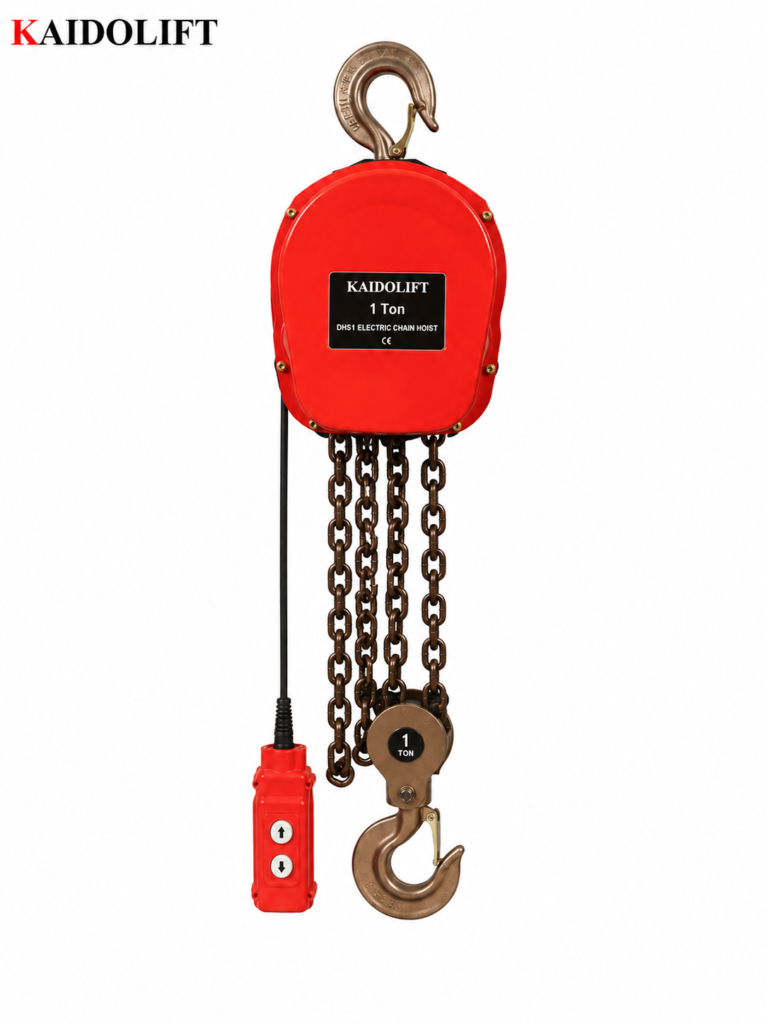
DHS Electric Chain Hoist Industrial Electric Hoist
Looking for a certified heavy-duty industrial electric hoist? The DHS electric chain hoist provides low-speed precision lifting with G80 alloy chains. Inquire for a factory-direct wholesale quote!
Calculation Example: Cycle Time Impact
Assume a 3 m vertical lift height and 5 lifts per hour (one every 12 minutes).
- Using HHSY‑5.0B at 2.8 m/min: one-way lift time = 3 ÷ 2.8 ≈ 1.07 min. Round-trip (up + down) ≈ 2.14 min.
- Using a hypothetical standard 4 m/min hoist: round-trip ≈ 1.5 min.
- Using VKL‑5.0A at 2.6 m/min: round-trip ≈ 2.31 min.
Over a 16-hour shift (80 lifts), the slower hoist adds roughly 50–60 minutes of pure lifting time. When horizontal travel and load attachment are included, the difference becomes a measurable production bottleneck. Always calculate total cycle time (lift + travel + attach/detach) rather than looking at speed alone.
Trolley Type: Fixed vs. Mobile
A hoist can be mounted in two ways:
Hook‑mounted (fixed) : The hoist hangs from a single point. Loads are lifted vertically only. This is the simplest, lowest‑cost configuration — suitable for a single workstation where loads do not need to move horizontally.
Trolley‑mounted: The hoist runs along a beam or track, enabling horizontal movement. A trolley hoist — the complete assembly of hoist plus trolley — can be configured in three varieties:
- Manual push trolley: Operator pushes the hoist along the beam by hand. Lowest cost, suitable for occasional repositioning.
- Manual geared trolley: Operated by a hand chain. Provides more precise positioning than push type.
- Electric trolley: Motor‑driven movement along the track. Ideal for long travel distances or frequent repositioning. Trolley speeds typically range from 5 to 12 m/min.
Selection rule: If loads must move between workstations or along a production line, a trolley‑mounted hoist is essential. For a single lifting point, a hook‑mounted hoist saves cost and complexity.
The HHSY, VKL, and DHS series can all be configured with either hook or trolley mounting, with manual or electric trolley options available.
Capacity: The Non‑Negotiable Limit
Capacity is the maximum load the hoist can lift — and it is not a suggestion.
The three series overlap in capacity range:
- HHSY: 0.5 t to 5.0 t
- VKL: 0.5 t to 5.0 t
- DHS: 1.0 t to 20 t
Critical rule: Never exceed the rated Working Load Limit (WLL). Overloading can damage the motor, chain, gears, or cause the hook to fail.
When selecting capacity, consider:
- Actual load weight — weigh it, do not guess.
- Future needs— a hoist that barely handles today’s loads will be overtaxed tomorrow.
- Chain falls — multiple chain falls (2, 3, or 4 lines) reduce individual chain load but increase complexity.
Calculation Example: Capacity Margin
A 4.2-ton stamping die is the heaviest regular load. Adding 25 % safety/future margin gives 5.25 t.
→ Select a 5 t rated model only if the exact load never exceeds 5 t and dynamic factors (swing, acceleration) are low. Otherwise move to the next available rating (or a dual-fall configuration) and verify the true working load limit under local standards.
Duty Cycle: The Overlooked Critical Factor
Duty cycle is the percentage of time a hoist can operate within a given period before needing to rest. It is determined by:
- Starts per hour — how often the hoist is started and stopped
- Running time per cycle — how long the motor runs per lift
- Load factor — whether lifts are at full capacity or partial
Light duty — occasional lifting in workshops, maintenance. Fewer than 150 starts per hour.
Medium duty — regular production work, multiple lifts per hour. 150‑300 starts per hour.
Heavy duty — continuous industrial use, high frequency. 300+ starts per hour.
What happens when duty cycle is mismatched:
- An underspecified chain hoist motor overheats, trips thermal protection, or fails prematurely
- Brake wear accelerates
- Gearbox oil breaks down
VKL series addresses this with a dual‑brake system combining magnetic and motor brakes, plus over‑temperature protection. The DHS series uses disc motors with planetary gearing for improved heat dissipation.
Selection rule: For production environments with frequent lifts, select a hoist with higher duty rating. For occasional use, a standard‑duty hoist is sufficient. If unsure, choose the next higher duty class — the cost difference is small compared to unplanned downtime.
Calculation Example: Starts per Hour & Running Time
Automotive press example:
- 1 lift every 12 minutes → 5 cycles/hour.
- Each cycle: 2 starts (up + down) → 10 starts/hour.
- Running time per cycle (3 m at 2.8 m/min) ≈ 2.14 min → 10.7 min running time per hour ≈ 18 % duty.
This falls into light-to-medium duty. However, if the same hoist is also used for die changes or tool transfers (adding another 8–10 cycles/hour), starts can exceed 30/hour and running time approaches 35–40 %. In that case a medium- or heavy-duty motor with better cooling (VKL dual-brake or equivalent) is strongly recommended. Always measure actual starts and running minutes over a full shift rather than relying on theoretical averages.
Industry Application Cases
1. Automotive stamping (original scenario)
5 t press dies moved between three lines over 40 m. High frequency (every 12 min), 16 h/day.
→ HHSY-5.0B or VKL-5.0A + electric trolley. Speed and duty cycle are the critical variables; capacity is fixed at 5 t.
2. Warehouse & logistics
Palletised goods (0.5–2 t) moved from receiving to racking aisles. Lifts are frequent but heights are moderate (2–4 m). Horizontal travel is long.
→ HHSY or VKL “A” series (higher speed) with electric trolley. Manual push trolley is insufficient for daily high-volume work.
3. Shipbuilding / heavy fabrication
Large structural sections or engines (5–15 t) lifted infrequently but requiring precise placement. Headroom is often limited.
→ DHS series (slower, controlled speed, higher capacity options) with geared or electric trolley. Precision and load control outweigh cycle time.
4. Equipment installation & maintenance workshops
Occasional lifts of pumps, motors or machine tools (1–3 t). Low starts per hour.
→ Hook-mounted HHSY or DHS is usually adequate and most economical. Electric trolley only if the workshop has multiple fixed workstations.
5. Light assembly / electronics or appliance lines
Repetitive lifting of 0.5–1 t sub-assemblies every few minutes.
→ High-speed HHSY-0.5A / 1.0A or VKL equivalent. Dual-speed or variable-frequency options (if available) further improve positioning accuracy.
These cases illustrate that the same four variables apply across industries; only the weighting changes.
Objective Comparison of the Three Series (and Alternatives)
| Aspect | HHSY Series | VKL Series | DHS Series | Typical Wire-Rope Hoist |
|---|---|---|---|---|
| Capacity range | 0.5–5 t | 0.5–5 t | 1–20 t | Often 1–50 t+ |
| Speed character | Fast (A) / Moderate (B) | Moderate to fast, compact motor | Slow, controlled | Wide range, often higher |
| Best for | High-frequency light–medium | Production with good cooling | Heavy / precision / high capacity | High capacity, long lifts |
| Cooling / duty | Standard | Dual brake + fan, stronger duty | Disc motor + planetary gearing | Varies by design |
| Headroom | Good | Excellent (compact) | Good | Usually requires more |
| Chain vs rope | Compact, true vertical lift | Same | Same | Can have more stretch, needs reeving |
| Cost (relative) | Lower–mid | Mid | Mid–higher for heavy models | Often higher for equivalent capacity |
| Limitation | Max 5 t | Max 5 t | Slower speeds | Bulkier, more maintenance on rope |
Key objective takeaways:
- Electric chain hoists excel in low-to-medium capacity, limited headroom, and true vertical lift applications.
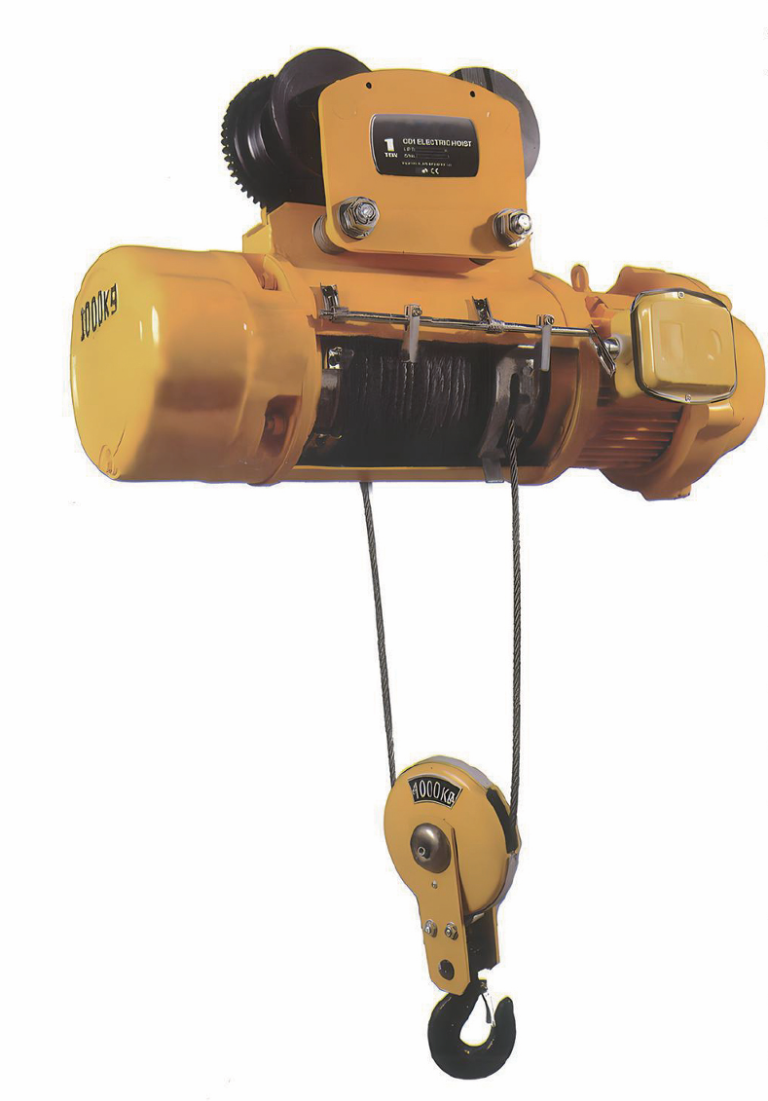
- Wire-rope hoists generally win on very high capacity or very long lift heights, but require more space and different maintenance.
- Within the three series, HHSY “A” prioritises speed, VKL emphasises thermal protection and compactness, DHS prioritises controlled heavy lifting. No single series is universally “best”; match to the dominant variable (speed, duty, or capacity).
- Always verify FEM duty group (1Am–4m) or equivalent local classification against your calculated starts and load spectrum. Manufacturer claims should be cross-checked with actual site data.
Putting It All Together: A Selection Workflow
- Define the load: What is the maximum weight? (Add 25% margin for unknowns.)
- Define the lift: How high? How often? How fast?
- Define the travel: Fixed point or moving along a beam?
- Calculate the duty: How many lifts per hour? At what load? (Use the starts-per-hour and running-time examples above.)
- Match to a series:
- High speed, light‑medium loads → HHSY “A” series
- Heavy loads, moderate speed → HHSY “B” series or VKL
- Heavy loads, slow controlled speed → DHS series
- Long travel distances → add electric trolley
- Occasional repositioning → manual trolley or hook mount
Operating Procedures and Critical Safety Rules
Before first use:
- Verify the hoist is installed on a stable, secure beam and aligned with the track
- Check that the power supply matches the hoist specifications (380V/50Hz three‑phase is standard for these series)
- Test the limit switch and load‑limiting device
During operation:
- Use smooth, controlled starts and stops — avoid jerking
- Never lift a load that exceeds the rated capacity
- Keep the load chain straight — side loading damages the chain and sprocket
- Use the 24V low‑voltage control pendant for safe operation (standard on VKL and DHS)
Prohibitions — read these carefully:
- NEVER stand under a suspended load
- NEVER use the hoist for personnel lifting
- NEVER operate with a damaged or worn chain — check for elongation, gouges, or twisted links
- NEVER bypass the limit switch or load‑limiting device
- NEVER operate in explosive atmospheres unless the hoist is specifically rated for that environment
Daily Inspection and Maintenance
Daily checks:
- Inspect the load chain for wear, elongation, or damage
- Check the hook for deformation or cracks; verify the safety latch works
- Listen for unusual noise from the motor or gearbox during operation
- Test the brake by lifting a small load and holding it mid‑travel
Regular maintenance:
- Keep the chain clean and lightly lubricated
- Inspect the motor and gearbox for overheating or oil leaks
- Check the chain hoist motor cooling fan for dust buildup
- Clean the hoist regularly to prevent dust accumulation that can cause overheating
Chain replacement: Under standards such as NCh 2245, chain elongation exceeding 3% requires immediate replacement. Always refer to the current official version of applicable standards.
Regulatory References
- ASME B30.21 — applies to manually lever‑operated chain hoists; many principles extend to electric chain hoists
- FEM 9.511 / 9.683 — defines hoist duty groups from 1Am (lightest) through 4m (heaviest continuous industrial use)
- Brazil NR‑11 — requires documented inspection records
- Mexico NOM‑151 — inspection record requirements
- Chile NCh 2245 — periodic load testing and chain wear standards
Always refer to the current official versions of these standards.
Key Takeaways
- Electric chain hoist selection involves four linked variables: speed, trolley, capacity, and duty cycle — never select one in isolation
- HHSY “A” series offers higher speeds (6.8‑7.8 m/min) for light‑medium loads
- HHSY “B” series and VKL use multiple chain falls for heavier loads at moderate speeds
- DHS series provides slower, controlled speeds (0.45‑2.25 m/min) for heavy lifts and precision work
- Trolley type determines whether loads move horizontally — choose electric trolley for long travel, manual for occasional repositioning
- Duty cycle must match your frequency of use — underspecifying leads to motor failure
- Calculate actual cycle time, starts per hour and running minutes before finalising the model
- Match the dominant requirement of your industry (speed for logistics, control for shipbuilding, frequency for automotive)
- Compare series objectively against capacity ceiling, thermal performance and headroom rather than price alone
- NEVER exceed the rated capacity; NEVER lift personnel; NEVER stand under a load
- Inspect the chain daily — elongation >3% requires replacement
- Comply with ASME B30.21, FEM classifications, and local regulations (NR‑11, NOM‑151, NCh 2245)