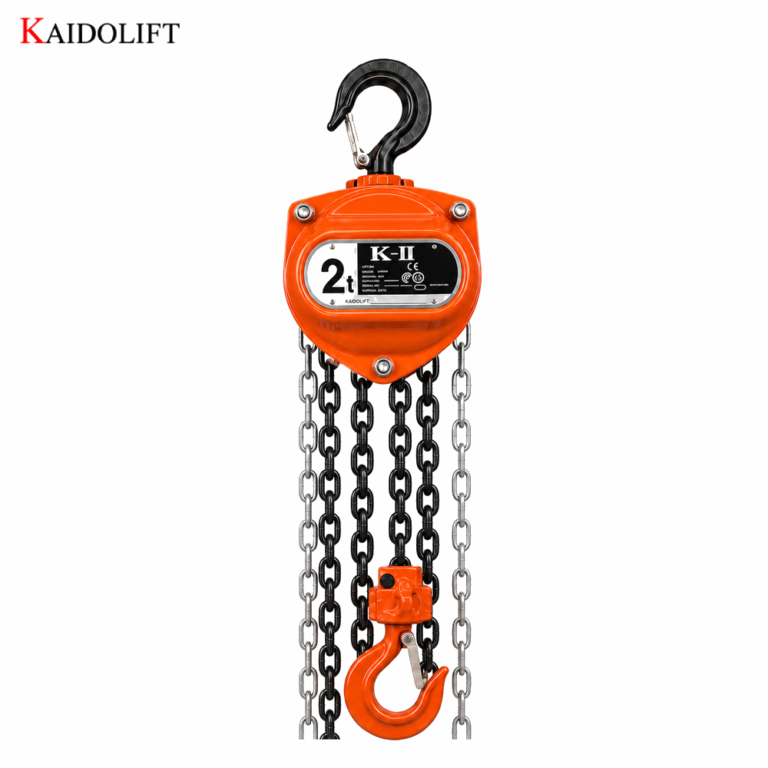
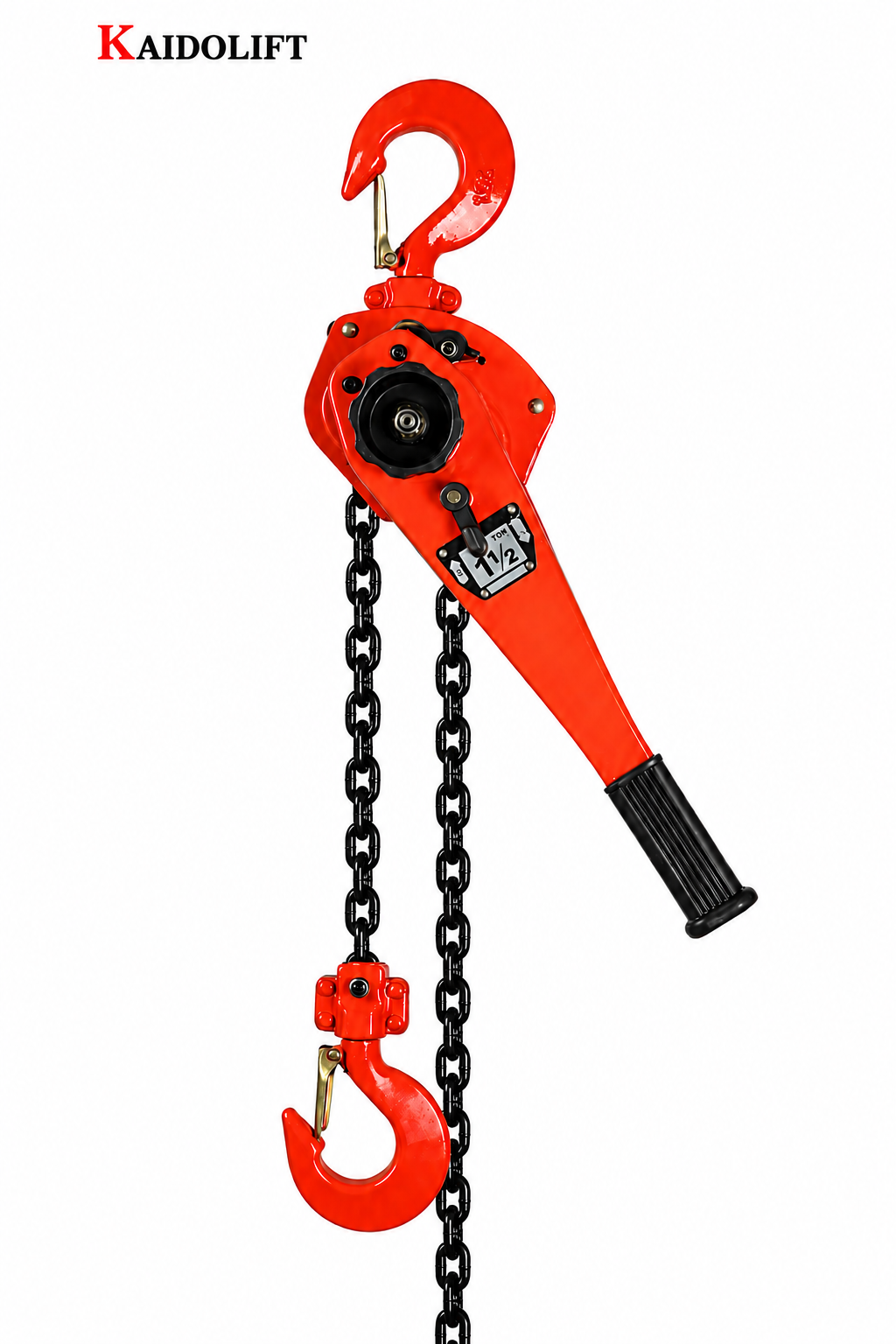
The HSH-VL lever block does more than lift—it pulls, tensions, and positions loads across three dimensions, making it one of the most versatile tools in any rigging crew’s inventory. On a Chilean copper mine maintenance bench, workers use one to tension a conveyor belt splice. At a Mexican pipeline construction site, the same tool pulls a 6-inch steel pipe into alignment for welding. On a Brazilian offshore platform, it lifts critical valves into position within a cramped equipment bay. These three applications—pulling, tensioning, and lifting—represent the full capability spectrum of the lever block, yet each demands different techniques, anchor configurations, and safety considerations. This guide examines each use case in detail, referencing ASME B30.21, EN 13157, and LatAm standards including Brazil’s NR-11, Mexico’s NOM-151, and Chile’s NCh 2245 where applicable.
Standard & Specifications Foundation
The HSH-VL lever block operates under the framework of ASME B30.21 (Lever Hoists), which covers ratchet-and-pawl type lever chain hoists used for lifting, pulling, and tensioning applications. The standard establishes that the load block, chain, and hoist body must be directly in line with the direction of loading to avoid side pull—a requirement that becomes particularly critical when the tool is used horizontally or at an angle.
EN 13157 provides additional safety requirements for hand-powered lifting equipment, specifying that lever hoists must incorporate a mechanical brake that holds the load securely in any position when the lever is released. The HSH-VL’s ratchet-and-pawl system meets this requirement through a self-sustaining brake mechanism that engages automatically.
Key specifications for the HSH-VL series:
| Parameter | Specification |
|---|---|
| Capacity range | 0.75 ton – 9 ton (standard models) |
| Load chain | Grade 80 calibrated chain |
| Standard lift height | 1.5 m – 3 m (customizable) |
| Lever operation | 180° ratchet-and-pawl |
| Brake type | Mechanical, self-sustaining |
| Min. hook opening | Varies by capacity (check each unit) |
For operations in Latin America, Brazil’s NR-11 requires that all material handling equipment—including lever blocks used for pulling and tensioning—be maintained in perfect working condition with documented inspection records. Mexico’s NOM-151 mandates load testing and certification documentation. Chile’s NCh 2245 requires periodic inspection intervals based on service severity. Operators must confirm that the unit’s rating plate is legible and that the WLL is appropriate for the intended application—whether pulling, tensioning, or lifting.
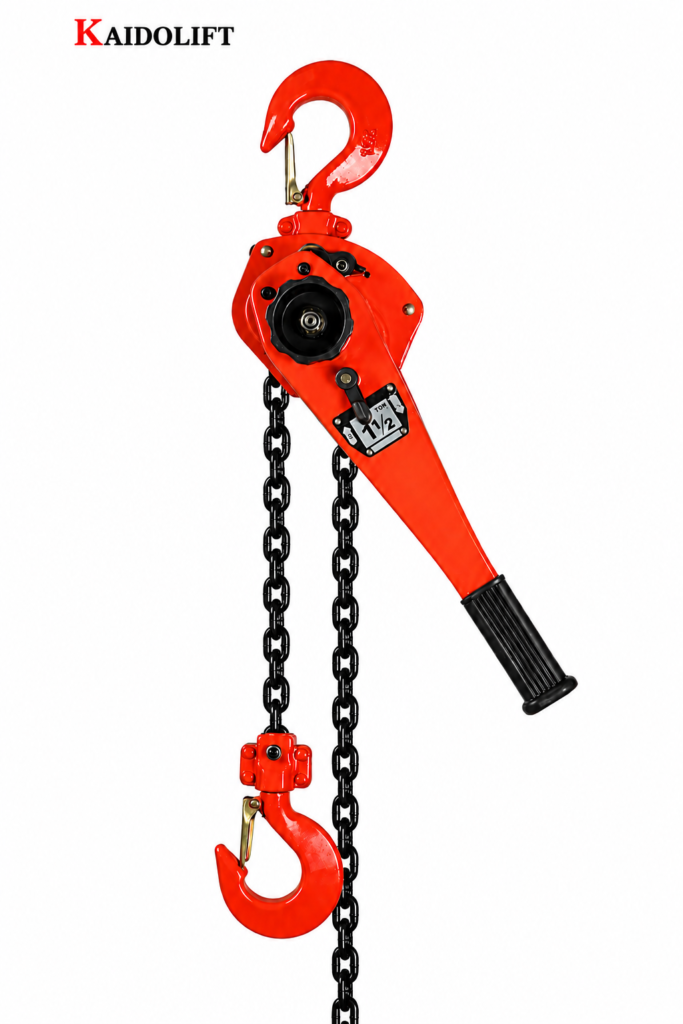
HSH-VL Lever Block Manual Chain Hoist | Heavy Duty Industrial Lifting Applications
HSH-VL Lever Block is a lightweight and heavy-duty manual chain hoist designed for lifting, pulling and positioning operations. Featuring alloy load chain, forged hooks and optimized gear transmission, it provides reliable performance for industrial applications from 0.8 ton to 9 ton.
Three Core Application Modes
The HSH-VL lever block is not a single-purpose tool. Its ratchet-and-pawl mechanism, combined with a mechanical brake and Grade 80 chain, enables three distinct operational modes. The difference between success and failure often lies in understanding which mode applies to the task at hand—and configuring the anchor, chain path, and load attachment accordingly.
Pulling – The Horizontal Workhorse
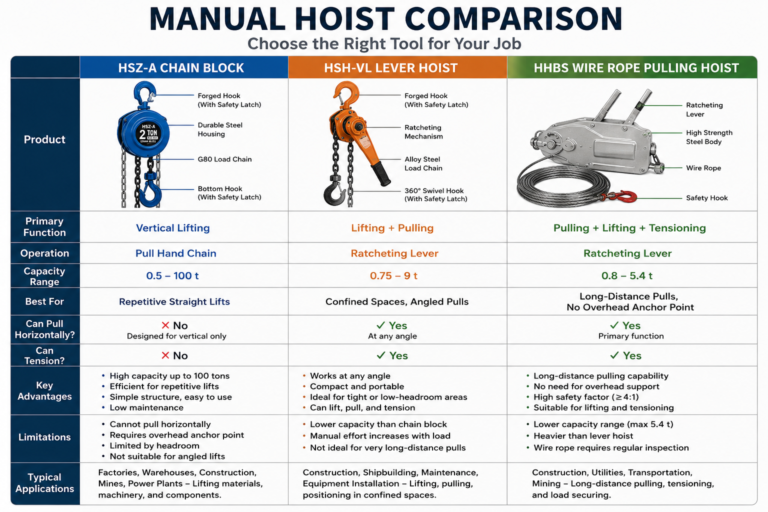
Pulling is the lever block’s most distinctive capability and the primary reason many rigging crews choose it over a manual chain hoist. Unlike a chain hoist, which is designed exclusively for vertical lifting, the HSH-VL can apply controlled horizontal force to move, align, or retrieve loads.
Typical pulling applications:
- Dragging machinery across workshop floors or loading docks
- Pulling structural steel members into alignment for bolting or welding
- Retrieving vehicles or equipment from off-road positions
- Pulling cables or hoses through conduits and trays
- Aligning flanges during pipeline construction
Operational requirements for pulling:
- Anchor point must be directly opposite the direction of pull
- The chain must form a straight line between anchor, hoist, and load
- Side pulling—where the chain deviates from the hoist’s centerline—is prohibited by ASME B30.21
- Multiple lever blocks can be used in tandem for heavier pulls, but each must be rated for the full load
- The mechanical brake holds position when the lever is released, allowing staged pulling operations
⚠️ CRITICAL NOTICE: When pulling horizontally, the anchor point must withstand the full applied force—often significantly higher than the load’s static weight due to friction and inertia. A 3-ton pull on a stuck load may require a 5-ton anchor capacity. Always over-spec the anchor, not the hoist.
Critical tip: For horizontal pulling, apply tension gradually. The ratchet mechanism delivers force in discrete increments with each lever stroke, and operators should avoid “pumping” rapidly when resistance is high. A slow, controlled pull reduces shock loading on the chain and anchor.
Tensioning – Holding Loads in Place
Tensioning is the lever block’s second distinct application mode. In this use case, the tool does not move a load from point A to point B—it holds a load in a fixed position under controlled tension. This is common in rigging, construction, and pipeline work where components must be held in alignment while permanent connections are made.
Typical tensioning applications:
- Tensioning conveyor belts during splice curing
- Holding pipe flanges together during bolting
- Maintaining tension on guy wires or temporary structural supports
- Tensioning wire rope or cable during installation
- Holding equipment in position during foundation bolting
Operational requirements for tensioning:
- The lever block must be positioned to maintain consistent tension without drift
- The mechanical brake must be in optimal condition—brake slippage during tensioning can cause sudden load release
- Locking the lever in position (if the model supports it) provides additional security
- Tension should be checked periodically if the load remains under tension for extended periods
🔧 MANDATORY PRACTICE: For extended tensioning operations (over 4 hours), install a secondary safety device—such as an additional lever block or a wire rope clamp—as a backup in case of brake failure. This is not a requirement in ASME B30.21 but is widely recommended in industry best practice.
Tensioning vs. pulling : The distinction is subtle but critical. Pulling involves moving a load. Tensioning involves holding a load. The HSH-VL can do both, but tensioning places greater demands on the brake system and requires more careful anchor selection.
Lifting – Vertical Capability When Needed
Although the HSH-VL is often positioned as a pulling and tensioning tool, it also performs vertical lifting—provided the load is suspended from an overhead anchor point and the hoist is oriented correctly. In this mode, the lever block functions similarly to a manual chain hoist, with the ratchet lever replacing the hand chain.
Typical lifting applications:
- Lifting equipment into position in confined spaces where a chain hoist won’t fit
- Temporary lifting during maintenance or repair work
- Positioning components for installation at height
- Lifting in locations without overhead trolley access
Operational requirements for lifting:
- Anchor point must be directly above the load (vertical centerline alignment)
- The lever block must be rigged with the load chain vertical and the lever accessible
- The lifting height is limited by the chain length (typically 1.5 m – 3 m standard)
- The load should not be lifted beyond the hoist’s rated capacity—the capacity rating applies regardless of orientation, but the brake design is optimized for vertical application
⚠️ CRITICAL NOTICE: When using a lever block for lifting, the operator must maintain a clear line of sight to the load and the hook. The lever’s ratchet mechanism provides positive engagement, but the operator must never release the lever completely while the load is suspended—the brake holds, but standard practice dictates maintaining hand contact with the lever during the entire lift.
Lifting vs. manual chain hoist : The HSH-VL can substitute for a manual chain hoist in vertical applications, but it is not designed for high-duty-cycle lifting. For repetitive vertical lifts on a production line, a manual chain hoist remains the better choice. The lever block excels when the same tool must also pull and tension—whereas the chain hoist cannot.
Maintenance & Safety Considerations Across Applications
Regardless of whether the HSH-VL is used for pulling, tensioning, or lifting, three maintenance and safety considerations are universal.
Chain inspection : The Grade 80 load chain is the most critical component. Before each use, inspect for:
- Visible wear—measure chain pitch; replace if elongation exceeds 3% of original length
- Corrosion or pitting—especially in offshore or humid environments
- Twists or kinks—these indicate improper operation or shock loading
- Hook deformation—check the hook opening; replace if increased by 10% or more
Brake performance : The mechanical brake must be tested before each shift. Apply a light load (approximately 10% of WLL), raise it slightly, and verify that the brake holds the load when the lever is released. Any drift indicates brake wear or contamination.
Lever and ratchet mechanism : The ratchet teeth must engage smoothly. A sticking ratchet suggests dirt or insufficient lubrication; a slipping ratchet indicates worn teeth—replace the unit immediately.
Inspection intervals under LatAm standards:
| Standard | Inspection Type | Frequency |
|---|---|---|
| NR-11 (Brazil) | Periodic documented | Monthly (severe service) |
| NOM-151 (Mexico) | Load test certification | Annually |
| NCh 2245 (Chile) | Visual + functional | Before each shift |
CRITICAL RULE: A lever block used for tensioning—where loads remain suspended for extended periods—should be inspected more frequently than a unit used only for intermittent pulling. The brake system on a tensioning unit experiences sustained load, which accelerates wear on the brake components.
Chain replacement trigger: If the chain shows any sign of elongation exceeding 3%, visible cracking, or corrosion that reduces cross-section, replace the entire chain set. Do not attempt to repair or rework Grade 80 chain—it is heat-treated and any welding or grinding compromises its integrity.
Conclusion & Summary
The HSH-VL lever block is a genuinely versatile tool. In pulling mode, it moves loads horizontally across job sites. In tensioning mode, it holds components in alignment while crews complete permanent connections. In lifting mode, it raises loads vertically in locations where a manual chain hoist cannot fit.
Key takeaways:
- Pulling is horizontal force application—anchor opposite the direction of pull
- Tensioning is sustained load holding—brake condition is paramount
- Lifting is vertical capability—respect the rated capacity and duty cycle limits
- All three modes require the same anchor and chain alignment discipline
- Inspection intervals and brake testing are universal across all modes
- LatAm compliance requires adherence to NR-11, NOM-151, and NCh 2245
No single tool can replace all three. The lever block simply replaces the need to carry three separate devices: a chain hoist (lifting), a come-along (pulling), and a tensioning rig (holding). That is its value proposition—and its limitation. Operators who understand each mode’s distinct requirements will get the most from the tool while keeping their job sites safe and efficient.