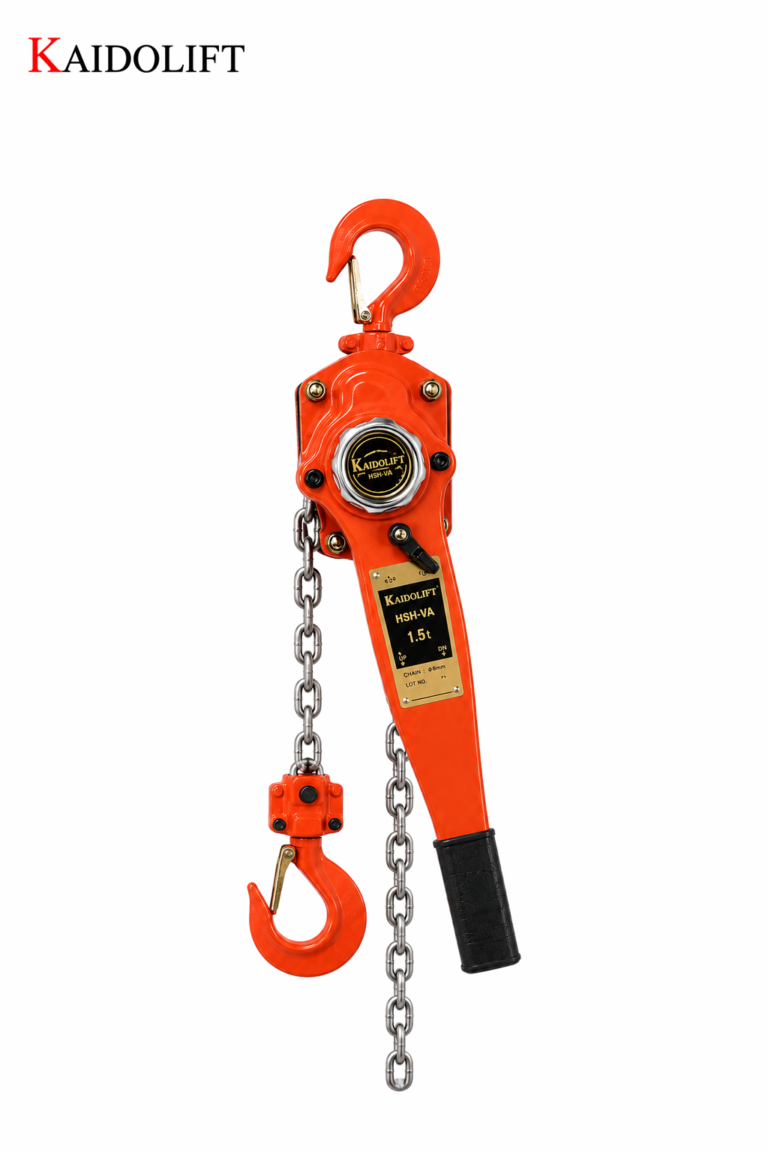
Today’s question is how to Maintain Hand Chain Block to Reduce Failure Rate
From shipyard rigging in Brazil’s Guanabara Bay to pipeline maintenance in Argentina’s Vaca Muerta field, the hand chain block remains an indispensable lifting tool across Latin American industry. Unlike powered equipment, this manually operated device seems simple — but neglect its maintenance, and you invite sudden failures that halt operations and endanger workers. This hand chain block maintenance guide provides maintenance teams with a systematic approach to inspection, lubrication, and component replacement that dramatically reduces unexpected downtime. Following these procedures ensures compliance with NR-11, and manufacturer specifications while maximizing service life in demanding environments.
Why Maintenance Matters: Cost, Safety & Reliability
The Hidden Cost of Neglect
Hand chain blocks are often perceived as “maintenance-free” tools. This misconception leads to:
- Premature failure: Lack of lubrication accelerates chain and gear wear
- Safety incidents: Brake mechanism degradation causes load drift or uncontrolled descent
- Operational downtime: A failed 1-ton block can halt an entire rigging operation
- Replacement costs: A neglected block lasting 1 year vs. a maintained block lasting 5 years represents a 5× cost difference
What Maintenance Achieves
A disciplined maintenance program delivers:
| Benefit | Impact |
|---|---|
| Extended service life | 3-5× longer equipment lifespan |
| Reduced failure rate | 80%+ decrease in unexpected breakdowns |
| Consistent performance | Smooth operation throughout service life |
| Regulatory compliance | Meets NR-11 and NOM-151 inspection requirements |
| Lower total cost | Reduced replacement frequency and downtime losses |
Maintenance Frequency Framework
| Maintenance Level | Frequency | Scope |
|---|---|---|
| Pre-use inspection | Every shift | Visual check, function test |
| Routine maintenance | Monthly | Lubrication, adjustment |
| Thorough inspection | Quarterly | Detailed component inspection |
| Overhaul | Annually | Complete disassembly, replacement of worn parts |
CRITICAL RULE: Remove any hand chain block from service immediately if it exhibits: chain stretch exceeding 3%, brake slip under load, cracked hooks, or stiff operation. Tag-out and repair before returning to use.
Daily Inspection Checklist: Pre-Use Verification
The 60-Second Pre-Use Check
Before every shift, operators must perform a quick but thorough inspection:
Visual Inspection:
- Load chain: Check for twisted links, excessive wear, rust, or damage
- Hand chain: Verify no kinks, broken links, or excessive wear
- Hooks (upper and lower): Inspect for cracks, deformation, or throat opening exceeding 5% of original
- Safety latches: Ensure both hooks have functional spring-loaded latches
- Load block: Check for cracks or deformation in the block housing
Function Test:
- Lift test: Raise a test load (or empty hook) 15cm and observe
- Brake hold: Stop lifting — load should hold without drift
- Lower test: Lower smoothly — no jerking or slipping
- Chain alignment: Chain should feed smoothly without binding
Documentation Requirements
Every pre-use inspection must be logged:
- Date and shift
- Operator name
- Equipment ID (serial number)
- Pass/fail determination
- Any defects noted
- Corrective action taken
🔧 MANDATORY PRACTICE: Never operate a hand chain block that fails any inspection point. Report defects immediately and tag the equipment “OUT OF SERVICE” until repaired by qualified personnel.
Periodic Maintenance Procedures: Monthly & Quarterly
Monthly Maintenance: Lubrication & Adjustment
Materials Required:
- Gear grease (NLGI Grade 2, lithium-based)
- Chain lubricant (SAE 30 or manufacturer-recommended)
- Clean rags
- Inspection mirror (for internal viewing)
Procedure:
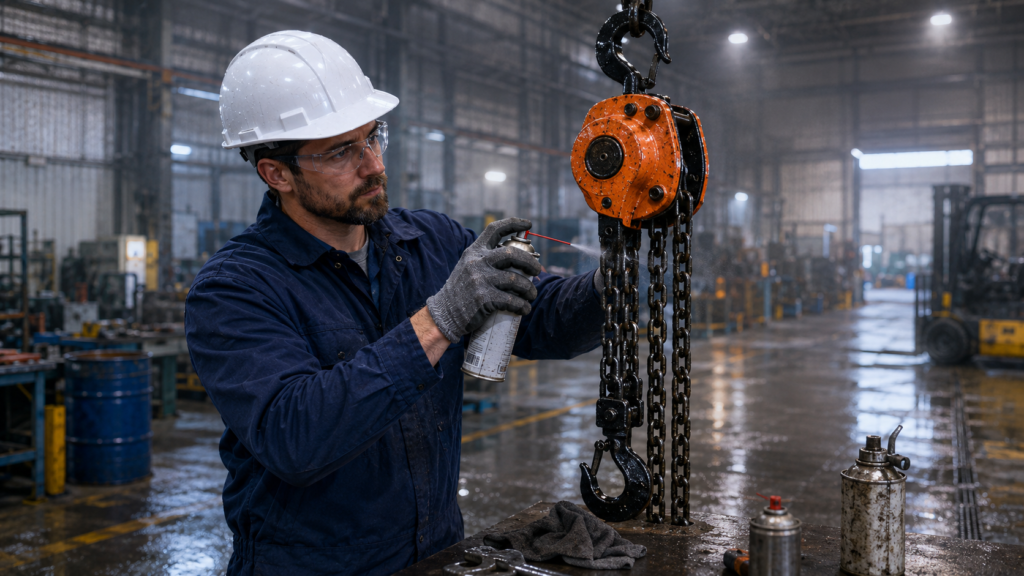
- Clean exterior: Wipe down chain and block housing to remove dirt and debris
- Lubricate load chain:
- Apply chain lubricant sparingly to entire chain length
- Operate block through full lift cycle to distribute lubricant
- Wipe excess to prevent dirt accumulation
- Lubricate hand chain: Light oil spray on hand chain links
- Check brake adjustment:
- Lift rated load and verify brake holds without drift
- If brake slips, adjust per manufacturer instructions (typically friction disc tension)
- Inspect hook rotation: Hooks should swivel freely but without excessive play
Quarterly Maintenance: Detailed Component Inspection
Disassembly Scope:
- Remove hand wheel cover
- Inspect gear teeth for wear or pitting
- Check brake disc condition
- Verify pawl and ratchet mechanism operation
Inspection Criteria:
| Component | Acceptance Criteria | Action if Failed |
|---|---|---|
| Load chain | Wear < 10% of original link diameter | Replace chain |
| Gear teeth | No pitting, wear < 0.5mm | Replace gear set |
| Brake disc | Thickness within spec, no cracks | Replace brake assembly |
| Pawl spring | Strong return action, no deformation | Replace spring |
| Bushings | No excessive play, no scoring | Replace bushings |
| Hooks | No cracks, throat opening < 5% increase | Replace hook |
Reassembly Notes:
- Apply fresh grease to all gear surfaces
- Verify brake disc orientation (asymmetric designs)
- Test operation through full cycle before returning to service
Annual Overhaul: Complete Service
Annual overhaul involves complete disassembly, ultrasonic cleaning of all components, replacement of all wear items (chains, gears, brake discs, bushings), and load testing to verify rated capacity. This should be performed by qualified technicians or sent to authorized service centers.
Common Failure Modes & Prevention
Failure Mode 1: Chain Stretch & Wear
Symptoms:
- Chain elongation (>3% indicates replacement needed)
- Stiff operation, especially under load
- Visible wear at link contact points
Root Causes:
- Insufficient lubrication
- Overloading
- Operation with twisted chain
- Corrosive environment without protection
Prevention:
- Lubricate chain monthly minimum
- Never exceed WLL
- Straighten twisted chains before use
- Use galvanized or stainless chains in corrosive environments
Failure Mode 2: Brake Slip
Symptoms:
- Load drifts downward when lifting stops
- Audible slipping during lift
- Inability to hold rated load
Root Causes:
- Brake disc contamination (oil, grease)
- Worn brake disc surface
- Weak or broken pawl spring
- Incorrect adjustment
Prevention:
- Keep brake mechanism clean and dry
- Inspect brake disc quarterly
- Replace pawl springs annually
- Follow manufacturer adjustment procedures
CRITICAL NOTICE: A slipping brake is a critical safety hazard. If load drift is detected, remove the block from service immediately. Do not attempt to compensate by “holding” the hand chain — this masks the problem and creates risk of uncontrolled load descent.
Failure Mode 3: Hook Deformation
Symptoms:
- Hook throat opening increased
- Visible bending or twisting
- Cracks at hook saddle or tip
Root Causes:
- Overloading
- Shock loading (dropping loads onto sling)
- Side loading (angular forces on hook)
- Corrosion weakening
Prevention:
- Never exceed WLL
- Use proper rigging techniques to avoid shock loads
- Ensure load is centered under hook
- Inspect hooks monthly for early detection
Failure Mode 4: Stiff Operation
Symptoms:
- Excessive force required to lift
- Jerky or uneven motion
- Hand chain difficult to pull
Root Causes:
- Lack of lubrication
- Dirt/debris in gear mechanism
- Bent or damaged chain
- Misaligned components
Prevention:
- Regular lubrication schedule
- Keep block clean, especially in dusty environments
- Inspect chain for damage before each use
- Ensure proper assembly after maintenance
Environmental Considerations for Latin American Operations
High Humidity & Coastal Environments
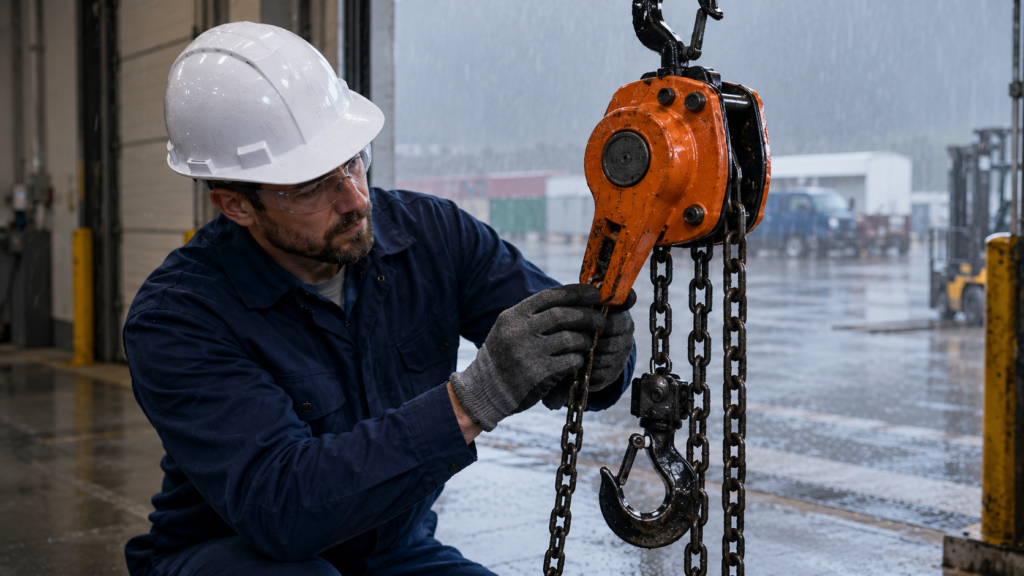
In coastal regions (Santos, Veracruz, Valparaíso), salt spray accelerates corrosion:
- Recommendation: Use galvanized or stainless steel chains
- Maintenance: Rinse with fresh water weekly, lubricate bi-weekly
- Storage: Keep in dry, covered area when not in use
High Dust Environments
Mining operations in Chile’s Atacama or construction sites expose blocks to abrasive dust:
- Recommendation: Use sealed block designs where available
- Maintenance: Clean exterior daily, lubricate weekly
- Inspection: Check for dust ingress in gear mechanism monthly
High Temperature
Operations in tropical regions or near furnaces:
- Recommendation: Use high-temperature grease (NLGI Grade 2, rated to 120°C)
- Maintenance: Increase lubrication frequency by 50%
- Inspection: Check for grease degradation (drying, hardening)
Conclusion
Hand chain block maintenance is not optional — it is a fundamental requirement for safe, reliable lifting operations. By implementing daily pre-use inspections, monthly lubrication, quarterly detailed checks, and annual overhauls, maintenance teams can reduce failure rates by over 80% while extending equipment service life by 3-5×. The investment in disciplined maintenance pays for itself many times over through reduced downtime, lower replacement costs, and most importantly, prevention of safety incidents. For Latin American operations under NR-11 and NOM-151 regulations, proper maintenance documentation also ensures compliance during regulatory audits.