Picture this: It’s 2 PM in a copper mine in Chile’s Atacama Desert. The thermometer reads 45°C. Your electric hoist, which worked perfectly last month, is now overheating and shutting down mid-lift. Or maybe you’re at a port in Santos, Brazil, where everything seems fine — until you discover that the chain block you installed six months ago is now rusted stiff from salt spray.
Sound familiar?
Here’s the thing nobody tells you: your lifting equipment doesn’t operate in a vacuum. The weather — temperature, humidity, wind, UV — is constantly attacking it, slowly degrading performance in ways you can’t see until something breaks. And in Latin America, where you’ve got everything from Amazon humidity to Patagonian winds, the challenges are extreme.
Let’s talk about what’s really happening to your equipment, and more importantly, what you can do about it.
The Heat Is On (Literally)
When Your Hoist Throws in the Towel
You know that feeling when your phone gets hot and slows down? Same principle, except your hoist doesn’t have a “low power mode” — it just fails.
Here’s what high temperature does to your equipment:
Your motor is cooking. Every 10°C above its rated temperature, the insulation life cuts in half. At 50°C ambient, that standard 25% duty cycle motor? More like 15% now. Push it harder, and you’re literally burning it out.
Your lubricant turned to soup. That grease inside your gearbox? Above 80°C, it gets so thin it might as well be water. Metal-on-metal contact, accelerated wear, and that “funny noise” you’ve been ignoring? That’s your gears saying goodbye.
Your synthetic slings are weakening. Polyester loses 10-15% strength at 100°C. Nylon? Even worse. That sling you bought for 2 tonnes? At high temps, it might only handle 1.7 tonnes safely.
The Quick Fix (Before You Need a New Hoist)
- Above 50°C? Start derating. Cut your working load by 10%.
- Above 60°C? You need tropicalized equipment. Standard hoists won’t cut it.
- Lubrication? Switch to high-temp synthetic grease. Check it monthly, not quarterly.
⚠️ Real talk: If you’re operating above 60°C with standard equipment, you’re not “pushing through” — you’re gambling with safety. Call the manufacturer. Get the right tool for the job.
The Cold Shoulder
When Everything Gets Brittle
Now flip the script. You’re in southern Argentina, it’s -15°C, and your chain block feels like it’s packed with concrete. The hand wheel won’t turn smoothly. The brake seems… sluggish.
Cold does the opposite of heat, but it’s equally destructive:
Steel gets cranky. Carbon steel below -20°C becomes brittle. Drop a load? Instead of deforming (which is what you want), it might crack. Not the behavior you want from a load-bearing component.
Your grease is basically glue. Standard lithium grease at -20°C has the consistency of cold butter. No wonder operation is stiff.
Batteries gave up. If you’re running electric hoists, that battery at -20°C has half the capacity it had yesterday. Plan accordingly.
Cold Weather Survival Kit
- Grease: Switch to NLGI Grade 0 or 00. Yes, it’s thinner. That’s the point.
- Steel: Make sure your hooks and shackles are impact-tested for low temps.
- Synthetic slings: Polyester handles -40°C fine. Nylon? Not so much. Know your material.
- Warm-up routine: Let equipment run unloaded for 5-10 minutes before loading. Think of it as a warm-up before exercise.
The Invisible Enemy: Humidity & Salt
Rust Never Sleeps (Especially Near the Ocean)
You can’t see corrosion happening. That’s what makes it so dangerous.
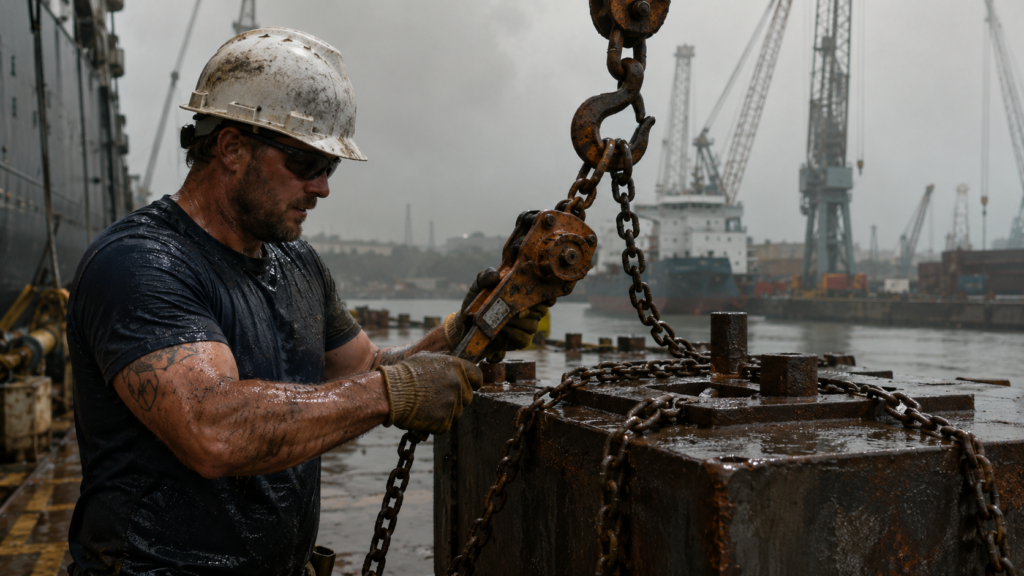
In coastal cities like Santos, Veracruz, or Valparaíso, your equipment is under constant attack from salt and humidity. Here’s what’s happening while you’re not looking:
Your chain is getting thinner. Corrosion eats away at the metal, link by link. Six months in, you might have lost 5-10% of the cross-section. Still “works fine,” right? Until it doesn’t.
Your wire rope is dying inside. The core corrodes first. You can’t see it. But those broken wires you’re finding during inspection? That’s corrosion fatigue, not just wear.
Your gearbox is full of rust. Water gets in somehow (it always does), and now your gears are pitting. That “gritty” feeling? That’s corrosion particles in your oil.
The Salt Spray Special
If you’re within 5 km of the ocean, you’re in the “marine environment” zone. Corrosion happens 5-10× faster here. Your options:
- Galvanized everything. Chains, shackles, wire rope. Non-negotiable.
- Stainless steel hooks. 316 grade, minimum.
- Fresh water rinse. Weekly. Yes, every week. Salt loves to hide in chain links and gear teeth.
- Sealed gearboxes. IP66 rating. If water can get in, it will.
🔧 Pro tip: That white powdery stuff on your galvanized chain? That’s white rust — zinc oxide. It means active corrosion. Don’t wait. Treat it now.
Wind: The Invisible Hand Pushing Your Load
When the Air Itself Becomes a Load
Here’s something that catches people off guard: wind doesn’t just make operation “difficult.” It actually adds load to your crane.
Think about it. You’re lifting a 10 m² panel. A 40 km/h wind creates roughly 400 N of force on that panel. Doesn’t sound like much, right? But that force creates a moment — a rotational force — on your crane. Now you’re not just lifting; you’re also trying to resist being pushed over.
The Wind Speed Rules (Don’t Argue With Physics)
- 0-20 km/h: Business as usual.
- 20-35 km/h: Slow down. Reduce load if you can. Stay alert.
- 35-50 km/h: Only essential lifts. Get engineering sign-off.
- 50+ km/h: Stop. Secure everything. Go have coffee.
Patagonia Is Its Own Beast
If you’re working in southern Argentina or Chile, you already know: the wind doesn’t stop. Average 30-50 km/h, gusts over 100 km/h. You might get 4-6 hours of lifting window per day.
Your move:
- Anemometers everywhere. You can’t manage what you don’t measure.
- Auto-shutdown. Set it at 40 km/h. Don’t rely on operator judgment when they’re cold and tired.
- Tag lines. Two people with ropes can control a lot of swing.
- Early morning lifts. Wind usually calms down before sunrise. Use that window.
The Sun Is Trying to Kill Your Slings
UV: The Silent Strength Thief
You left your polyester sling outside for a few months. Now it looks… different. The color is faded. The surface feels chalky. It’s stiffer than it used to be.
Bad news: that sling just lost 20-30% of its strength. And no, you can’t “recondition” it. UV damage is permanent.
Here’s the UV damage leaderboard:
- Polyester: Moderate resistance. Still dies if you abuse it.
- Nylon: Poor resistance. Don’t even think about leaving it outside.
- Polypropylene: Terrible. Just… don’t.
How to Not Destroy Your Slings
- Store them properly. Opaque bags. Covered containers. Out of the sun.
- Rotate inventory. Don’t let the same sling take all the UV hits.
- Inspect monthly. Chalking, fading, stiffness = retirement time.
- Buy UV-stabilized versions. They cost more. So does replacing slings every 3 months.
⚠️ Hard truth: If your sling looks damaged from UV, it is damaged. Don’t “test” it by lifting a load. Just replace it.
Your Region, Your Rules
Look, Latin America isn’t one climate. It’s five or six completely different environments packed into one continent. Here’s your cheat sheet:
Amazon Basin: Humidity is your enemy. Seal everything. Inspect weekly. Expect biological growth (yes, mold on your equipment).
Atacama Desert: Heat and UV will cook your gear. High-temp lubricants. Sealed gearboxes. Shade when possible.
Patagonia: Wind is the boss. Plan around it. Don’t fight it.
Coastal Cities: Salt corrosion is constant. Rinse weekly. Galvanize everything.
High Altitude: UV is intense, temps swing wildly. Cold-weather lubricants. UV protection.
The Bottom Line
Weather isn’t just “background noise.” It’s actively degrading your equipment right now. The question isn’t whether it’s affecting you — it’s how much you’re willing to spend to fix the damage later versus preventing it now.
A $50 bag of the right grease. A weekly rinse routine. Storing slings indoors. These aren’t “nice to haves.” They’re the difference between equipment that lasts 5 years and equipment that fails in 1.
Your call.