Spring balancers suspend industrial tools and deliver adjustable counterbalancing force to cut down the load borne by operators’ hands.
Heavy handheld tools are core equipment for modern manufacturing, assembly, equipment maintenance and metalworking workflows. Chain blocks, lever hoists, grinders, riveters, welding torches and electric torque tools help workers complete high-intensity tasks efficiently.
Even if a tool only weighs a few kilograms, repeatedly lifting, shifting and adjusting it over an entire shift imposes massive physical strain. Sustained muscle tension, repetitive movements, awkward working postures and prolonged static gripping are widely recognized ergonomic hazards by the CDC (Centers for Disease Control and Prevention).
Spring balancers for heavy tools deliver a mature solution. Mounted overhead at workstations, they suspend tools via retractable steel wire ropes and generate constant upward force to offset the tool’s dead weight. Operators can move the tool freely within its travel range without bearing the full weight at all times.
What Is a Spring Balancer?
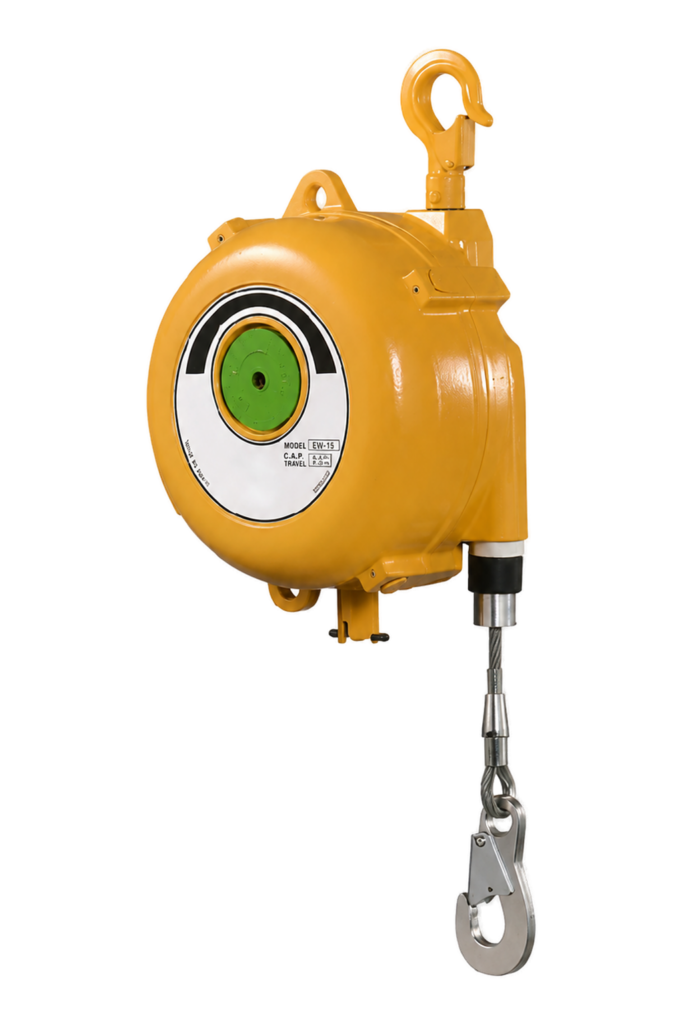
A spring balancer is an auxiliary lifting and tool holding device for industrial workstations, designed to suspend handheld equipment off the ground.
Unlike standard hoists built for lifting general cargo, its key functions focus on:
- Counteracting the self-weight of working tools
- Reducing downward load on operators’ arms
- Enabling vertical lifting and lowering of tools within a set travel range
- Mounting tools overhead or beside workstations for instant access
- Providing controlled retraction and stationary hovering of tools
Overhead Support Bracket
│
▼
┌─────────────────┐
│ Spring Balancer │
└─────────────────┘
│
│ Steel Wire Rope
│
↑ Upward Counterbalance Force
│
↓ Tool Dead Weight
│
┌─────────────────┐
│ Handheld Working Tool │
└─────────────────┘
Operational Pain Points Caused by Heavy Handheld Tools
Workers can tolerate heavy industrial tools for short periods, yet fatigue becomes severe after hundreds of lifting, lowering and repositioning cycles per production shift. Multiple factors compound physical strain:
Static Gripping Operations
When operators hold tools in a fixed position for extended periods, shoulder, arm and hand muscles remain constantly tensed even without active movement. Long-term static gripping leads to muscle strain and restricted local blood circulation (CDC).
Repeated Lifting & Repositioning
Assembly staff frequently move tools from standby positions to workpieces. After thousands of repetitions, cumulative strain develops — especially when working above waist or shoulder height.
Awkward Working Postures
When processing vertical components, overhead parts or confined internal equipment spaces, workers often bend wrists, hunch shoulders or extend arms far forward. Non-standard postures require significantly more muscle exertion than neutral ergonomic positions.
Tool Vibration & Torque Kickback
Electric and pneumatic tools transmit vibration and reverse torque to operators during operation. While spring balancers cut weight load, they cannot eliminate vibration or torque recoil. Auxiliary accessories such as torque reaction arms, reaction brackets, matched tool fittings and workstation modifications are required as supplementary support.
Core Advantages of Spring Balancers for Heavy Tools
1. Dramatically Reduces Manual Load Bearing
The primary function of spring balancers is transferring nearly all tool weight to the overhead support structure.
Operators only guide and position the tool instead of supporting its full dead weight, making them ideal for repetitive assembly, tightening, grinding and riveting workflows. Industry manufacturers universally state that spring balancers free operators from heavy manual load and allow unrestricted vertical movement of suspended tools.
2. Maintains Ergonomically Neutral Working Postures
Properly installed balancers hold tools at optimal working heights. Workers eliminate constant reaching for tools from workbenches, floors or material racks.
Tools stay within a comfortable operating zone, minimizing overreaching, shoulder elevation and wrist twisting — fully aligning with OSHA ergonomic guidelines that reduce physical exhaustion and posture-related injuries through tool and workstation upgrades.
3. More Precise Tool Movement & Positioning
When spring tension is matched to suspended load, operators only need minimal force to raise or lower tools.
This suits processes demanding high positioning accuracy: bolt tightening, component assembly, spot welding, riveting, grinding & polishing, drilling and multi-point cyclic workpiece machining.
Non-recoil balancer models maintain consistent retraction force and lock tools stationary at any height within the travel stroke (Chicago Pneumatic).
4. Keeps Workstations Tidy & Organized
Tools hang suspended rather than resting on benches or floors, eliminating clutter from scattered tools, air hoses and cables that crowd operating space.
When released, tools remain fixed within a designated work zone without resting on workpieces, fixtures or surrounding machinery.
5. Mitigates Risks of Tool Dropping & Impact Damage
Compliant spring balancers maintain a permanent connection between tools and overhead mounting hardware, drastically lowering incidents of dropped tools damaging workpieces or equipment.
Important Note: Balancers do not replace standard safety protocols. Secondary safety slings/chains, load-rated mounting anchor points and regular equipment inspections are all mandatory.
Illustration Suggestion 3: Side-by-Side Comparison Photo – Operator Manually Holding Heavy Grinder vs. Grinder Suspended by Spring Balancer
Image Alt Text: Comparison of manual heavy tool operation and assisted operation with spring balancer
List of Industrial Hand Tools Compatible with Spring Balancers
Spring balancers support a wide range of industrial handheld processing equipment:
表格
| Equipment Type | Core Function | Balancer Benefit |
|---|---|---|
| Chain Lever Hoists | Reduce tool load | Eliminate manual weight bearing |
| Heavy Assembly Fixtures | Component positioning & machining | Smooth controlled vertical lifting/lowering |
Official product catalogs from all major balancer manufacturers list compatible gear: pneumatic power tools, assembly torque equipment, spray guns, riveters, torque wrenches, grinders & polishers, spot welding torches.
Application Case: Full Vehicle Automotive Assembly Line
Workers on automotive assembly lines continuously use electric and pneumatic torque wrenches throughout each shift.
Workflow Without Spring Balancers
- Pick up torque tool
- Lift tool to bolt fastening position
- Align socket by hand
- Complete tightening operation
- Lower tool
- Place tool back on workstation bench
- Move to next vehicle/workpiece and repeat cycle
Workflow With Correctly Sized Spring Balancers
Tools hover permanently near the working area. Operators only push the tool to bolt positions and complete fastening; tools automatically hover in place when released. No continuous dead weight support required.
While balancers may not directly boost overall line speed, they eliminate redundant pick-and-place tool movements and drastically reduce repetitive motion fatigue, sustaining consistent performance across long shifts.
Illustration Suggestion 4: On-site Photo – Spring Balancer Mounted Over Wheel Assembly Station Suspending Impact Wrench
Image Alt Text: Industrial spring balancer paired with impact wrench on automotive assembly production line
Selection Guide for Spring Balancers for Heavy Tools
Accurate sizing is critical: undersized balancers cannot stably support tools, while overrated units with improperly adjusted tension cause dangerous uncontrolled upward tool pull.
1. Calculate Total Suspended Load Weight
Do not only measure the bare tool weight. Total suspended mass includes all permanently attached hardware moving with the tool:
Main handheld tool body, sockets/clamping heads, tool connection brackets, pipe fittings, suspended air hose sections, suspended cables and all permanent auxiliary attachments.
Manufacturer standards require the full combined weight of tool and accessories to fall within the balancer’s rated load range.
2. Verify Rated Load Range
Every spring balancer is marked with a minimum and maximum compatible weight. The full suspended load must sit between these two values.
Example: A balancer rated for 9–15kg cannot support a 6kg lightweight tool nor a full assembly weighing 18kg.
Always reference the official manufacturer selection chart — never purchase solely based on maximum load capacity.
3. Confirm Required Steel Wire Travel Stroke
Measure the full vertical operating range: lowest standby position of the tool, maximum machining height and minimum machining height.
The selected balancer’s wire rope stroke must fully cover the entire working vertical distance; never extend the cable beyond its rated travel limit.
4. Consider Tool Movement Direction
Most spring balancers are designed for vertical lifting/lowering only. Aggressive horizontal pulling accelerates wear on cable guides, steel wire ropes and the balancer housing.
Workstation layout must ensure the wire rope stays as vertical as possible during operation.
5. Evaluate Operating Environment Conditions
Check whether the workstation presents harsh conditions including welding sparks, metal dust, high humidity, paint/chemical corrosive media, high-frequency continuous operation, outdoor exposure or corrosive gas environments.
For demanding environments, select models with specialized housing materials, heavy-duty abrasion-resistant steel cables and reinforced safety structures per manufacturer specifications.
Balancer Selection Checklist
表格
| Selection Parameter | Required Verification Details |
|---|---|
| Total suspended assembly weight | Mass of tool, working heads, cables, air hoses and all fittings combined |
| Operating travel stroke | Maximum vertical distance the tool needs to lift/lower |
| Mounting height | Vertical distance from overhead support point to working zone |
| Usage frequency | Intermittent use, standard daily use, 24-hour continuous duty |
| Operating environment | Dust, moisture, welding sparks, chemical or corrosive agents |
| Tool movement pattern | Vertical-only travel / mixed vertical + horizontal movement |
| Mandatory safety features | Secondary safety sling, rope wheel lock, anti-drop structure |
Frequently Asked Questions (FAQ)
Can spring balancers make heavy tools completely weightless?
They cannot alter the tool’s actual physical mass. They only generate upward counterbalancing force to offset dead weight and drastically reduce the perceived load on operators.
Can one balancer be used with multiple different tools?
Yes, provided the full combined weight of each tool assembly stays within the balancer’s rated load range. Spring tension recalibration is required after switching tools.
Do air hoses and cables count toward total suspended load?
All air hoses, cables, connectors and fittings suspended by the balancer that move with the tool must be included in total load weight calculations.
Can spring balancers be mounted on sliding overhead rails?
For workstations requiring wide horizontal movement, balancers can be fitted to compliant overhead trolley rails or mobile carts. The rails, trolleys and anchor connections must meet full load requirements for the operating conditions.
Can spring balancers replace standard lifting hoists for cargo transport?
Spring balancers are engineered exclusively for suspending workstation tools and are not recommended as general lifting hoists for cargo. Cargo lifting is only permitted if explicitly authorized in writing by the original equipment manufacturer.
How often should steel wire ropes be inspected?
Inspection cycles are determined by usage frequency, environmental conditions and official manufacturer guidelines. For high-frequency operation, dusty, corrosive or spark-prone environments, inspection intervals must be shortened.
Conclusion
Heavy handheld tools are essential for industrial production, yet sustained load bearing creates severe repetitive strain and long-term physical fatigue for operators.
Properly sized spring balancers for heavy tools transfer nearly all tool weight to overhead support structures. Operators only apply light force to shift and position tools, while equipment remains accessible and suspended close to work zones at all times.
Key Operational Benefits Summary
- Significantly reduces manual load on workers’ hands and arms
- Enables effortless vertical lifting/lowering and precise tool positioning
- Maintains clean, organized workstation layout
- Eliminates repetitive strain from constant tool lifting and setting down
- Compatible with high-weight, high-cycle processing tools
- Delivers consistent, uniform handling performance for mass production lines