When procurement engineers in Mexico City specify slings for a new assembly line, or safety managers in São Paulo review lifting plans for a construction project, three terms appear repeatedly on equipment nameplates and test certificates: Rated Load, Breaking Load, and Safety Factor. These are not interchangeable marketing phrases — they represent precisely defined engineering parameters with direct implications for operational safety and regulatory compliance. This lifting equipment load terminology guide demystifies each concept, explains how they relate mathematically, and clarifies what they mean for daily operations under standards like EN 1492-1, ASME B30.9, and Latin American regulations including NR-11 and NOM-151.
Rated Load (WLL): The Operational Limit
Definition
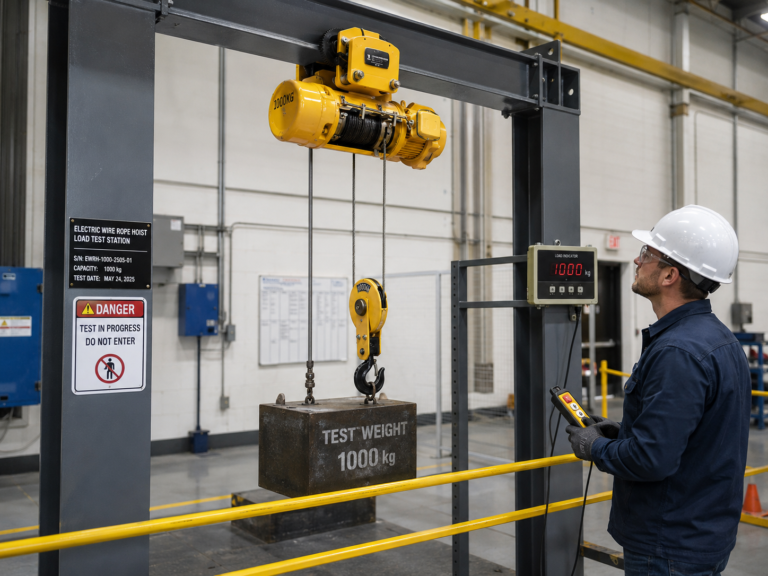
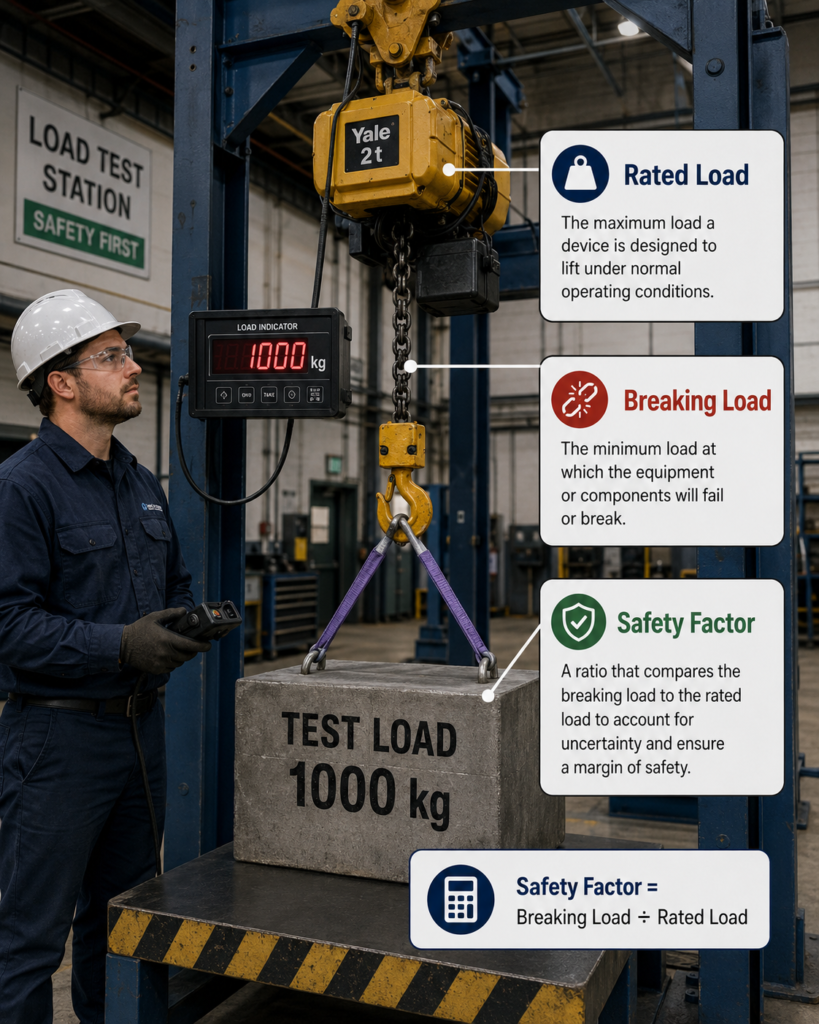
Rated Load, also called Working Load Limit (WLL), is the maximum mass that a lifting device is designed to lift safely under normal service conditions. It is the number you see stamped on the equipment nameplate and the value you must never exceed during operation.
- Synonyms: WLL, SWL (Safe Working Load), Rated Capacity
- Units: Tonnes (T), kilograms (kg), or pounds (lbs)
- Where to find it: Equipment nameplate, test certificate, manufacturer documentation
Key Characteristics
- It is NOT the maximum the equipment can hold — it is the maximum you should lift
- Already accounts for normal dynamic effects (starting, stopping, swinging)
- Assumes proper use: correct hitch configuration, within temperature range, no sharp edges
- Applies to the equipment in new condition — wear reduces actual capacity
Real-World Example
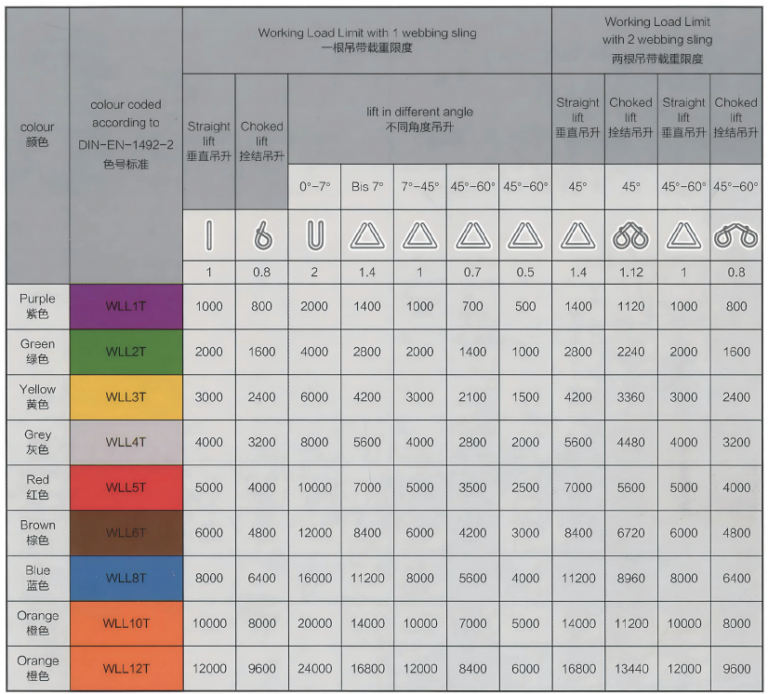
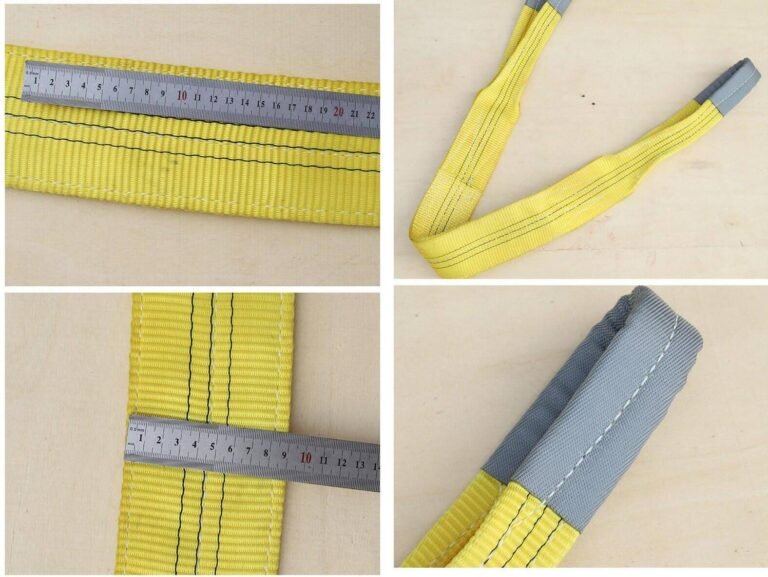
A polyester webbing sling marked WLL = 2T means:
- You may lift loads up to 2,000 kg with this sling
- This assumes vertical hitch, temperature between -40°C and +100°C, no chemical exposure
- If you use a choker hitch, the WLL is reduced (typically to 75% = 1.5T)
- If the sling has visible damage, the actual safe capacity may be lower
CRITICAL RULE: Never exceed the WLL. Doing so voids all safety certifications, violates NR-11 and NOM-151 regulations, and creates immediate risk of equipment failure and personnel injury.
Breaking Load (MBL): The Physical Limit
Definition
Breaking Load, also called Minimum Breaking Load (MBL) or Ultimate Strength, is the force at which the equipment physically fails — the point where the material tears, the wire rope snaps, or the hook deforms permanently.
- Synonyms: MBL, Ultimate Tensile Strength, Breaking Strength, Minimum Burst Load
- Units: Tonnes (T), kilograms (kg), kilonewtons (kN), or pounds (lbs)
- How it’s determined: Destructive testing of sample units per EN 1492-1 or ASME B30.9
Key Characteristics
- This is a destructive test — the tested sample is ruined
- Represents the lower bound of failure strength (minimum, not average)
- You should NEVER approach this value in operation
- Used primarily for engineering design and safety factor calculation
Real-World Example
The same 2T WLL polyester sling might have:
- MBL = 12T (12,000 kg)
- This means in laboratory testing, the sling didn’t break until loaded to at least 12 tonnes
- The ratio between MBL and WLL defines the safety factor (see below)
Proof Load: The Middle Ground
Between WLL and MBL exists a third value: Proof Load
- Definition: A load higher than WLL but lower than MBL, applied during factory testing
- Purpose: Verify equipment integrity without causing damage
- Typical value: 1.25× to 2× WLL (depending on standard)
- Result: Equipment that passes proof load test is certified for service
| Load Type | Typical Value (for 2T WLL sling) | Purpose |
|---|---|---|
| WLL (Rated Load) | 2T | Maximum operational load |
| Proof Load | 2.5T – 4T | Factory verification test |
| MBL (Breaking Load) | 12T | Physical failure point |
Safety Factor: The Engineering Margin
Definition
Safety Factor (also called Design Factor or Safety Coefficient) is the ratio between Breaking Load and Rated Load. It represents the engineering margin built into the equipment to account for uncertainties in loading, material properties, and operating conditions.
Formula:
Safety Factor = MBL / WLL
Typical Safety Factors by Equipment Type
| Equipment | Typical Safety Factor | Governing Standard |
|---|---|---|
| Wire rope slings | 5:1 | EN 13414-1, ASME B30.9 |
| Synthetic web slings | 7:1 | EN 1492-1, ASME B30.9 |
| Chain slings | 4:1 | EN 818-2, ASME B30.9 |
| Hooks | 4:1 | EN 1677-1, ASME B30.10 |
| Shackles | 5:1 | EN 13889, ASME B30.26 |
| Wire rope (static) | 5:1 to 10:1 | EN 12385, application-dependent |
Why Different Safety Factors?
The variation reflects different risk profiles:
- Synthetic slings (7:1): Higher factor because material properties are more sensitive to UV, chemicals, temperature, and abrasion — more unknowns in field conditions
- Chain slings (4:1): Lower factor because chain is more durable, inspectable, and predictable in behavior
- Wire rope (5:1-10:1): Varies by application — elevators (10:1) have higher consequences than general lifting (5:1)
Real-World Calculation
For a synthetic web sling with:
- WLL = 2T
- Safety Factor = 7:1
The Minimum Breaking Load is:
MBL = WLL × Safety Factor = 2T × 7 = 14T
This means the sling won’t break until loaded to at least 14 tonnes — 7 times the maximum you should ever lift with it.
How These Values Relate: The Complete Picture
The Load Hierarchy
Understanding the relationship between these three values is fundamental to safe lifting operations:
For Operators:
- Only the WLL matters for daily operations
- Never ask “how much can it really hold?” — the answer is irrelevant and dangerous
- If equipment has no legible WLL marking, remove it from service
For Procurement:
- Specify WLL based on your maximum load + any derating factors (angle, temperature)
- Safety factor is determined by equipment type and standard — not negotiable
- Request test certificates showing MBL verification
For Safety Managers:
- WLL must be clearly marked and visible to operators
- Regular inspection ensures actual capacity hasn’t degraded below WLL
- Training must emphasize that WLL ≠ Breaking Load
Common Misconceptions
| Misconception | Reality |
|---|---|
| “Safety factor 7:1 means I can overload by 7×” | NO — Safety factor is design margin, not operational allowance |
| “If it held 3T without breaking, WLL must be 3T” | NO — WLL is determined by design, not field testing |
| “Higher safety factor = better quality” | Not necessarily — different equipment types have appropriate factors; 4:1 chain is not inferior to 7:1 synthetic |
| “WLL is the same as proof load” | NO — Proof load is a test value; WLL is the operational limit |
Latin American Regulatory Context
NR-11 (Brazil)
Brazil’s NR-11 regulation requires:
- All lifting equipment must display WLL clearly
- Safety factors must comply with manufacturer specifications and applicable standards
- Annual inspection must verify equipment integrity relative to WLL
NOM-151-STPS (Mexico)
Mexico’s NOM-151 mandates:
- Equipment must be used within rated capacity
- Safety factors must meet or exceed industry standards (typically ASME B30.9 for slings)
- Operators must be trained on load limits and consequences of overloading
NCh 2245 (Chile)
Chilean standard NCh 2245 references international standards and requires:
- Clear marking of WLL on all lifting devices
- Periodic verification that equipment remains within rated capacity
- Documentation of safety factors for engineering calculations
🔧 MANDATORY PRACTICE: Before any lift, verify that the load weight is known and does not exceed the WLL of every component in the lifting system (slings, shackles, hooks, crane). The system WLL is determined by its weakest link.
Conclusion
Rated Load (WLL), Breaking Load (MBL), and Safety Factor are not abstract engineering concepts — they are the foundation of safe lifting operations. WLL defines what you may lift, MBL defines where failure occurs, and Safety Factor defines the margin between them. Understanding these terms ensures compliance with NR-11, NOM-151, and international standards while protecting personnel and equipment. The key takeaway is simple: always operate within WLL, never test the limits of MBL, and trust that the Safety Factor provides the margin you need for safe, predictable performance.