In steel fabrication shops, manufacturing plants, and construction sites across Latin America—from the industrial corridors of Monterrey to the port facilities of Santos and the mining workshops of Santiago—the safe and efficient handling of heavy steel plates, blocks, and components is a daily operational necessity. Traditional methods using chains, slings, or mechanical clamps can be time-consuming, labor-intensive, and pose significant safety risks.
The permanent magnetic lifter—also known as a magnetic lifting magnet or PML magnetic lifter—offers a compelling alternative. Compact, self-contained, and requiring no external power source, these devices use the intrinsic force of high-strength permanent magnets to grip and lift ferrous materials with a simple lever action. This guide provides a comprehensive introduction to permanent magnetic lifters, covering their working principles, types, applications, selection criteria, and key safety standards including ASME B30.20, OSHA regulations, and regional LatAm requirements such as Brazil NR-11 and Mexico NOM-151.
1. What Is a Permanent Magnetic Lifter?
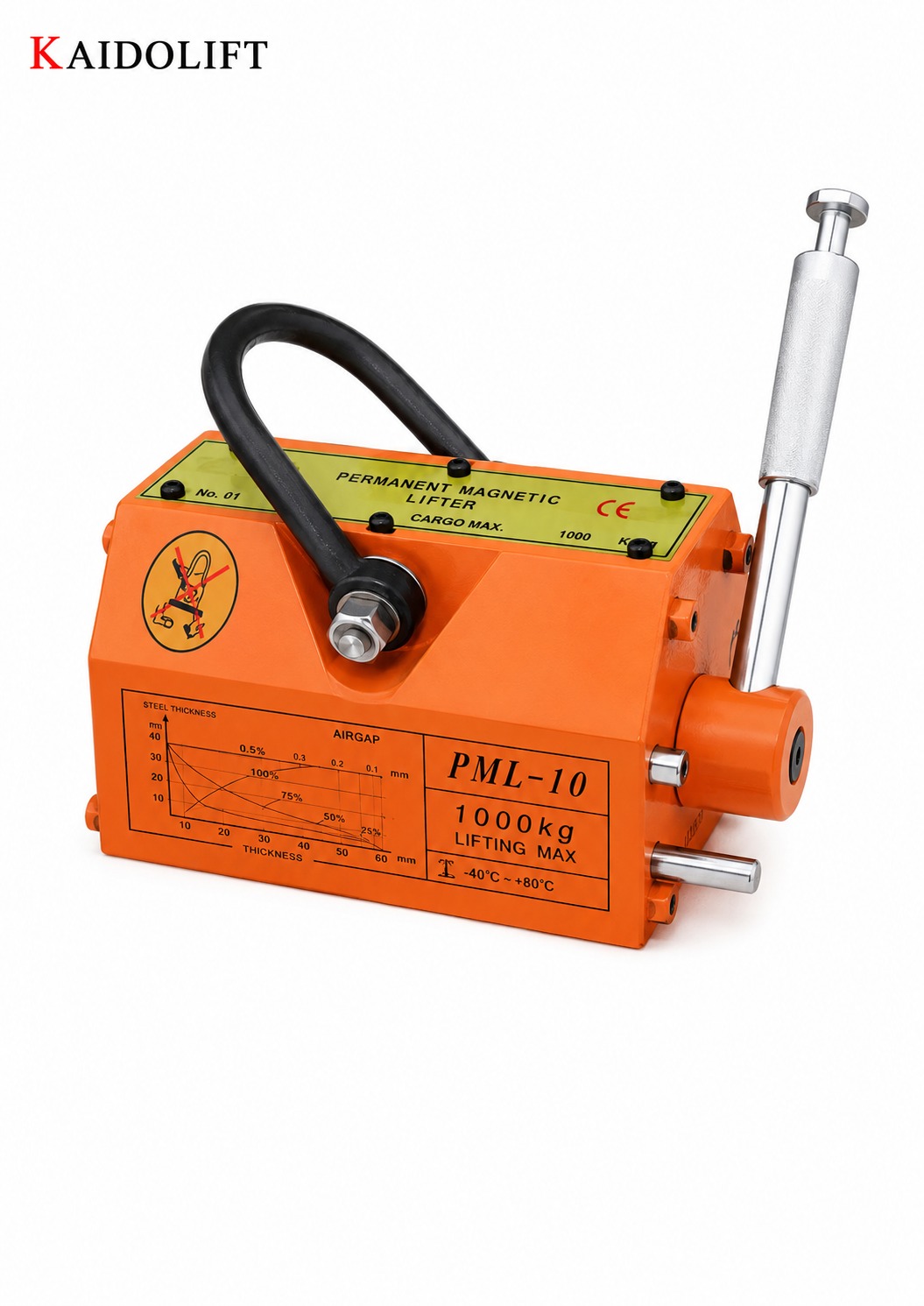
A permanent magnetic lifter is a below-the-hook lifting device that uses the force of permanent magnets—typically made from high-grade neodymium (Nd-Fe-B) or ferrite materials—to attract, hold, and lift ferromagnetic workpieces. Unlike electromagnetic lifters that require a continuous electrical current to generate a magnetic field, permanent magnetic lifters have a fixed magnetic field that is mechanically switched on or off.
The device consists of:
- A magnetic circuit containing high-performance permanent magnets
- A manual handle or lever that rotates the internal magnet assembly to open or close the magnetic circuit
- A housing (typically steel or aluminum) that protects the magnetic components
- A lifting eye or shackle at the top for connection to a crane hook or hoist
When the operator places the lifter on a ferrous surface and turns the handle to the “ON” position, the internal magnets align to create a closed magnetic circuit through the workpiece, generating a powerful holding force. Turning the handle to “OFF” redirects the magnetic flux internally, releasing the load.
🔧 MANDATORY PRACTICE: The lifter must always be placed on the ferrous surface in the “OFF” position before switching it to “ON.” Never switch the magnet to “ON” when it is not in contact with a ferrous workpiece.
2. Types of Magnetic Lifters: Permanent vs. Electromagnetic vs. Electro-Permanent
Three primary magnet types are used for material handling: permanent, electromagnetic, and electro-permanent. Understanding the differences is essential for selecting the right equipment.
PML Permanent Magnetic Lifter
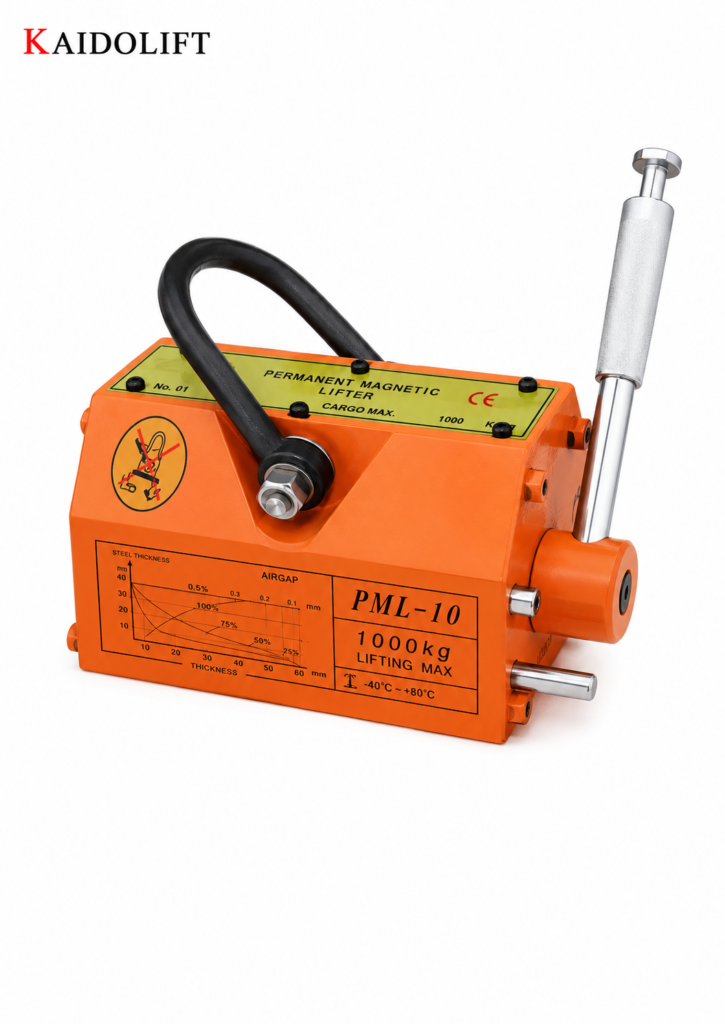
The PML Permanent Magnetic Lifter (widely recognized in global industrial supply chains as the Magnetic Lifting Magnet, and specified by engineers across Latin America as Elevador magnético) is a heavy-duty, electricity-free material handling solution engineered for elite rigging, metalworking, and warehouse logistical workflows. Utilizing ultra-high-grade Neodymium rare-earth magnets, this manual steel lifter requires zero external electrical power, mitigating operational failure risks during sudden factory blackouts.
Permanent Magnetic Lifters
How They Work: Use high-strength permanent magnets (neodymium or ferrite) to generate lifting force. The magnetic field is mechanically switched on or off by rotating a handle or lever.
| Feature | Detail |
|---|---|
| Power Source | None—completely self-contained |
| Magnetic Force | Fixed and constant once engaged |
| Safety Behavior | Maintains holding strength even during power failure |
| Typical Capacity | 100 kg to 5 tons |
| Maintenance | Minimal—no electrical components |
| Best For | General shop use, moderate capacities, facilities without electrical power at the lifting point |
Electromagnetic Lifters
How They Work: Generate a magnetic field when electrical current flows through copper coils inside the device. Turning the current off releases the load.
| Feature | Detail |
|---|---|
| Power Source | Requires electrical power (AC, DC, or battery-assisted) |
| Magnetic Force | Adjustable based on load size |
| Safety Behavior | Power loss can release the load unexpectedly without battery backup |
| Typical Capacity | 500 kg to 30+ tons |
| Maintenance | Focuses on coils, wiring, and control units |
| Best For | High-volume, continuous operations where speed and precision matter |
Electro-Permanent Lifters
How They Work: Combine permanent magnets with an electric coil. An electric impulse lasting a few seconds magnetizes or demagnetizes the system. Once switched, the magnet remains “on” or “off” without continuous power.
| Feature | Detail |
|---|---|
| Power Source | Brief electric impulse for switching only |
| Magnetic Force | Constant once engaged; no power needed to maintain hold |
| Safety Behavior | Does not require a safety battery; load remains held even during power failure |
| Typical Capacity | 150 kg to 2,400 kg |
| Maintenance | Low—no continuous power consumption, no heat generation |
| Best For | Applications requiring the safety of permanent magnets with remote or automated switching |
⚠️ CRITICAL NOTICE: Permanent magnets are maintenance-free and energy-efficient, while electromagnets offer more control but require power. Electromagnetic lifters without battery backup pose a safety risk: a power failure can release the load unexpectedly.
3. How Does a Permanent Magnetic Lifter Work?
The operating principle of a permanent magnetic lifter is based on magnetic circuit switching—a clever mechanical method of redirecting magnetic flux.
The Magnetic Circuit
Inside the lifter housing, multiple high-strength permanent magnets are arranged with alternating polarity. This arrangement concentrates the magnetic field close to the surface of the lifter. The handle or lever rotates the internal magnet assembly by a small distance—typically just a millimeter or so.
In the “ON” position: The magnets align to create a closed magnetic circuit that passes through the ferrous workpiece. The magnetic flux travels from the magnet, through the magnet-conductive plate, into the workpiece, and back to the magnet, generating a powerful holding force.
In the “OFF” position: The internal magnets rotate to redirect the magnetic flux internally within the lifter housing. With no magnetic field extending outside the housing, the lifter releases the workpiece.
This switching mechanism makes permanent magnetic lifters bistable—they remain in either the “ON” or “OFF” state without any external power input.
Key Operational Steps
- Position: Place the lifter on the ferrous workpiece with the handle in the “OFF” position.
- Engage: Press the safety button (if equipped) and turn the handle from “OFF” to “ON”.
- Lock: Ensure the handle is fully locked in the “ON” position before lifting.
- Lift: Attach the crane hook to the lifting eye and lift the load.
- Release: After positioning the load, turn the handle from “ON” to “OFF” to release.
⚠️ CRITICAL NOTICE: Empty loading (operating the lifter without a load) is strictly prohibited. Never strike or impact the permanent magnetic lifter during operation, as this may affect its performance.
4. When Should You Use a Permanent Magnetic Lifter?
Permanent magnetic lifters are ideal for a wide range of applications involving ferromagnetic materials.
Suitable Materials
Permanent magnetic lifters are designed for ferromagnetic materials:
- Mild steel and carbon steel
- Low-alloy steel
- Cast iron (depending on composition)
Materials that are generally unsuitable:
- Aluminum, copper, brass, and non-ferrous alloys
- Austenitic (non-magnetic) stainless steel
🔧 MANDATORY PRACTICE: Even among steels, magnetic performance can vary depending on material composition. Before purchasing a magnetic lifter, confirm the exact material specification of the loads being handled.
Common Applications
Steel Fabrication and Metalworking
- Lifting and transporting steel plates, blocks, bars, and fabricated components
- Moving plates from cutting tables
- Transferring steel components between workstations
- De-stacking sheet material where clamps and slings would slow production
Manufacturing
- Handling machine parts, press molds, and punch molds
- Feeding materials into production lines
- Moving fabricated assemblies
Construction and Infrastructure
- Handling steel beams, pipes, and structural components
- Moving manhole covers
Warehousing and Logistics
- Loading and unloading steel materials
- Handling steel coils (magnetic coil lifters attach to the top of the coil, allowing coils to be stored closer together)
Shipbuilding and Heavy Engineering
- Handling steel plates and sections in shipyards
- Moving large fabricated components
Specialized Environments
Permanent magnetic lifters are particularly valuable in:
- Fire and explosion-proof environments (no electrical sparks)
- Remote locations without reliable electrical power
- Outdoor operations where power access is limited
5. Key Selection Factors
Selecting the right permanent magnetic lifter requires more than simply matching the load weight to the lifting capacity.
Load Weight and Working Load Limit (WLL)
The starting point is determining the maximum weight of the loads being lifted. Always ensure the magnetic lifter’s Working Load Limit (WLL) exceeds the weight of the intended load and takes into account real-world operating conditions.
Common capacity ratings: 100 kg, 300 kg, 500 kg, 600 kg, 1,000 kg, 2,000 kg, 3,000 kg, and up to 5,000 kg.
⚠️ CRITICAL NOTICE: Never exceed the rated capacity. Overloading can cause the load to drop, resulting in serious injury or death.
Material Thickness
One of the most important factors affecting magnetic lifting performance is material thickness. Magnetic force travels through the material being lifted. If the material is too thin, it cannot carry the full magnetic flux generated by the lifter.
For example, a magnetic lifter rated for 1,000 kg on thick steel plate may achieve significantly lower lifting performance on thinner materials. Some lifters are specifically designed for thin plate (as low as 5mm thickness) and removing single sheets from a stack.
Load Shape and Geometry
Different load geometries affect magnetic performance:
- Flat steel plates—standard magnetic lifters work well
- Round bar, pipes, and tubes—some lifters are engineered to handle both flat and round loads
- Steel blocks—standard configuration
- Fabricated components—may require specialized lifters
Safety Factor
Quality permanent magnetic lifters incorporate a safety factor—typically 3:1 or 3.5:1. This means the lifter’s maximum pulling force is 3 to 3.5 times greater than its rated lifting capacity. This safety margin provides a buffer against unexpected loads or variations in material properties.
Some manufacturers recommend a more conservative approach: “Never lift more than 33% of the rated capacity” (equivalent to a 3:1 safety factor).
Environmental Factors
Consider the working environment:
- High temperatures—can affect magnet performance
- Outdoor use—may require corrosion-resistant materials
- Corrosive environments—consider protective coatings
- Presence of dirt, scale, or contaminants—can affect surface contact
6. Safety Standards and Regional Compliance
International Standards
ASME B30.20 (Below-the-Hook Lifting Devices) is the primary standard governing lifting magnets. Both permanent and electric-rated lifting magnets fall under the compliance standards established by ASME B30.20-3.
Key ASME requirements include:
- Marking: The rated load must be legibly marked on the lifting magnet or on a tag attached to the lifting magnet where it is visible.
- Inspection: Magnets must be regularly and periodically inspected to ensure they are serviceable.
- Training: Operators must be qualified and trained in the use of the magnet and in performing assessments of materials to be lifted.
OSHA 29 CFR 1910.179 and general duty clause requirements also apply to the use of lifting magnets in the workplace.
Regional Standards: Latin America
For operations in Latin America, the following standards apply:
| Region | Standard | Key Requirements |
|---|---|---|
| Brazil | NR-11 | Equipment must be designed and constructed to provide the necessary guarantees of strength and safety and maintained in perfect working conditions. Training is obligatory for all personnel involved in material handling operations, including the proper usage of PPE. |
| Mexico | NOM-151-SSA1 | Establishes safety requirements for material handling equipment |
| Chile | NCh 2245 | Defines technical specifications for industrial lifting equipment |
⚠️ CRITICAL NOTICE: Under ASME B30.20, lifting magnets must be removed from service if capacity or safety tags are missing. The rated load capacity must be clearly marked and visible on the device.
7. Inspection and Maintenance
Regular inspection and maintenance are essential for safe operation.
Pre-Use Inspection (Daily)
Before each use:
- Visually inspect the entire magnet
- Wipe clean the pole shoes and the surface of the load
- Remove burrs and bumps using a file if necessary
- Check the entire magnet including the hoisting eye and screws for deformations
- Test the handle lock condition and ensure it engages properly
Periodic Inspection
- Regular use: Inspect once every 1–2 months
- All lifting systems: Should be serviced every 12 months by a competent person
Maintenance Best Practices
- Keep the lifting surfaces of the magnet clean, smooth, flat, and free of rust and any foreign materials
- Maintain the pole feet in good condition
- Check the suitability of equipment used in conjunction with the lifter
- Test the adsorption force periodically with small ferromagnetic objects (e.g., nails, bolts). If local adsorption is significantly weaker, magnetic force attenuation may have occurred
Removal from Service
According to ASME B30.20 and OSHA requirements, remove the magnet from service if:
- Capacity or safety tags are missing
- The rated load capacity marking is not visible
- Visible damage to the housing, lifting eye, or switching mechanism
- The handle does not lock securely in the “ON” position
- Magnetic force appears significantly weakened
Conclusion
The permanent magnetic lifter is a versatile, reliable, and safe tool for handling ferrous materials across a wide range of industrial applications. Its key advantages—no external power requirement, consistent holding force, low maintenance, and compact design—make it an ideal choice for steel fabrication, manufacturing, construction, warehousing, and shipbuilding operations.
When selecting a permanent magnetic lifter, consider:
- Load weight—ensure WLL exceeds the maximum load
- Material thickness—thinner materials reduce effective capacity
- Load shape—flat plates, round bars, or fabricated components
- Safety factor—typically 3:1 or higher
- Environmental conditions—temperature, corrosion, contaminants
For operations across Latin America, compliance with ASME B30.20, OSHA regulations, and regional standards such as Brazil NR-11, Mexico NOM-151, and Chile NCh 2245 is essential. Ensure that equipment is properly marked, regularly inspected, and operators are adequately trained. When in doubt, consult the manufacturer’s documentation and follow all safety guidelines.
📋 Need Help Selecting the Right Permanent Magnetic Lifter for Your Operation?
Our material handling team provides free, no-obligation magnetic lifter selection assistance for fabrication shops, manufacturing facilities, and construction operations across Latin America. We can help you:
- Match the right permanent magnetic lifter to your load weight, shape, and material thickness requirements
- Verify ASME B30.20 compliance and NR-11 / NOM-151 / NCh 2245 alignment
- Source lifters with the appropriate safety factor and safety features
- Provide inspection checklists and operator training guidance
[Request Magnetic Lifter Selection Assistance Now] or download our LatAm-Compliant Magnetic Lifter Selection Guide (PDF) with capacity tables, material thickness reference charts, and inspection checklists.