In industrial lifting operations across Latin America, not all loads are uniform. From the fragile precast architectural panels used in high-rise construction to the irregularly shaped machinery components being transported through ports, the diversity of cargo demands a rigging approach that goes beyond simple capacity ratings. The choice between a flat webbing sling and a round synthetic sling—the two primary types of soft lifting slings—can determine whether a valuable load arrives intact or suffers costly damage.
This guide provides a comprehensive framework for selecting the right soft lifting sling for irregular loads. We will examine the unique characteristics of irregular and delicate loads, compare the performance of flat and round slings in these applications, and provide practical selection criteria aligned with EN 1492-1, EN 1492-2, ASME B30.9, and regional LatAm standards including Brazil NR-11, Mexico NOM-151, and Chile NCh 2245.
1. Understanding Irregular and Delicate Loads
Defining Irregular Loads
Irregular loads are those that do not present a uniform, flat, or easily grippable surface for lifting. Common characteristics include:
- Non-uniform geometry: Curved surfaces, tapered sections, or complex contours
- Off-center center of gravity: Uneven weight distribution requiring careful rigging
- Variable cross-sections: Different dimensions along the length of the load
- Protruding components: Flanges, fittings, or attachments that complicate sling placement
Defining Delicate Loads
Delicate loads are those that are susceptible to damage from the lifting process itself. Common characteristics include:
- Surface sensitivity: Finished, painted, polished, or coated surfaces
- Fragile materials: Glass, ceramics, composites, or thin-walled structures
- Precision components: Machined surfaces requiring absolute protection
- Cosmetic requirements: Architectural elements where appearance is critical
The Challenge for Rigging
The intersection of “irregular” and “delicate” creates the most demanding rigging scenario. The load is difficult to securely grip and easily damaged by improper contact. In these situations, the choice of lifting sling is critical.
2. Comparing Soft Lifting Slings: Flat vs. Round
Both flat webbing slings and round synthetic slings offer significant advantages over steel wire rope or chain alternatives for irregular and delicate loads. However, their distinct design characteristics make each type better suited to specific applications.
Webbing Slings (Flat Lifting Slings)
A flat lifting sling consists of a woven polyester webbing with a flat, rectangular cross-section. Load-bearing fibers run parallel along the length of the sling, enclosed within a woven protective jacket.
Strengths for Irregular/Delicate Loads:
- Wide contact area: The flat bearing surface distributes load over a larger area, minimizing point pressure on delicate surfaces
- Excellent surface protection: The soft, woven surface prevents marring and scratching of finished materials
- Superior edge resistance: The flat construction resists cutting at edges better than round slings
- Easy visual inspection: Damage to the woven structure is readily apparent
- Stable lift: The flat profile resists twisting and rolling under load
- High abrasion resistance: Woven construction withstands abrasive contact
Limitations:
- Less flexible in tight spaces: The wide profile can be bulky when threading through narrow lifting points
- Potential for twisting: If not properly aligned, flat slings can twist under load
- Limited conformability: Less able to conform to highly irregular shapes
Round Slings
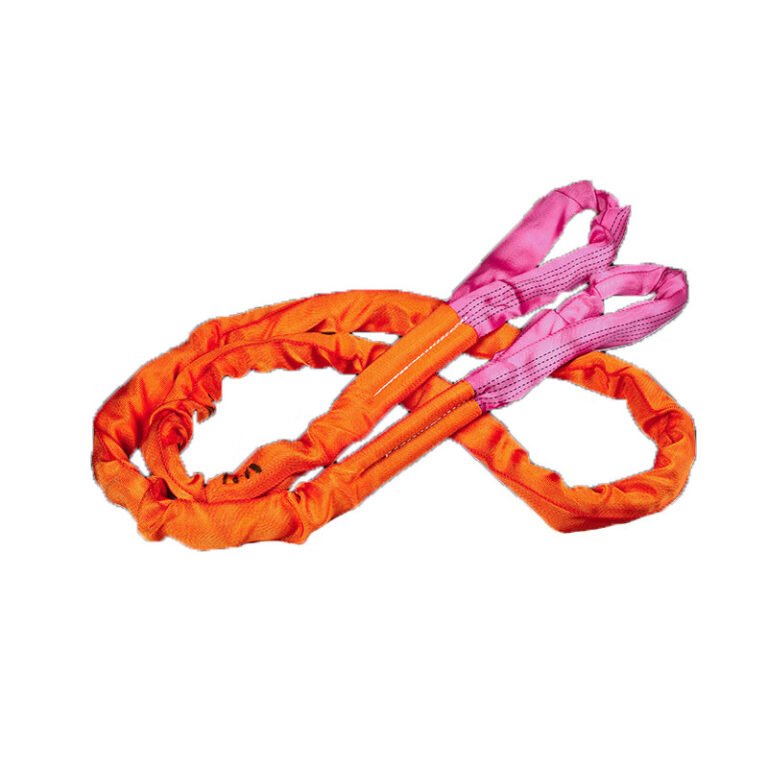
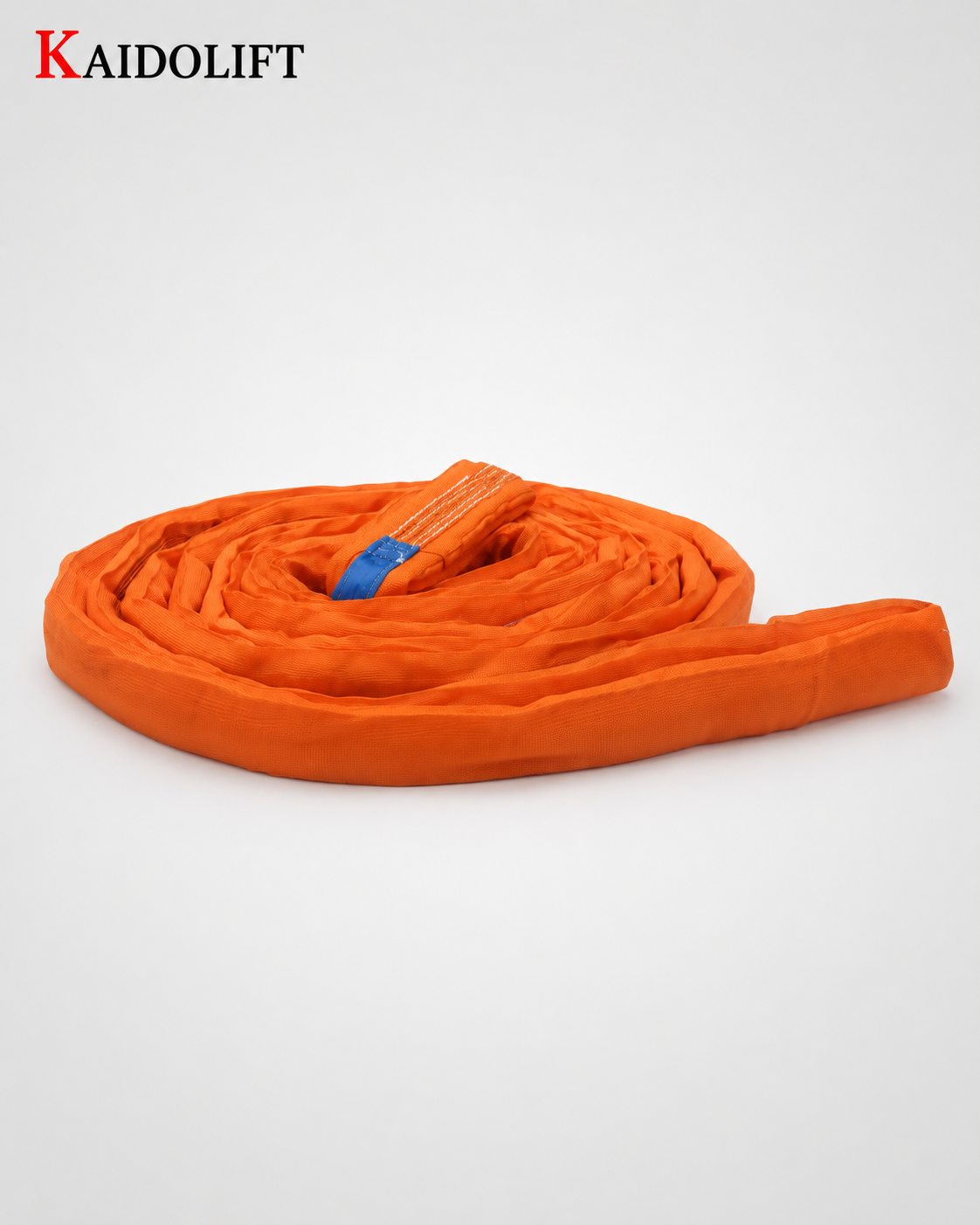
A round synthetic sling consists of a continuous loop of polyester fibers enclosed within a tubular protective cover. The core yarns run continuously, providing strength in all directions.
Strengths for Irregular/Delicate Loads:
- Exceptional flexibility: Conforms easily to irregular shapes and contours
- 360° load contact: The circular cross-section adapts to load geometry from any angle
- Compact profile: Ideal for tight clearances and confined spaces
- Shock absorption: Continuous yarn construction absorbs dynamic loads
- Multi-leg versatility: Excellent in complex lifting arrangements
- No stitching vulnerability: Endless construction eliminates stitch failure points
Limitations:
- Lower abrasion resistance: Protective cover more susceptible to abrasion damage
- Poorer edge resistance: Circular cross-section concentrates pressure on sharp edges
- Internal damage risk: Core damage may not be visible externally
Selection Matrix: Irregular and Delicate Loads
| Application | Webbing Sling | Round Sling |
|---|---|---|
| Precast architectural panels | ✓ Strongly Preferred | Use with edge protection |
| Irregular machinery components | Use with caution | ✓ Preferred |
| Finished/painted surfaces | ✓ Preferred | ✓ Good |
| Glass and ceramic products | ✓ Strongly Preferred | ✓ Good |
| Complex curved surfaces | Use with caution | ✓ Preferred |
| Thin-walled structures | ✓ Preferred | Use with caution |
| Multiple lifting points | Suitable | ✓ Preferred |
| Tight clearance operations | Use with caution | ✓ Preferred |
| High abrasion environment | ✓ Preferred | Use with caution |
🔧 MANDATORY PRACTICE: For loads with both delicate surfaces and irregular shapes, consider using a round sling with protective sleeves to combine the conformability of round slings with the surface protection of webbing.
3. Key Selection Factors
Load Weight and Capacity
The first step in any selection is calculating the total weight of the load. The sling’s WLL must exceed the load weight, accounting for any angle factors in the hitch configuration.
Standard Formula for Basket Hitches:
WLL (at angle) = WLL (Vertical) × Number of Legs × Cos(θ)
Where θ is the angle between the vertical axis and the sling leg.
⚠️ CRITICAL NOTICE: If the angle from vertical exceeds 60°, the Cos(θ) drops below 0.5. This drastically compromises the structural integrity of the lift, and alternative rigging configurations must be deployed immediately.
Surface Protection Requirements
For delicate loads, surface protection is paramount. Webbing slings inherently distribute pressure over a wide area, reducing the risk of surface damage. When using a round sling on a delicate load, additional padding or protective sleeves are recommended.
Surface Protection Options:
| Protection Type | Application | Recommendation |
|---|---|---|
| Standard polyester webbing | General surface protection | Suitable for most finished surfaces |
| PVC coating | Additional surface protection | Protects against fine surface scratches |
| Protective sleeves | Added protection for round slings | Essential for fragile or high-value loads |
| Corner protectors | Preventing sharp edge contact | Required for loads with any sharp edges |
Edge Contact Assessment
Sharp edges are the enemy of all synthetic slings, regardless of type. A sharp steel or concrete edge can compromise a sling’s structural integrity by cutting through the outer layers to the load-bearing fibers.
⚠️ CRITICAL NOTICE: Any sharp or abrasive edge that contacts a soft lifting sling without protection reduces the sling’s effective WLL by up to 50%, regardless of the printed safety factor.
Edge Protection Options:
- Corner protectors: Prevent direct edge-to-sling contact
- Abrasion sleeves: Protect against abrasive surfaces
- Reinforced edge construction: Premium slings with enhanced edge resistance
- Load pads: Cushioning pads that conform to load contours
Flexibility and Conformability
For irregular loads, the sling must conform to the load’s contours to ensure even load distribution and secure contact. Round slings offer superior conformability, while flat slings provide more stability on uniform surfaces.
Conformability Assessment:
| Load Characteristic | Best Sling Type | Reason |
|---|---|---|
| Curved or contoured surfaces | Round sling | Conforms to surface shape |
| Uniform, flat surfaces | Webbing sling | Wide bearing surface provides stability |
| Complex, multi-directional shapes | Round sling | Adapts to all surface angles |
| Highly variable cross-sections | Round sling | Continuous loop design conforms to variations |
Working Length Considerations
The Effective Working Length (EWL) of a sling is the straight-line distance between the bearing points (eyes) when the sling is under tension. For irregular loads, careful length selection is critical:
- Too short: Creates steep angles that significantly increase tension
- Too long: Reduces hook height and introduces load swing
- Mismatched lengths: Unequal leg lengths can cause uneven load distribution
4. Application Examples: Real-World Scenarios
Scenario 1: Precast Architectural Concrete Panel
Load Characteristics: 4-ton curved architectural panel, finished surface requiring absolute protection, embedded lifting points at specific locations.
Recommendation: Webbing sling with wide bearing surface and corner protectors at the lifting points.
Rationale:
- Wide bearing surface protects the finished concrete surface from pressure marks
- Excellent surface protection prevents marring
- Flat configuration provides stability for the panel during lifting
- Designed for precision and damage-free handling
Scenario 2: Irregular Machinery Component
Load Characteristics: 8-ton contoured casting with protruding flanges and fittings, no flat surfaces.
Recommendation: Round sling in basket hitch configuration with protective sleeves at contact points.
Rationale:
- Exceptional flexibility conforms to the irregular shape
- Continuous loop design adapts to multiple contact points
- Protective sleeves prevent damage to the flanges
- No stitching vulnerability eliminates failure points at complex load contact areas
Scenario 3: Architectural Glass or Stone Panel
Load Characteristics: High-value finished stone panel, extremely sensitive to point pressure, thin cross-section.
Recommendation: Webbing sling with full-width load distribution and PVC coating.
Rationale:
- Wide bearing surface minimizes point pressure on delicate material
- Soft surface prevents scratching or marring
- Flat profile provides stable, gentle lifting
- Designed for sensitive and fragile lifting applications
Scenario 4: Wind Turbine Blade Section
Load Characteristics: 12-ton curved composite blade section, fragile material, complex geometry.
Recommendation: Multiple round slings in basket hitch configuration with specialized protective covers.
Rationale:
- Superior conformability to curved blade surfaces
- Continuous yarn construction distributes load evenly along the blade profile
- Multiple sling points accommodate complex geometry
- Protective covers prevent damage to composite material
5. Safety and Inspection Considerations
Pre-Use Inspection Checklist
For both soft lifting slings handling irregular or delicate loads, pre-use inspection is essential:
Webbing Slings:
- Run hands along entire length to detect cuts, snags, or internal damage
- Check for UV degradation (color fading, chalky surface)
- Inspect stitching for loose, broken, or missing stitches
- Verify identification tag is legible and secure
- Examine edges for fraying or fiber separation
- Look for chemical damage (discoloration, stiffness, crumbling)
Round Slings:
- Inspect outer cover for cuts, tears, or abrasion
- Check for visible core yarns (immediate removal)
- Verify identification tag is legible and secure
- Periodically remove cover to inspect core yarns
- Look for melting, glazing, or weld splatter
- Check for chemical damage (discoloration, stiff spots)
Discard Criteria
Both sling types must be removed from service immediately if:
| Condition | Action |
|---|---|
| Missing or illegible identification tag | Immediate removal |
| Cuts penetrating load-bearing yarns | Immediate removal |
| Visible core yarns (round sling) | Immediate removal |
| Acid or caustic burns | Immediate removal |
| Heat damage (melting, glazing, charring) | Immediate removal |
| Width reduction > 10% (≤100mm sling) | Immediate removal |
| Width reduction > 12% (>100mm sling) | Immediate removal |
| Abrasion > 15% of thickness | Immediate removal |
6. Storage and Care for Delicate Load Applications
To maintain the surface protection properties of your soft lifting slings, proper storage is essential:
- Store in a clean, dry, well-ventilated area away from contaminants
- Hang slings on corrosion-resistant, non-metallic pegs
- Keep clear of ground contact, welding stations, and chemical storage
- Protect from UV degradation when not in use
- Never store slings in contact with oils, solvents, or chemicals
- Ensure storage area is free of sharp edges or abrasive surfaces
Conclusion
Choosing the right soft lifting sling for irregular or delicate loads requires a careful assessment of both the load characteristics and the lifting environment.
Choose a webbing sling (flat lifting sling) when:
- Surface protection is the primary concern
- The load has a relatively uniform, flat surface
- Sharp edges require cutting resistance
- Visual inspection must be straightforward
- Stability and non-twisting lifting are required
Choose a round sling when:
- The load has highly irregular shapes or contours
- Maximum flexibility and conformability are needed
- Lifting points are complex or multi-directional
- Space and clearance are limited
- Multi-leg configurations require adaptability
For loads that are both irregular and delicate, consider:
- A round sling with protective sleeves for maximum conformability and surface protection
- A webbing sling with padding for uniform surfaces with high-value finishes
- Consulting with a rigging engineer for complex or high-value applications
By matching the sling type to the specific requirements of your load and maintaining rigorous inspection and storage protocols, you can protect both your valuable cargo and your workers.
📋 Need Help Selecting the Right Sling for Your Application?
Our engineering team provides free sling selection assistance for irregular and delicate load lifting operations across Latin America. We can help you:
- Match the right soft lifting sling to your specific load
- Source edge protection and abrasion sleeves
- Verify NR-11 / NOM-151 / NCh 2245 compliance
- Supply certified slings with complete documentation
[Request Sling Selection Assistance Now] or download our LatAm-Compliant Soft Lifting Sizing Guide (PDF) with selection matrices and inspection checklists.