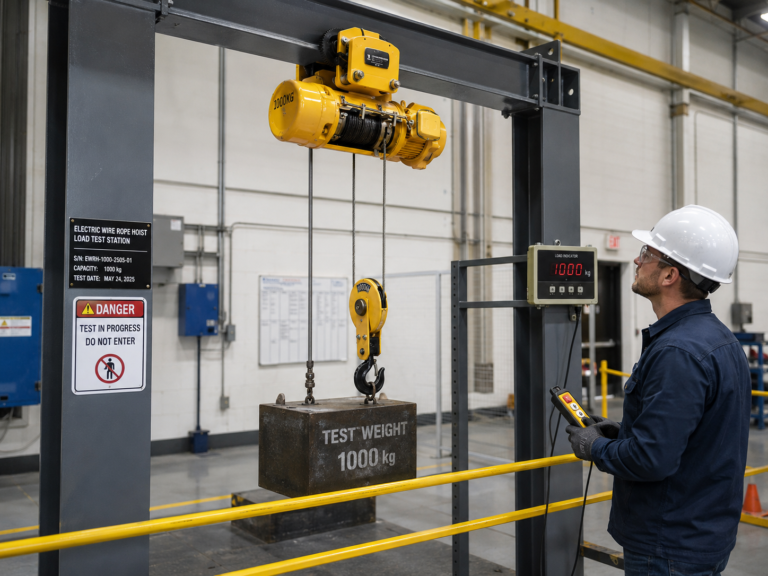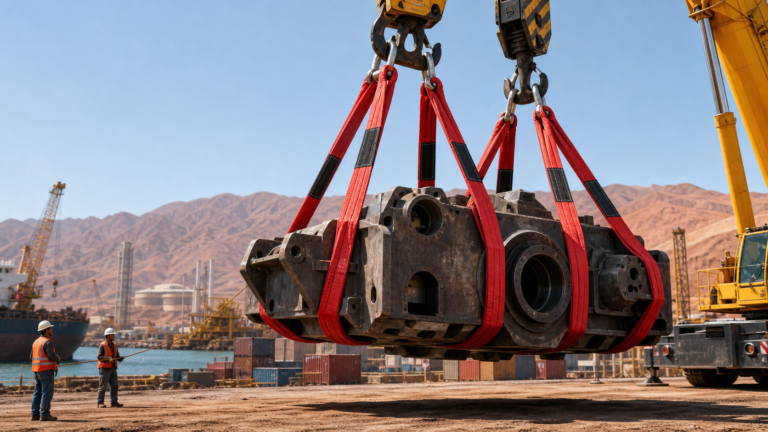
A 4‑ton steel beam needs to be lifted to the 8‑metre level of a new building. The crane cannot reach the interior. A forklift cannot operate on the unfinished floor. The crew has one option: an electric chain hoist. But the hoist must lift slowly — fast lifting would swing the beam into the steel columns. And the hoist must fit through a narrow stairwell to get to the upper floor.
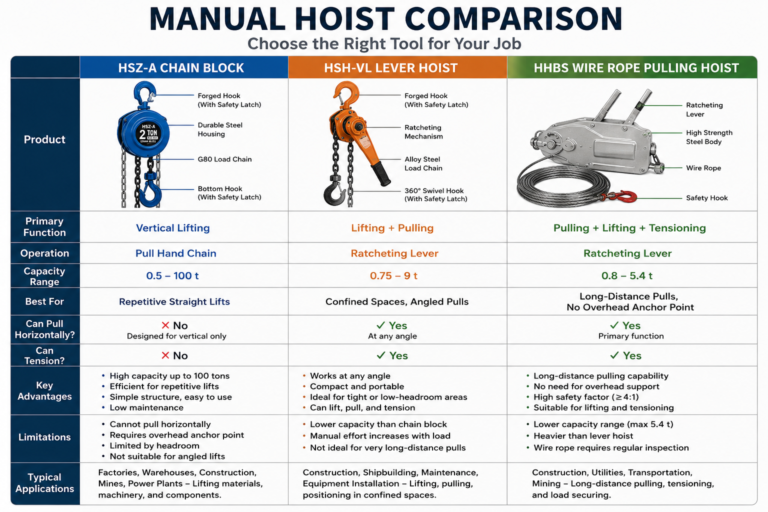
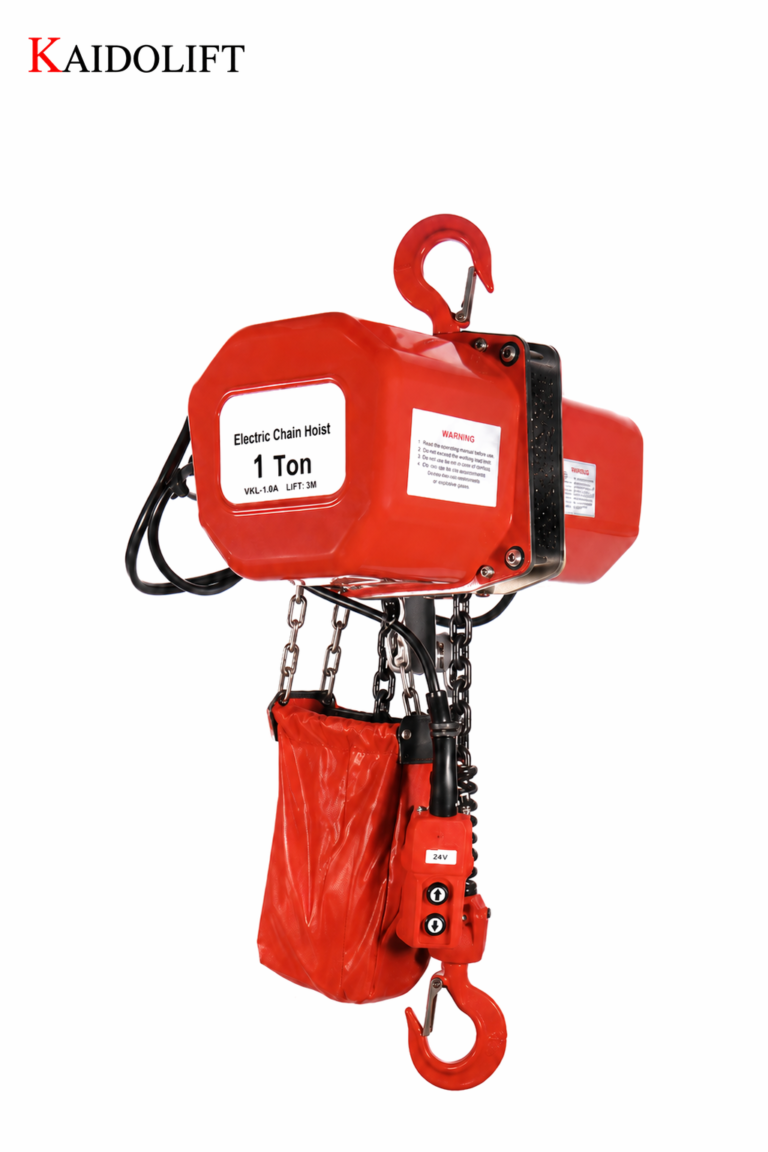
This is a typical challenge in construction lifting. The DHS electric chain hoist is built for these conditions — controlled speed, compact body, and capacities from 1 to 5 tons. It is also a reliable warehouse hoist for high‑bay storage, loading docks, and maintenance bays where slow, precise lifting is more important than speed.
This article covers the DHS series specifications, warehouse and construction applications, operating procedures, and the safety rules that apply in both environments.
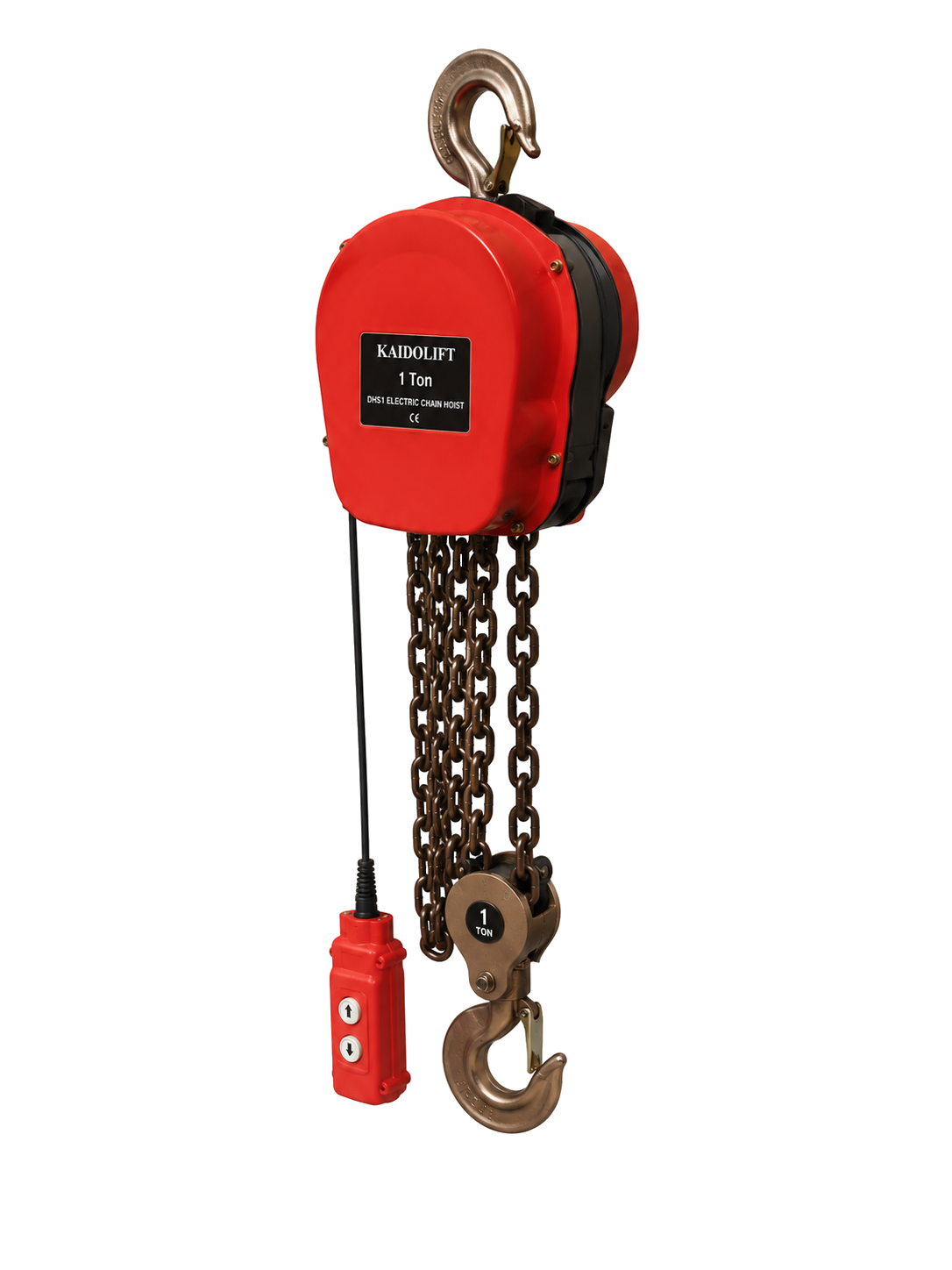
Why DHS Electric Chain Hoist for Warehouse and Construction?
The DHS series is designed around one principle: controlled lifting. While some hoists prioritise speed, the DHS prioritises:
- Low lifting speeds — from 2.25 m/min (1 ton) down to 0.9 m/min (5 tons), ideal for precision placement
- Compact dimensions — fits through tight access points in construction sites
- Disc motor with planetary gearing — provides smooth starts and stops, reducing load swing
- 24V low‑voltage control — safe operation in damp or dusty conditions
- CE certified — meets international safety standards
- G80 manganese steel load chain — high strength and abrasion resistance
DHS Series Specifications
| Model | Capacity | Standard Lift | Motor Power | Lift Speed | Chain Falls | Chain Diameter | Net Weight |
|---|---|---|---|---|---|---|---|
| DHS 1T | 1.0 t | 3 m | 500 W | 2.25 m/min | 1 | 7.1 mm | 38 kg |
| DHS 2T | 2.0 t | 3 m | 750 W | 1.85 m/min | 1 | 7.1 mm | 42 kg |
| DHS 3T | 3.0 t | 3 m | 750 W | 1.10 m/min | 2 | 7.1 mm | 56 kg |
| DHS 5T | 5.0 t | 3 m | 750 W | 0.90 m/min | 2 | 9.0 mm | 63 kg |
Data source: DHS series product specifications
The DHS is available with standard 3 m lift height and customisable for higher lifts. The 1 ton electric chain hoist (DHS 1T) lifts at 2.25 m/min — slow enough for delicate positioning but fast enough for routine warehouse lifts. At the other end, the 5 ton hoist (DHS 5T) operates at 0.9 m/min, prioritising safety and control over speed.
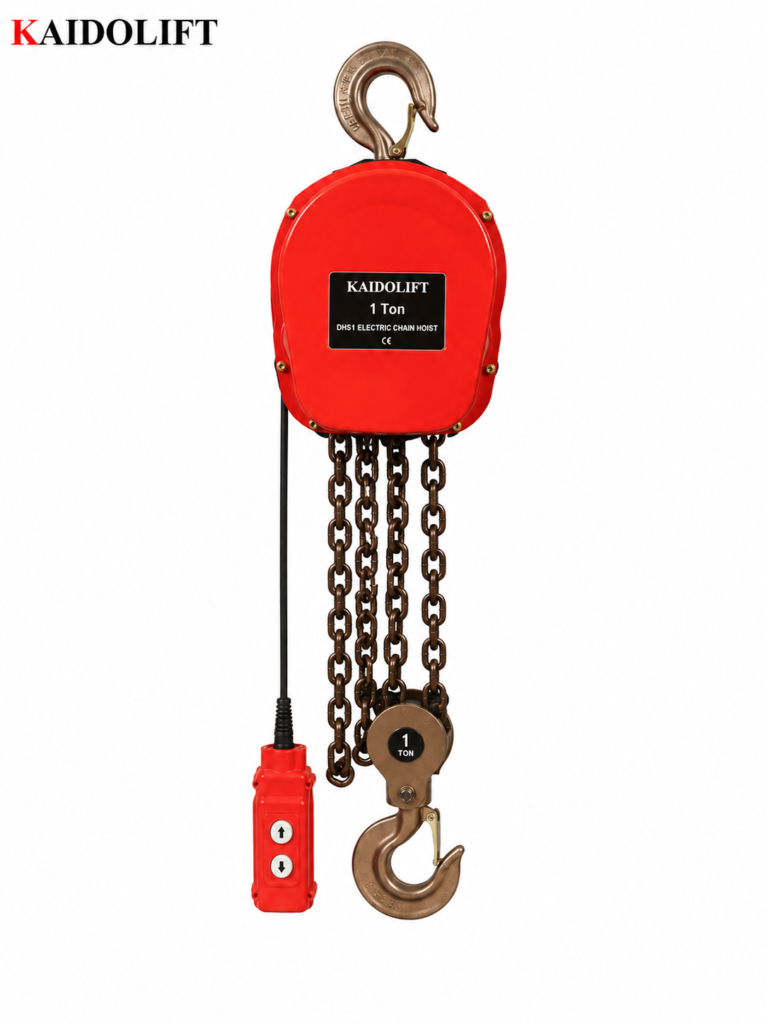
DHS Electric Chain Hoist Industrial Electric Hoist
Looking for a certified heavy-duty industrial electric hoist? The DHS electric chain hoist provides low-speed precision lifting with G80 alloy chains. Inquire for a factory-direct wholesale quote!
Key Design Features
1. Disc Motor with Planetary Gearing
The DHS uses a disc motor — a compact, high‑efficiency motor design — combined with planetary gearing. This combination provides:
- Smooth starting — reduces load swing during lift initiation
- Minimal backlash — precise load positioning
- High efficiency — the 750 W motor delivers consistent power across the duty cycle
- Quiet operation — lower noise in warehouse and construction environments
2. Compact Body
The DHS body is designed to fit through restricted access points. The total headroom (hook‑to‑hook distance) is minimised, making it suitable for low‑clearance applications. The net weight ranges from 38 kg to 63 kg — light enough for two workers to position during installation.
3. Two‑Stage Limit Switch
The DHS includes a two‑stage limit switch that stops the hoist at both upper and lower travel limits. This is critical in warehouse environments where the hoist operates near overhead beams, and in construction where the load must stop precisely at floor levels.
4. 24V Low‑Voltage Pendant Control
The standard pendant control operates at 24V — safe for operators in wet or dusty conditions. The pendant includes:
- Up/down buttons
- Emergency stop
- Easy‑grip handle
Warehouse Applications
High‑Bay Storage
Warehouses with racking up to 10 metres or more need a hoist that can lift pallets, equipment, or machinery to height without swinging. The DHS 1T at 2.25 m/min provides a controlled ascent that does not disturb adjacent racks. For heavier items — such as spare motors, drums of chemicals, or machinery parts — the DHS 2T at 1.85 m/min gives the operator time to guide the load into position.
Key advantage: The low speed allows a single operator to manage the load without a second person guiding from below.
Loading Docks
Lifting goods from ground level to truck beds or mezzanine floors. The DHS 3T handles palletised loads weighing up to 3 tons. The two‑chain configuration keeps the load balanced during lifting, preventing tipping that could damage goods or injure workers.
Maintenance and Repair Bays
Removing heavy components — electric motors, pumps, gearboxes — from equipment for servicing. The precise control of the DHS allows the operator to lower the component onto a workbench or pallet without damaging it. For warehouse hoist applications, the reliability of the DHS reduces unplanned downtime.
Construction Applications
Interior Lifting
When a tower crane or mobile crane cannot reach the interior of a building — typically after the roof is in place — the DHS provides an alternative. The hoist is suspended from a beam, steel frame, or temporary structure, and lifts materials, tools, or equipment to the required level.
The DHS 1T and 2T are commonly used for lifting:
- Masonry blocks and bags of cement
- Steel reinforcing bars
- Ductwork and pipe sections
- Tools and small equipment
Low‑Clearance Areas
The compact body of the DHS makes it suitable for construction lifting in low‑headroom areas: basements, mechanical rooms, tunnels, and under‑floor spaces. The slow speed also means operators can position loads accurately in tight spaces without overshooting.
Equipment Placement
Positioning generators, compressors, or electrical panels on upper floors. The DHS 5T at 0.9 m/min gives a crew the control they need when lowering a 5‑ton generator through a narrow opening. Every centimetre matters — and the slow speed prevents the load from drifting.
Mounting Options
The DHS can be mounted in three configurations:
| Mounting Type | Description | Best For |
|---|---|---|
| Hook‑mounted | Fixed single‑point suspension | Single lifting point, vertical lifts only |
| Manual trolley | Hand‑pushed along an I‑beam | Occasional horizontal repositioning |
| Electric trolley | Motor‑driven horizontal travel | Frequent travel along a beam |
For warehouse applications with multiple aisles or bays, the electric trolley option is recommended. The trolley speed is typically 5–12 m/min, matching the controlled pace of the hoist.
Operating Procedures
Before first use:
- Verify the hoist is securely mounted to a beam or trolley that can support the full rated capacity
- Check the power supply (standard: 380V/50Hz three‑phase)
- Test the limit switch at both upper and lower positions
- Test the emergency stop on the pendant
- Run a trial lift with a representative load to verify smooth operation
During operation:
- Use the pendant to start and stop the lift smoothly
- Keep clear of the load path — do not stand under the load
- Do not “inch” the hoist unnecessarily — use the speed appropriate for the job
- Let the motor brake hold the load — do not rely on the pendant button to hold position
Construction‑specific:
- Inspect the temporary anchor structure before each lift — it must support the load plus dynamic forces
- Use a tag line on long or awkward loads to control swing
- Keep the lifting area clear of debris and personnel
Warehouse‑specific:
- Ensure the load is within the rated capacity of both the hoist and the racking structure
- Position the load carefully over the target area before lowering
Safety Boundaries — Prohibitions
- NEVER exceed the Working Load Limit (WLL) — the DHS has no overload protection; exceeding the WLL can damage the motor and chain
- NEVER stand or work under a suspended load
- NEVER use the DHS for personnel lifting
- NEVER operate with a twisted, kinked, or worn chain — inspect before each use
- NEVER bypass the limit switch
- NEVER operate the hoist in explosive atmospheres unless specifically rated for that environment
- NEVER allow untrained personnel to operate the hoist
- NEVER use the hoist to drag a load horizontally — side loading damages the chain and sprocket
Chain safety: Under NCh 2245, chain elongation exceeding 3% requires immediate replacement. On construction sites where the chain may be exposed to abrasive materials (sand, concrete dust), inspect the chain more frequently.
Daily Inspection Checklist
- [ ] Inspect the load chain for visible wear, elongation, twists, or gouges
- [ ] Check the hook for deformation, cracks, or damaged safety latch
- [ ] Test the brake — lift a small load and hold it mid‑travel for 30 seconds
- [ ] Test the limit switch at upper and lower stops
- [ ] Check the pendant cable and control buttons for damage
- [ ] Verify the emergency stop functions correctly
- [ ] Listen for unusual noise from the motor or gearbox
Construction site extra checks:
- [ ] Verify the beam or anchor structure is secure — no corrosion, cracks, or loosening
- [ ] Check the chain for abrasion or impacts from handling
Weekly maintenance:
- Clean the chain and apply light lubricant
- Check the motor cooling fins for dust buildup
- Inspect trolley wheels and track (if trolley‑mounted)
Regulatory References
- ASME B30.16 — covers hand chain hoists (chain blocks); principles relevant to electric chain hoists
- ASME B30.21 — applies to manually lever‑operated chain hoists; extends to electric chain hoists in many jurisdictions
- Brazil NR‑11 — documented inspection records for lifting equipment
- Mexico NOM‑151 — inspection and testing record requirements
- Chile NCh 2245 — periodic load testing and chain wear standards (elongation >3% = replacement)
- FEM 9.511 / 9.683 — hoist duty classifications
Always refer to the current official versions of these standards.
Key Takeaways
- DHS series covers 1 to 5 tons with lift speeds from 0.9 to 2.25 m/min
- Controlled speed reduces load swing — ideal for precision placement in warehouses and construction
- Disc motor with planetary gearing provides smooth starts and stops
- Compact body fits through restricted access and low‑clearance areas
- 24V pendant control is standard for operator safety
- No overload protection — the WLL is a hard limit that must never be exceeded
- Daily inspection is mandatory — chain wear, hooks, brakes, limit switches
- NEVER exceed rated capacity; NEVER lift personnel; NEVER stand under a load
- Chain elongation >3% requires immediate replacement (NCh 2245)
- Comply with ASME B30.16 / B30.21 and local regulations (NR‑11, NOM‑151, NCh 2245)
📥 Further Reading: Need the DHS Electric Chain Hoist Selection & Application Guide PDF? [Click here to download]() — includes full specification tables, mounting configuration matrix, daily inspection checklist, and Latin American compliance summary.