A 3-ton transformer needs repositioning at a mountain substation. The nearest power outlet is 800 metres away. A diesel generator cannot be brought up, and an electric hoist is simply unusable.
This is a daily reality for crews in power transmission, oilfields, building sites, and emergency rescue. Where there is no power supply, limited access, or no road at all, the wire rope pulling hoist (also known as a Tirfor hoist or manual cable puller) is the primary practical solution.
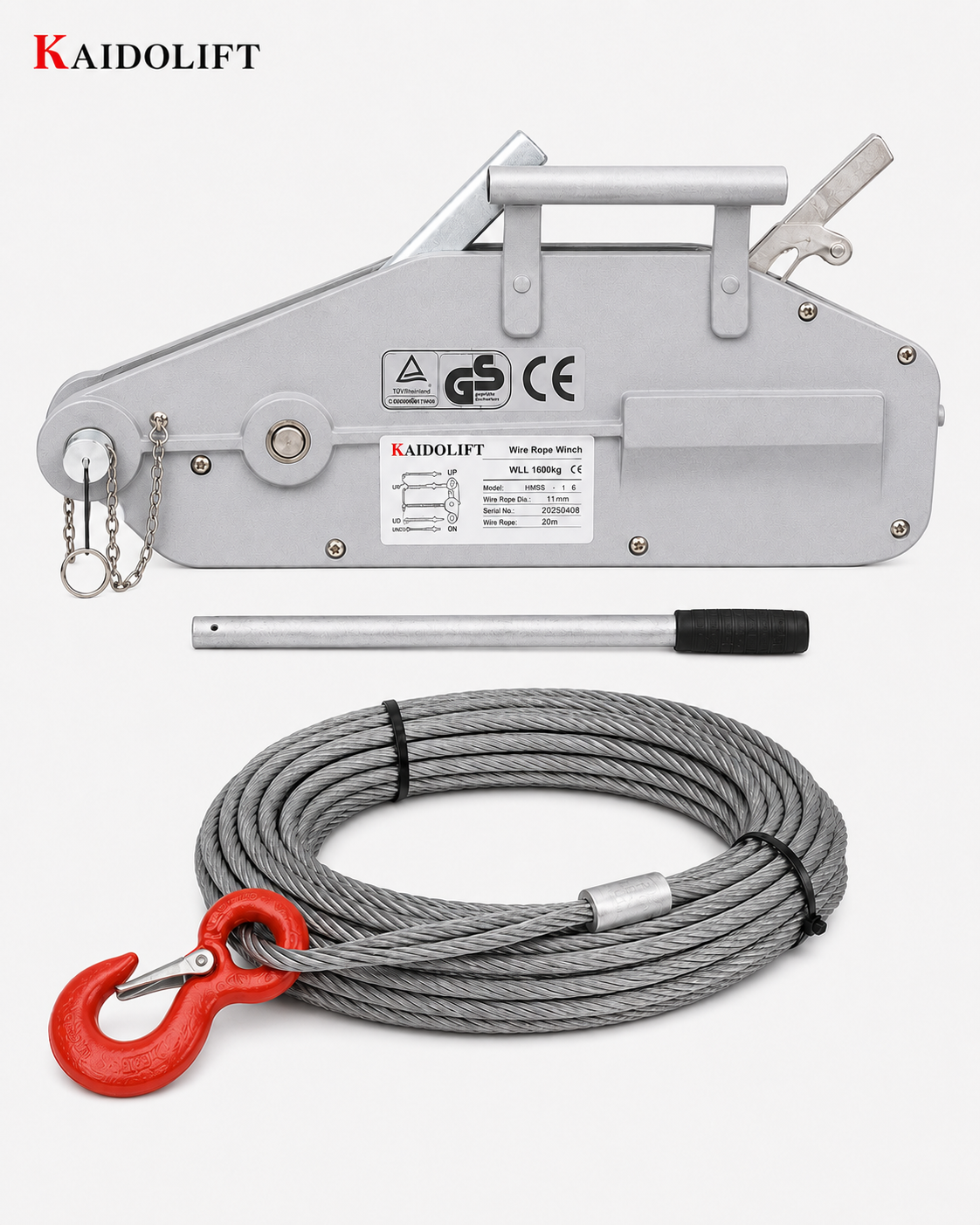
The HHBS and NHS wire rope pulling hoists are engineered specifically for such power-free, high-mobility environments. Their high-strength aluminium alloy bodies are both lightweight and rugged. Through a lever-operated gripping mechanism, they convert manual effort into controlled pulling, lifting, or tensioning without electricity. The matched wire rope has a safety factor of 5:1, and the complete hoist structure meets a static safety factor of 5:1. Whether performing vertical lifting, horizontal pulling, or angled tensioning, these hoists operate reliably in any orientation.
Why Conventional Lifting Gear Fails Here
- No power source required: Electric winches and chain hoists are unusable in remote field work, disaster zones, or sites without grid access. The wire rope pulling hoist requires only human power.
- Inaccessible locations: Heavy equipment cannot enter narrow cable trenches, deep shafts, tunnels, or tight interior spaces. A pulling hoist is compact (HHBS 0.8 dimensions: 428×64×235 mm) and weighs as little as 6 kg, allowing a single operator to carry it anywhere.
- No overhead anchor point needed: Traditional hoists require an overhead suspension point, which is often missing on slopes, open ground, or ditches. The pulling hoist can be anchored to any stable ground anchor or existing structure, with the wire rope extending to the load for remote operation.
- Multi-angle capability: Many field tasks involve inclined, horizontal, or obstacle-bypassing pulls rather than simple vertical lifts. The hoist operates at any angle.
HHBS and NHS wire rope pulling hoists Key Specifications at a Glance
| Model | Rated Load | Effective Lever Stroke | Rope Diameter | Net Weight | Dimensions (L×W×H) |
| HHBS 0.8 / NHS-0.8 | 0.8 t | 52 mm | 8 mm | 6 kg | 428×64×235 mm |
| HHBS 1.0 | 1.0 t | ≥52 mm | 8 mm | 6 kg | 428×64×235 mm |
| HHBS 1.6 / NHS-1.6 | 1.6 t | ≥55 mm | 11 mm | 12 kg | 545×97×286 mm |
| HHBS 3.2 / NHS-3.2 | 3.2 t | ≥28 mm | 16 mm | 23 kg | 660×116×350 mm |
| NHS-5.4 | 5.4 t | ≥30 mm | 20 mm | 56 kg | 720×140×380 mm |
Data source: HHBS and NHS series product specifications.
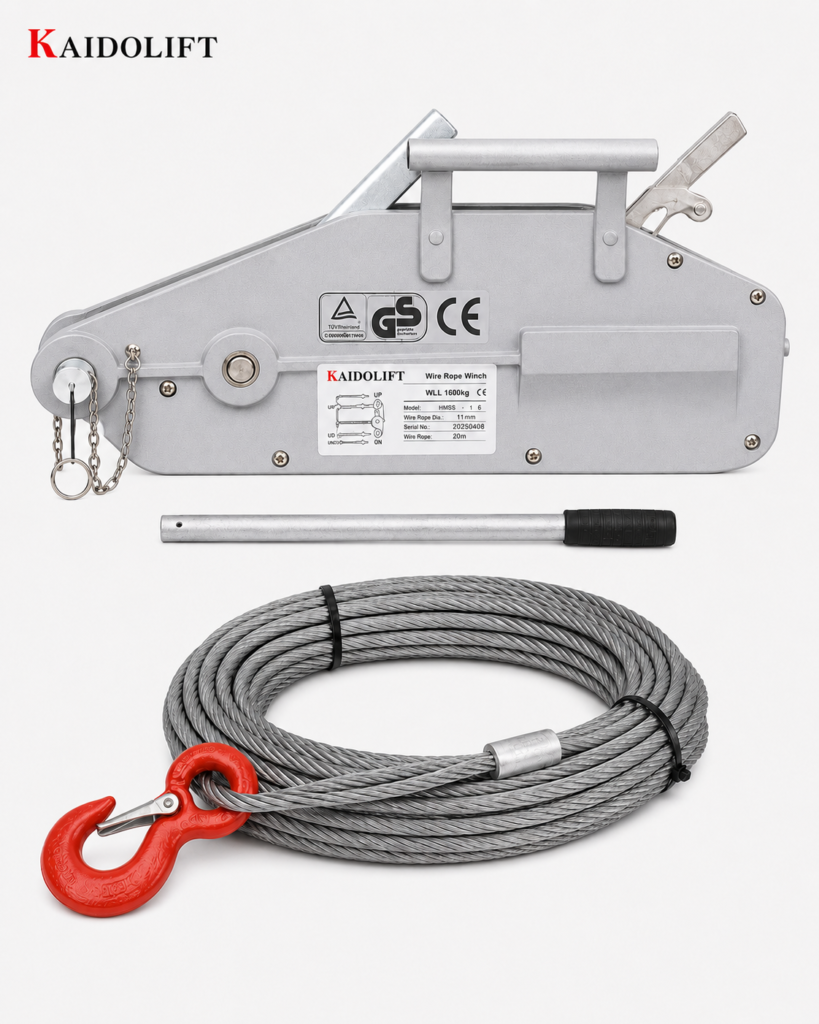
HHBS Wire Rope Pulling Hoist (Tirfor) | 0.8T to 3.2T Manual Lever Hoist
Premium HHBS Wire Rope Pulling Hoist with 10m/20m steel cable. This heavy-duty manual lever hoist offers 0.8T to 3.2T capacity for pulling, lifting, and tensioning. Ideal for LATAM mining and forestry. Get a factory wholesale quote.
Notable design features:
- Built-in overload protection: A shear pin breaks under severe overload, preventing catastrophic mechanical failure and accidents.
- Adjustable lever handle: Adapts to varying operating clearances and manual force requirements.
- Customisable rope length: Standard 10 m or 20 m configurations, with custom lengths available upon request.
- Test certification: Each unit is supplied with a test certificate, and wire ropes are proof-tested at 150% of rated capacity.
Construction Site Applications
- High-rise building exterior work: When scaffolding is unavailable, the hoist can suspend working platforms or haul materials for facade projects. The unit anchors to the roof structure while the rope descends vertically, allowing the operator to control elevation via the lever.
- Steel structure and tower erection: From precise alignment of structural steel members to tensioning guy wires, the hoist provides accurate force control at any angle. It is widely applied in transmission line tower component placement.
- Large-diameter pipe laying: Pull and align heavy pipes in trenches without relying on external power or heavy cranes.
- Bridge construction and railway maintenance: Used for positioning bridge elements, replacing railway sleepers, and aligning tracks. On long, narrow sites, its portability is advantageous.
Field Recovery and Emergency Response
- Vehicle recovery: Transport departments and rescue teams utilize wire rope pulling hoists for vehicle extrication, debris clearing, and emergency path restoration when heavy equipment cannot access the site.
- Natural disaster response: Following earthquakes or floods, these hoists assist in clearing rubble, securing unstable structures, and moving heavy debris.
- Oilfield and energy facility maintenance: In remote energy installations where power is scarce, the hoist is used for pipe alignment, equipment repositioning, and field maintenance pulling operations.
Operating Procedures and Critical Safety Steps
1. Pre-use inspection (perform in a open area before entering working zone)
- Check that all housing screws are tight.
- Operate the lever to ensure smooth action without jamming or abnormal noise.
- Inspect the wire rope for broken wires, kinks, severe wear, or corrosion.
- Inspect hooks for deformation or cracks, and confirm safety latch operation.
2. Threading and gripping the rope
- Move the release handle to the release position.
- Insert the clean, matched wire rope through the guide entry until it engages the gripping jaws.
- Warning: Use only the designated manufacturer wire rope; never substitute standard steel wire ropes.
3. Anchoring and pulling
- Select a solid anchor point capable of supporting the working load and secure the hoist body.
- Engage the release handle into the working position.
- Attach the operating lever to the forward shaft and reciprocate to tension the rope.
- Pull steadily and uniformly; avoid sudden jerks or dynamic loading.
4. Releasing and dismounting
- Move the lever handle to the reverse shaft and reciprocate to slacken the rope.
- Always remove the load completely before disengaging the jaw release handle.
- Disconnect the anchor only after all tension is completely relieved.
Safety Boundaries – Prohibitions
- NEVER exceed the Working Load Limit (WLL).
- NEVER stand, walk, or position body parts under or along the load path.
- NEVER use the hoist for lifting personnel or human suspension.
- NEVER use in explosive, highly combustible, or chemically hostile atmospheres unless certified.
- NEVER operate a unit displaying mechanical damage or abnormal resistance.
- NEVER use the wire rope as a sling around loads.
- NEVER operate during lightning or severe electrical storms.
- NEVER strike the control housing or shear pin mechanism.
- NEVER operate in reverse when the rope end clamp approaches the hoist entry.
- Ensure the hoist body pivots freely and does not rest against rigid obstacles during operation.
- Single-operator restriction: Only one person may operate the lever at a time; do not use extensions or multiple operators to force the lever.
Maintenance and Compliance Notes
Daily Maintenance
- Keep moving parts clean. Use a suitable cleaning solvent to remove dirt, grit, and mud.
- Do not apply heavy grease to the internal jaw surfaces. Use clean, light mineral oil to lubricate internal linkages as specified by the manufacturer.
- Inspect wire ropes daily for broken strands and corrosion.
Storage Requirements
- Store indoors in a clean, dry, protected environment.
- Avoid extreme temperature ranges (consult the manufacturer for environments exceeding 60°C or below -29°C).
- Keep away from corrosive chemicals, acid fumes, and salt spray.
Regulatory References
- ASME B30.21: Manually Lever-Operated Hoists (covers design, inspection, testing, and maintenance).
- Brazil (NR-11): Safety Standards for Material Handling, Storage, and Transportation.
- Mexico (NOM-006-STPS): Workplace Material Handling and Lifting Equipment Safety Requirements.