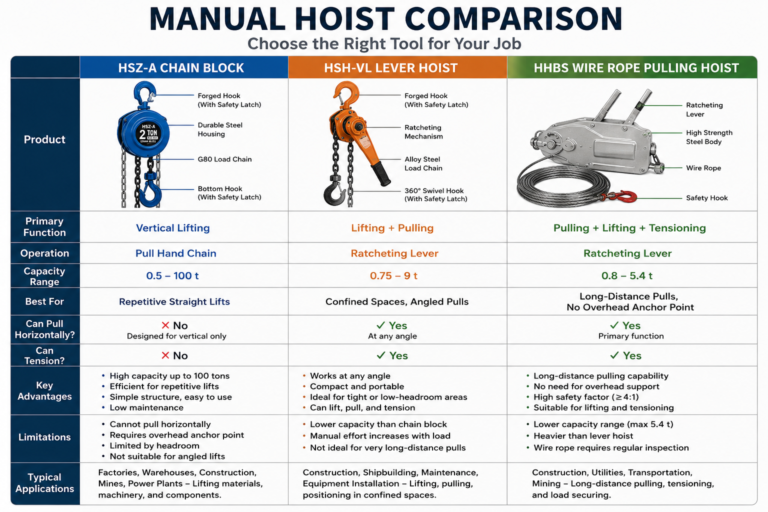
A 2-ton compressor needs to go into a below-grade pump room with only 1.5 m of headroom and an 800-mm access hatch. A standard chain hoist requires vertical chain travel that simply does not fit, and a forklift cannot reach the opening. This is the reality of confined-space machinery installation—and exactly where a lever hoist for confined space becomes the practical solution.
The HSH-VL lever hoist is engineered for these restricted environments. With body heights ranging from approximately 120 mm (0.5 t model) to 220 mm (9 t model), it delivers usable hook-to-hook distance that standard hoists cannot match. The 360° rotating handle and multi-angle capability allow precise positioning of machinery in pits, equipment bays, cable trenches, and overhead locations where conventional lifting gear cannot operate.
Unlike hand chain hoists that require significant vertical clearance for chain travel, lever hoists use a compact ratcheting mechanism that operates within the tool’s own envelope. This makes them the preferred choice when headroom is limited and when the job requires both lifting and pulling.
The Lever Hoist for Confined-Space Problem: Three Barriers to Installation
- Insufficient headroom. Oversized hoist bodies reduce usable hook-to-hook distance. In a 1.5-meter clearance, every millimeter counts. Standard lever hoists with bulky housings can consume 400–500 mm of vertical space before the load is even attached.
- Restricted lever swing. Long handles—often 400 mm or more—are blocked by walls, steel beams, or adjacent equipment. Operators cannot complete a full stroke, reducing mechanical advantage and increasing fatigue.
- Excess tool weight. Heavy hoists become exponentially more difficult to maneuver in low-clearance access points. A 9 t hoist weighing 47 kg is challenging enough on open floor; in a confined space, it becomes a handling hazard.
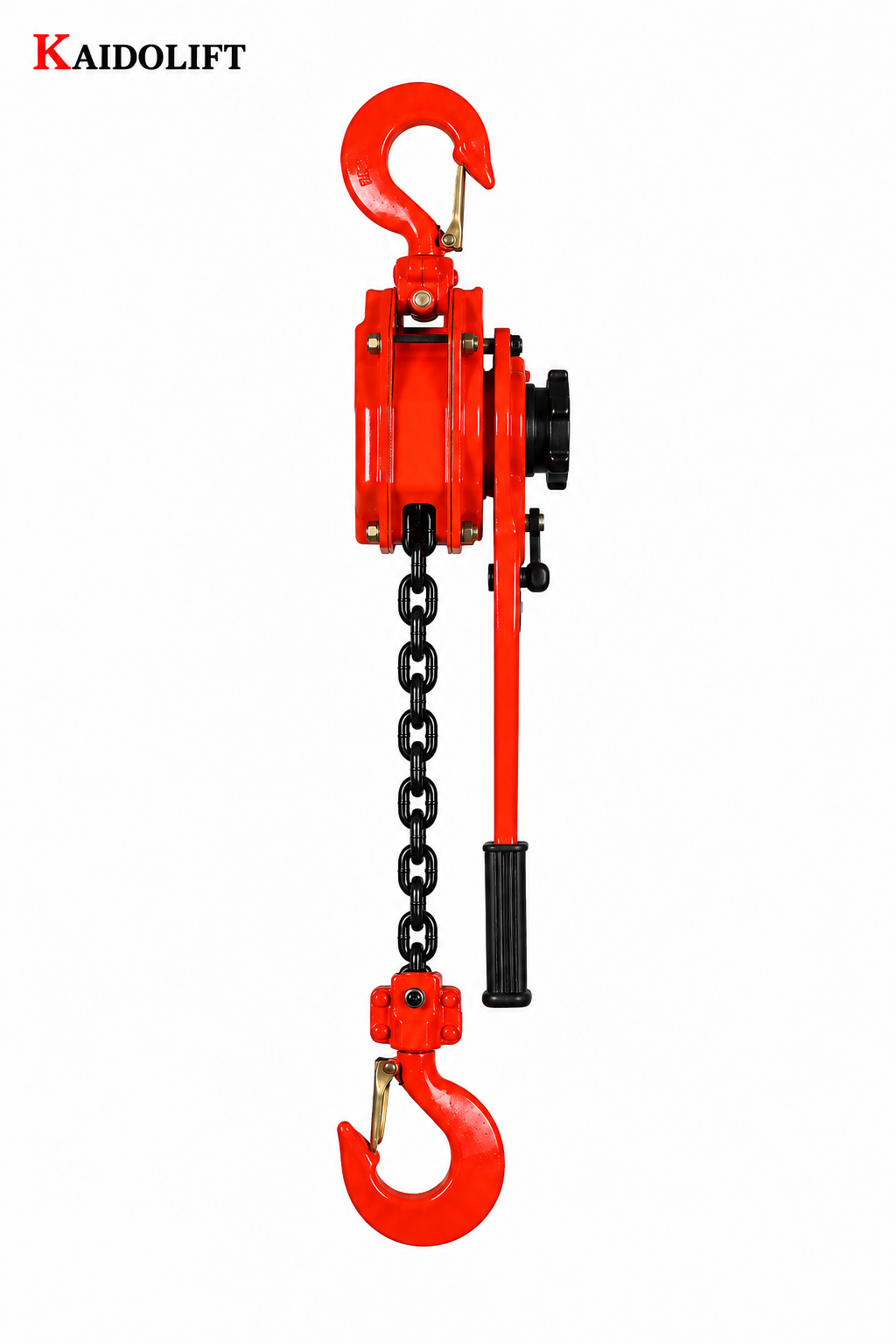
The HSH-VL addresses these directly with compact housing dimensions, an ergonomic short lever with rubber anti-slip grip, and a lightweight alloy body that maximizes strength-to-weight ratio.
Key Design Features That Make the Difference
| Feature | Design Advantage | Confined-Space Benefit |
| Compact housing | Minimal hook-to-hook dimensions | Under 300 mm total headroom on smaller models |
| 360° rotating handle | Operates in any orientation | Works where handle rotation is restricted by walls |
| Lightweight alloy construction | High strength-to-weight ratio | Single-handed positioning in tight access |
| Weston double-pawl automatic brake | Positive engagement | Controlled, predictable load movement |
| Grade 80 alloy load chain | High strength in small diameter | Reduced chain bulk in confined spaces |
| Rubber anti-slip handle | Secure grip in any condition | Safe operation even with gloves or moisture |
The HSH-VL offers capacities from 0.5 t to 9 t, with standard lift heights of 1.5 m and custom options up to 6 m available. The lever supports vertical lifting, horizontal pulling, or intermediate angles—provided the load chain remains in a straight line with the force.
Critical Safety Requirement: Straight-Line Loading
Important: Lever hoists must be used in the direction of loading for which they are designed. ASME B30.21 explicitly states that “the load block, chain, and hoist body are directly in line with the direction of loading to avoid side pull”. Side loading reduces capacity and can damage the ratchet mechanism, leading to sudden load drop.
The standard also requires that “the hoist body or frame shall not bear against any object or the supporting structure”—a critical consideration in confined spaces where operators may be tempted to brace the hoist against nearby surfaces.
Never use a lever hoist for lifting personnel. ASME B30.21 explicitly excludes personnel lifting from its scope, and OSHA prohibits using material hoists as rescue retrieval systems in permit-required confined spaces.
Practical Installation Techniques
Below-Grade Installations (Pits and Pump Rooms)
Anchor the hoist above the access hatch. Lower the equipment vertically into the pit. Once the load reaches floor level, reposition the anchor point at floor level and switch the lever to horizontal pulling mode. This two-stage approach—vertical lowering followed by horizontal positioning—is the most efficient method for below-grade machinery installation.
Equipment Bays with Limited Access
Use two hoists in tandem to “walk” the load into position. Synchronize strokes carefully—a one-stroke difference per cycle creates 10–20 mm of skew over a 1-meter pull. This skew places uneven load on the chain and hooks, potentially exceeding the Working Load Limit (WLL) on one side even when the total load is within capacity.
Capacity Considerations for Horizontal Pulling & Dragging
When a lever hoist is used in a direct vertical or horizontal inline pull, the full rated Working Load Limit (WLL) applies. However, when dragging loads along a surface, static and kinetic friction force ($F = \mu \times N$) significantly increases the tension on the rigging. Rigging calculations must account for the surface friction coefficient to ensure total line pull stays within the hoist’s rated WLL. Furthermore, when pulling at an angle, vector forces increase the effective load; always verify manufacturer certifications before executing angled pulls.
Chain Protection
Where the load chain contacts sharp edges, use a protective sleeve or chafe guard. Abrasion damage is one of the leading causes of chain failure in confined spaces, where operators may not have clear visibility of the chain path.
Pre-Operation Safety Checklist
Before deploying any lever hoist in a confined space:
- Assess headroom before rigging. Confirm the hoist body, hook, and load all fit within the available clearance.
- Inspect the load chain for twists, gouges, elongation, and corrosion.
- Test the brake and pawl mechanism with a light load before applying full WLL.
- Verify the direction selector is correctly set for lifting or pulling.
- Check that the anchor point is rated for the full load plus any rigging hardware.
- Ensure adequate lighting and clear communication between operators.
Prohibited Actions
- Never stand under or within the path of a suspended load.
- Never exceed the Working Load Limit (WLL).
- Never side-load the hoist or subject it to off-axis tension.
- Never use the hoist for personnel lifting.
- Never operate with a damaged or elongated load chain.
- Never brace the hoist body against surrounding structures or obstructions.
- Never operate if the friction brake components are contaminated with oil, grease, or moisture.
Maintenance and Regulatory Compliance
Daily Inspection (Before Each Use)
- Check chain for elongation, twists, nicks, and gouges.
- Inspect hooks for deformation, cracks, and latch function.
- Test brake engagement with a light load.
- Verify the pawl and ratchet operate smoothly.
- Clean debris from the chain and housing.
Periodic Inspection & Regional Standards
ASME B30.21 outlines regular inspection intervals for lever hoists. At a minimum, inspect operating mechanisms for proper operation and unusual sounds, and inspect hooks in accordance with ASME B30.10.
Adherence to local statutory safety codes is required:
- Brazil: NR-11 and NR-12 require material handling equipment to be maintained in safe operating condition, supported by periodic technical reports (Laudo Técnico) issued by a qualified engineer.
- Mexico: NOM-006-STPS-2014 sets mandatory occupational safety conditions, inspection protocols, and operational records for material handling equipment.
- Chile: NCh 2189 and NCh 2200 govern technical specifications, inspection, and safe usage requirements for lifting equipment and components.