In warehouses, manufacturing plants, and distribution centers across Latin America—from the industrial hubs of São Paulo to the logistics corridors of Mexico and the port facilities of Chile—the efficient movement and storage of palletized goods is a daily operational necessity. While forklifts and pallet jacks are familiar tools, there is a middle-ground solution that combines the affordability of manual equipment with the lifting capability of powered machinery: the hydraulic pallet stacker.
A hydraulic pallet stacker is a specialized material handling tool designed to lift, transport, and stack palletized loads in busy industrial environments. It uses a hydraulic system to elevate pallets to higher levels—typically up to 3,000mm (approximately 10 feet) or more—allowing operators to place loads onto storage racks, load trucks, or feed materials into production lines. This guide provides a comprehensive introduction to hydraulic pallet stackers, covering their definition, types, key specifications, applications, and safety standards.
1. What Is a Hydraulic Pallet Stacker?
Definition and Core Function
A hydraulic pallet stacker—also referred to as a manual stacker, pallet stacker truck, or simply a stacker—is a mobile machine built to lift, maneuver, and stack palletized materials efficiently. It combines the horizontal transport capabilities of a traditional hand pallet truck with the vertical lifting ability needed to place loads onto shelving or racking systems.
The defining characteristic of a hydraulic pallet stacker is its hydraulic lifting mechanism. Unlike a standard pallet jack which raises loads only a few inches off the ground, a stacker uses a hydraulic pump—activated by hand pumping, foot pedal, or electric motor—to raise the forks to significant heights. This allows operators to stack pallets in multi-level storage systems, load and unload trucks, and position materials at ergonomic working heights.
Stacker vs. Pallet Truck: Understanding the Difference
While both tools help move goods, they serve different purposes:
| Feature | Hydraulic Pallet Stacker | Hand Pallet Truck |
|---|---|---|
| Primary Function | Lift, move, and stack pallets | Move pallets horizontally across the floor |
| Lifting Height | Up to 3,000mm or more | 100–200mm (just enough to clear the floor) |
| Mast Structure | Has a vertical mast for lifting | No mast; forks only |
| Typical Capacity | 500–3,000kg | 1,000–3,000kg |
| Best For | Racking, stacking, truck loading | Floor-level transport |
A stacker sits between a pallet truck and a forklift in terms of capability. It offers greater lifting height than a pallet truck but is more affordable and compact than a forklift.
Stacker vs. Forklift: Key Differences
Hydraulic stackers differentiate themselves from forklifts by offering an entry-level solution at a lower price point:
| Feature | Hydraulic Stacker | Forklift |
|---|---|---|
| Cost | Significantly lower acquisition cost | Higher investment |
| Operator Certification | Typically not required | Required (OSHA, NR-11 training) |
| Maneuverability | Compact, works in narrow aisles | Requires more space |
| Power Source | Manual or semi-electric | Usually engine or battery-powered |
| Lift Height | Up to 3.5m | Up to 6m+ |
| Maintenance | Low maintenance | Higher maintenance requirements |
2. How Does a Hydraulic Pallet Stacker Work?
The operation of a hydraulic pallet stacker is based on a simple but effective principle: hydraulic fluid pressure converts manual or electric input into lifting force.
The Hydraulic System
The stacker contains a hydraulic cylinder, a pump, and a reservoir of hydraulic oil. When the operator activates the pump—by pumping the handle, pressing a foot pedal, or pressing a button on an electric model—hydraulic fluid is forced into the cylinder, which extends and raises the forks.
Key components:
- Hydraulic pump: Generates the pressure needed to lift the load
- Hydraulic cylinder: Converts fluid pressure into linear motion
- Control valve: Allows controlled lowering of the forks
- Mast: The vertical structure that guides the forks during lifting
Lifting Mechanisms by Type
| Mechanism | How It Works | Best For |
|---|---|---|
| Hand Pump (Tiller) | Operator pumps the handle up and down to build pressure | Occasional use, light to medium loads |
| Foot Pump | Repeated operation of a foot pedal activates the hydraulic system | Hands-free operation, moderate use |
| Electric Motor | Battery-powered motor activates the hydraulic pump | Frequent use, heavy loads, reduced operator fatigue |
| Hand Crank | Mechanical crank winds a mechanism to lift forks | Light loads, budget-conscious operations |
Lowering the Load
To lower the forks, the operator activates a control lever or release valve, which allows hydraulic fluid to flow back into the reservoir, gradually lowering the forks under controlled speed. This controlled descent is critical for safety when placing loads on racks or stacking.
3. Types of Hydraulic Pallet Stackers
Hydraulic pallet stackers are available in several configurations, each suited to different operational needs and budgets.
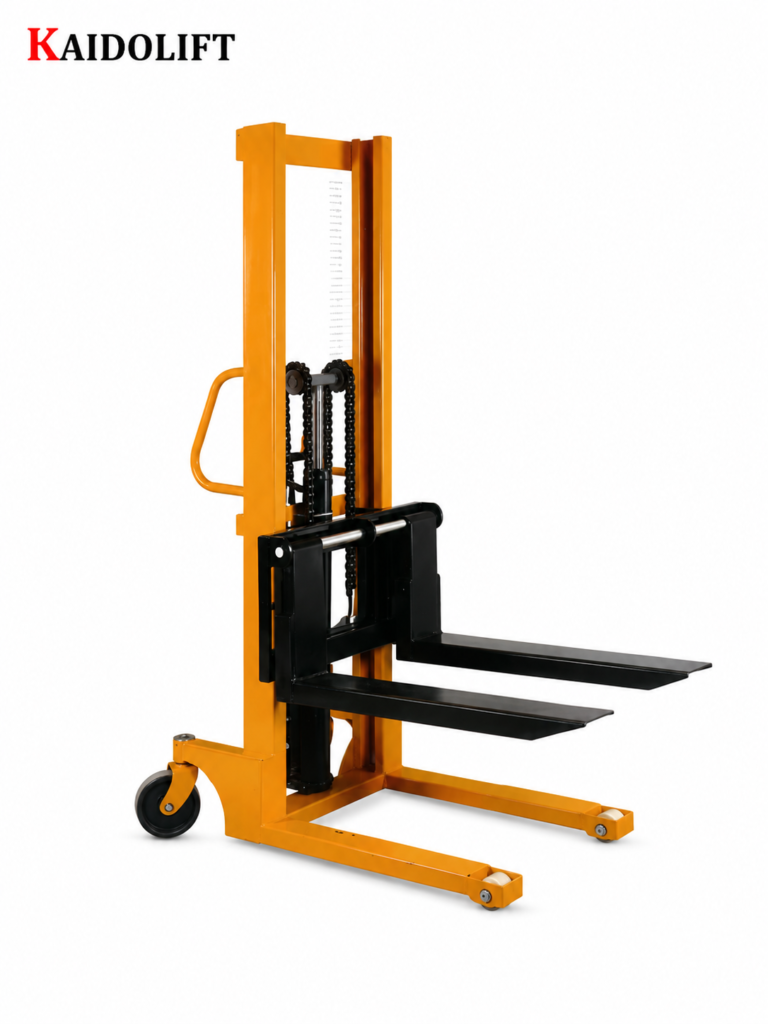
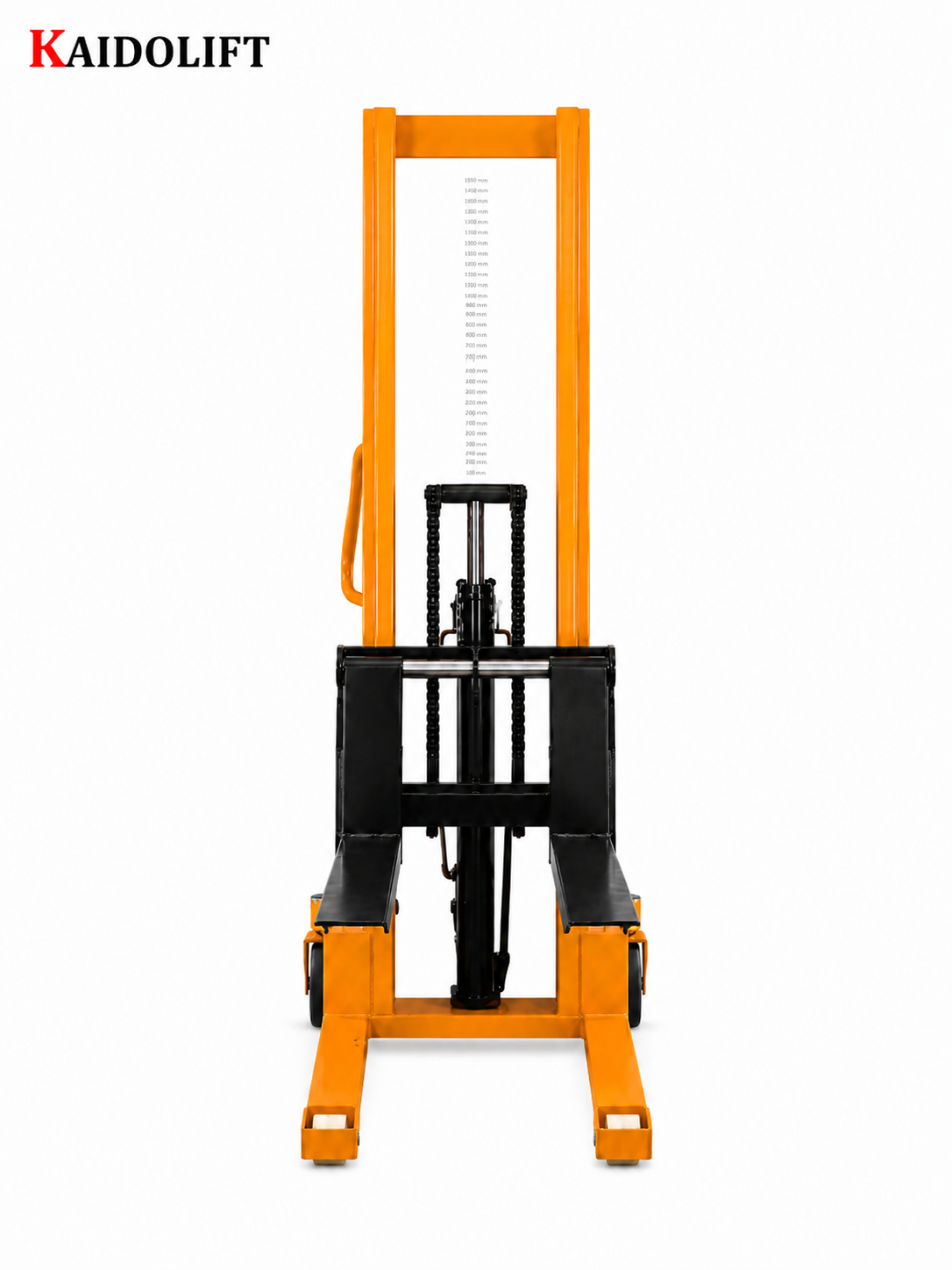
Hydraulic Pallet Stackers | Warehouse Material Handling
Hydraulic Pallet Stackers are designed for lifting, stacking and transporting palletized goods in warehouses, workshops, factories and logistics areas. With a steel frame, manual hydraulic lifting system and stable fork structure, this pallet stacker provides a practical solution for daily material handling and warehouse stacking operations.
Manual Hydraulic Stackers
Manual stackers are completely operated by hand and require no external power source. The operator pumps a hydraulic handle or foot pedal to lift the load and physically pushes or pulls the unit to move it.
Advantages:
- Lowest acquisition cost
- No electricity or battery required
- Low maintenance
- Lightweight—can be used on mezzanine floors
- Portable and suitable for remote locations
Limitations:
- Requires physical effort from the operator
- Best suited for lighter loads and less frequent use
- Operator fatigue can limit productivity over long shifts
Ideal for:
- Small warehouses and workshops
- Occasional stacking tasks
- Operations with budget constraints
- Areas without reliable electricity access
Semi-Electric (Powered-Lift/Manual-Push) Stackers
Semi-electric stackers combine electric lifting with manual pushing. An electric motor—powered by a rechargeable battery—activates the hydraulic pump to raise the forks. However, the operator must still push or pull the unit manually.
Advantages:
- Faster lifting with less physical effort than manual models
- Reduced operator fatigue
- Suitable for short-distance transport
- Rechargeable battery typically lasts up to 12 hours
Limitations:
- Still requires manual pushing
- Battery requires charging and maintenance
- Higher cost than manual models
Ideal for:
- Warehouses with moderate lifting frequency
- Operations where loads are moved short distances
- Environments where reduced operator fatigue is a priority
Fully Electric (Powered) Stackers
Fully electric stackers have an electric motor that both propels the unit and raises and lowers the forks. These are the most advanced and efficient option in the stacker category.
Advantages:
- No physical exertion required for lifting or movement
- Suitable for longer distances and inclined surfaces
- Faster operation
- Quiet operation with zero emissions
- Advanced features: adjustable forks, variable speed controls
Limitations:
- Highest cost among stacker types
- Battery requires regular charging
- More maintenance than manual models
Ideal for:
- High-volume warehouses and distribution centers
- Operations requiring frequent, repetitive lifting
- Environments where operator efficiency is critical
- Multi-level storage systems
Subtypes by Configuration
Beyond the power source, stackers are also categorized by their undercarriage configuration:
| Configuration | Description | Best For |
|---|---|---|
| Straddle Stacker | Outrigger legs positioned outside the forks for stability | Stable lifting; can lift any pallet type with sufficient leg clearance |
| Fork-Over Stacker | Outrigger legs positioned directly under the forks | More compact footprint; open-bottom pallets and skids |
| Counterbalanced Stacker | Weight at the rear counterbalances the load | Heavy loads; no outrigger legs required |
4. Key Specifications and Capacities
When selecting a hydraulic pallet stacker, understanding the key specifications is essential.
Load Capacity (WLL)
Hydraulic pallet stackers are available in a range of load capacities, typically from 500kg up to 3,000kg.
Common capacity ratings:
| Capacity | Typical Application |
|---|---|
| 500–1,000kg | Light-duty, small workshops, retail backrooms |
| 1,000–1,500kg | General warehouse operations |
| 2,000kg | Heavy-duty industrial use |
| 3,000kg | Heavy loads, demanding applications |
🔧 MANDATORY PRACTICE: Always select a stacker with a rated capacity that exceeds the maximum load weight you intend to lift. The load should be evenly distributed on the pallet or forks.
Lifting Height
Lifting heights typically range from 1,600mm to 3,500mm. Common lift heights include 1.6m, 2.0m, 2.5m, 3.0m, and 3.5m.
| Lift Height | Application |
|---|---|
| 1,600mm | Single-level racking, workbench feeding |
| 2,500mm | Double-level racking, truck loading |
| 3,000mm+ | Multi-level racking, high-bay storage |
Fork Dimensions
Standard fork specifications include:
- Fork length: Typically 900–1,150mm
- Fork width (adjustable): Typically 320–700mm
- Minimum fork height: Typically 80–100mm
Load Center Distance
The load center—the distance from the fork face to the load’s center of gravity—is typically 400mm for standard hydraulic stackers. This specification is critical for ensuring the stacker can safely handle the rated load.
5. Where Are Hydraulic Pallet Stackers Used?
Hydraulic pallet stackers are versatile tools found across a wide range of industries and applications.
Warehouses and Distribution Centers
In warehouses, hydraulic stackers are used for:
- Loading and unloading pallets from storage racks
- Organizing inventory in multi-level storage systems
- Preparing orders for shipment
- Moving goods between receiving and shipping areas
Manufacturing and Production Facilities
In manufacturing environments, stackers support:
- Moving raw materials to production lines
- Feeding materials into machines
- Transporting finished products to storage or shipping
- Supporting assembly line operations
Retail and Wholesale Operations
Retail and wholesale operations use stackers for:
- Stock handling in backrooms and stockrooms
- Loading and unloading delivery trucks
- Organizing inventory in storage areas
- Moving goods to the sales floor
Construction Sites
On construction sites, hydraulic stackers help with:
- Moving building materials
- Loading and unloading supplies from trucks
- Positioning materials at elevated work areas
Cold Storage and Food Processing
Hydraulic stackers—particularly manual models—are well-suited for cold storage environments because they:
- Require no batteries that may fail in low temperatures
- Produce no emissions
- Have a low capital entry point
Specialized Environments
Hydraulic stackers are also ideal for fire and explosion-proof environments such as:
- Printing workshops
- Oil depots
- Chemical storage areas
- Docks and ports
Their manual operation eliminates the risk of sparks or electrical hazards, making them suitable for hazardous locations.
6. Safety Standards and Regional Compliance
Key International Standards
The primary standard for manually propelled stackers is ASME B56.10—the “Safety Standard for Manually Propelled High Lift Industrial Trucks”. This comprehensive standard covers:
- Lift design and manufacture
- Performance requirements
- Testing protocols
- Safe use and operation
Additionally, OSHA 29 CFR 1910.178 includes training and evaluation requirements for operators of powered industrial trucks.
Regional Standards: Latin America
For operations in Latin America, the following standards apply:
| Region | Standard | Key Requirements |
|---|---|---|
| Brazil | NR-11 | Equipment must be designed and built to provide necessary guarantees of strength and safety. Operators of transport equipment must receive specific training provided by the employer. Training must be documented; operators must carry identification cards. |
| Mexico | NOM-151-SSA1 | Establishes safety requirements for material handling equipment |
| Chile | NCh 2245 | Defines technical specifications for industrial lifting equipment |
NR-11 specifies that training is obligatory for all personnel involved in material handling operations, including the proper usage of Personal Protective Equipment (PPE). Operators must receive both theoretical and practical instruction.
⚠️ CRITICAL NOTICE: Under NR-11, all material handling equipment must be kept in perfect working condition. Employers are responsible for ensuring that operators are qualified and that equipment is regularly inspected and maintained.
7. Maintenance and Care
Proper maintenance extends the service life of a hydraulic pallet stacker and ensures safe operation.
Regular Inspection Checklist
Before each use:
- Check for visible damage to forks, mast, and frame
- Verify the hydraulic system operates smoothly
- Test the lowering control—it must be responsive
- Ensure the load is evenly distributed
Monthly:
- Inspect forks, wheels, chains, and other moving parts
- Check for hydraulic leaks
- Verify the lifting mechanism reaches full height without difficulty
Quarterly:
- Check hydraulic oil level with forks fully lowered
- Inspect hydraulic system for leakage
Hydraulic Oil Maintenance
Hydraulic oil is the lifeblood of the stacker’s lifting system.
| Maintenance Task | Frequency |
|---|---|
| Check oil level | Every 6 months |
| Replace hydraulic oil | Annually or every 1,500 working hours |
| Check oil quality | Regularly—oil must be clean and free of emulsification |
Recommended oil: ISO VG32 (viscosity 32cSt at 40°C). For ambient temperatures between -5°C and 40°C, HL-N46 or HL-N68 may be used.
Performance test: Under rated load, the stacker must not sink more than 5mm within 10 minutes. If it does, the hydraulic system requires attention.
Conclusion
The hydraulic pallet stacker is an essential tool for material handling operations across Latin America’s industrial, logistics, and manufacturing sectors. By combining the affordability and simplicity of manual equipment with the lifting capability needed for racking and stacking, it fills a critical gap between pallet jacks and forklifts.
When selecting a hydraulic pallet stacker, consider:
- Load capacity—match the WLL to your heaviest loads
- Lift height—ensure it reaches your racking levels
- Power type—manual, semi-electric, or fully electric based on usage frequency
- Configuration—straddle, fork-over, or counterbalanced based on your pallet types and workspace
For operations across Latin America, compliance with Brazil NR-11, Mexico NOM-151, and Chile NCh 2245 is essential. Ensure that equipment is properly maintained, operators are trained, and inspection records are documented.
📋 Need Help Selecting the Right Hydraulic Pallet Stacker for Your Operation?
Our material handling team provides free, no-obligation stacker selection assistance for warehouses, manufacturing facilities, and distribution centers across Latin America. We can help you:
- Match the right hydraulic pallet stacker to your load and height requirements
- Compare manual vs. semi-electric vs. electric options for your budget
- Verify NR-11 / NOM-151 / NCh 2245 compliance
- Provide maintenance schedules and operator training guidance
[Request Stacker Selection Assistance Now] or download our LatAm-Compliant Material Handling Equipment Guide (PDF) with selection matrices and maintenance checklists.