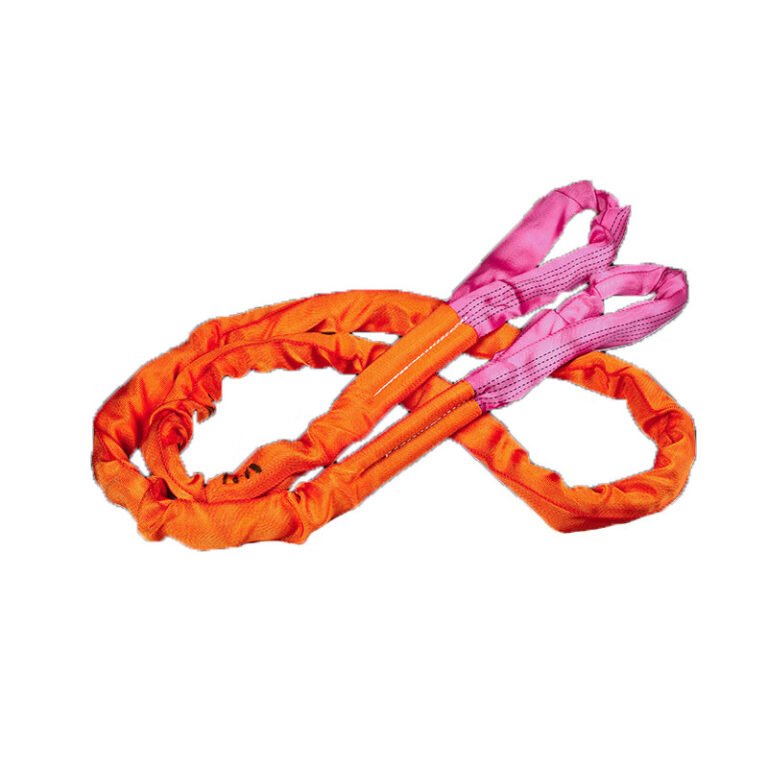
In the heavy-lifting sector across Latin America—from copper mines in Chile to port logistics in Brazil—choosing the wrong synthetic sling is a direct path to downtime or, worse, site accidents. While a standard flat lifting sling appears deceptively simple, its real-world performance hinges on three interdependent variables: rated capacity, effective length, and the geometry of the hitch.
This guide kicks off our multi-part technical series by breaking down these fundamentals. We reference international benchmarks like EN 1492-1 and ASME B30.9, while also addressing the specific climatic and operational conditions common throughout the LatAm industrial belt.
1. Decoding the Label: WLL, Safety Factors, and Local Compliance
Every certified synthetic web sling comes with a tag that tells a story—but only if you know how to read it. The most critical figure is the Working Load Limit (WLL) , which represents the maximum mass the sling is authorized to handle in a straight vertical lift.
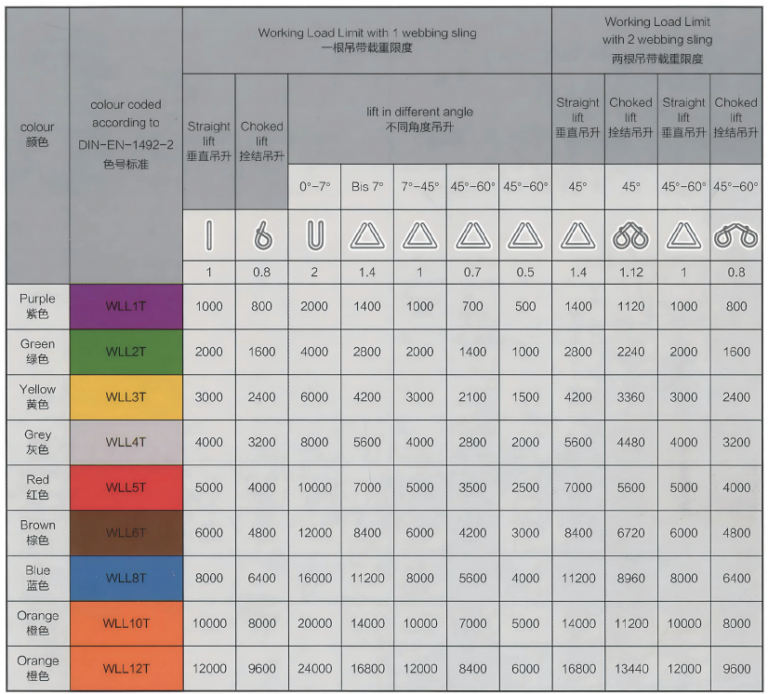
Under EN 1492-1, these WLLs are universally color-coded for quick visual inspection (e.g., Violet for 1T, Green for 2T, Yellow for 3T, up to Orange for 10T+). However, safety doesn’t stop at color. European standards typically mandate a 7:1 safety factor, while ASME often specifies a 5:1 ratio. For distributors and safety officers sourcing equipment for regional projects, it is crucial to verify that the chosen eslinga de poliester meets or exceeds local regulatory equivalents, such as Mexico’s NOM-151-SSA1 or Brazil’s NR-11 guidelines for rigging hardware.
2. Core Sizing Variables: Matching Tonnage, Length, and Material to the Job
Selecting the right gear isn’t just about picking a color off the shelf. This section bridges the gap between tonnage rating and length calculation—the two pillars of effective flat sling dimensioning.
Determining the Effective Working Length (EWL)
A common misconception is that sling length equals the total physical length of the webbing. In practice, the Effective Working Length (EWL) is the straight-line distance between the two bearing points (eyes) when the sling is under tension and bearing the load.
When measuring for overhead crane clearance, remember that a sling that is too short forces a sharp horizontal angle, exponentially increasing tension. Conversely, an overly long sling reduces hook height and introduces dangerous load swing. Always calculate the required EWL based on the headroom clearance and the distance between the load’s lifting points before finalizing your order.
Polyester vs. Nylon: Material Resilience in LatAm Climates
While we often default to specifying a heavy-duty polyester webbing sling, its material composition directly impacts longevity—especially in diverse environments. Here is a quick technical breakdown for field engineers:
- Polyester (Recommended) – Moisture regain < 0.4%; retains full strength when wet. Superior resistance to UV degradation and most industrial acids. Ideal for: Coastal ports (e.g., Veracruz, Santos) and high-humidity tropical zones.
- Nylon (Caution) – High elasticity absorbs shock well but loses approximately 10–15% of its strength when wet. Vulnerable to acidic environments and degrades faster under prolonged sunlight. Not recommended for open-air tropical operations without protective coatings.
For outdoor applications across the region, choosing high-tenacity polyester construction ensures your slings won’t betray you halfway through a shift under the sun.
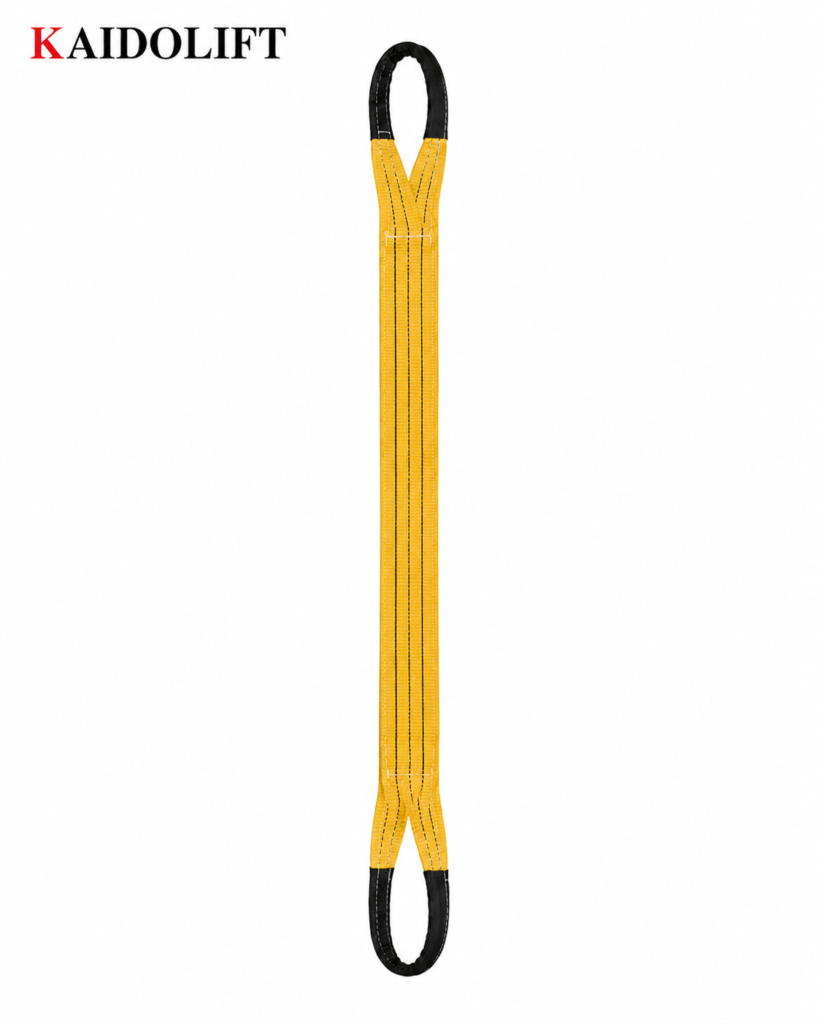
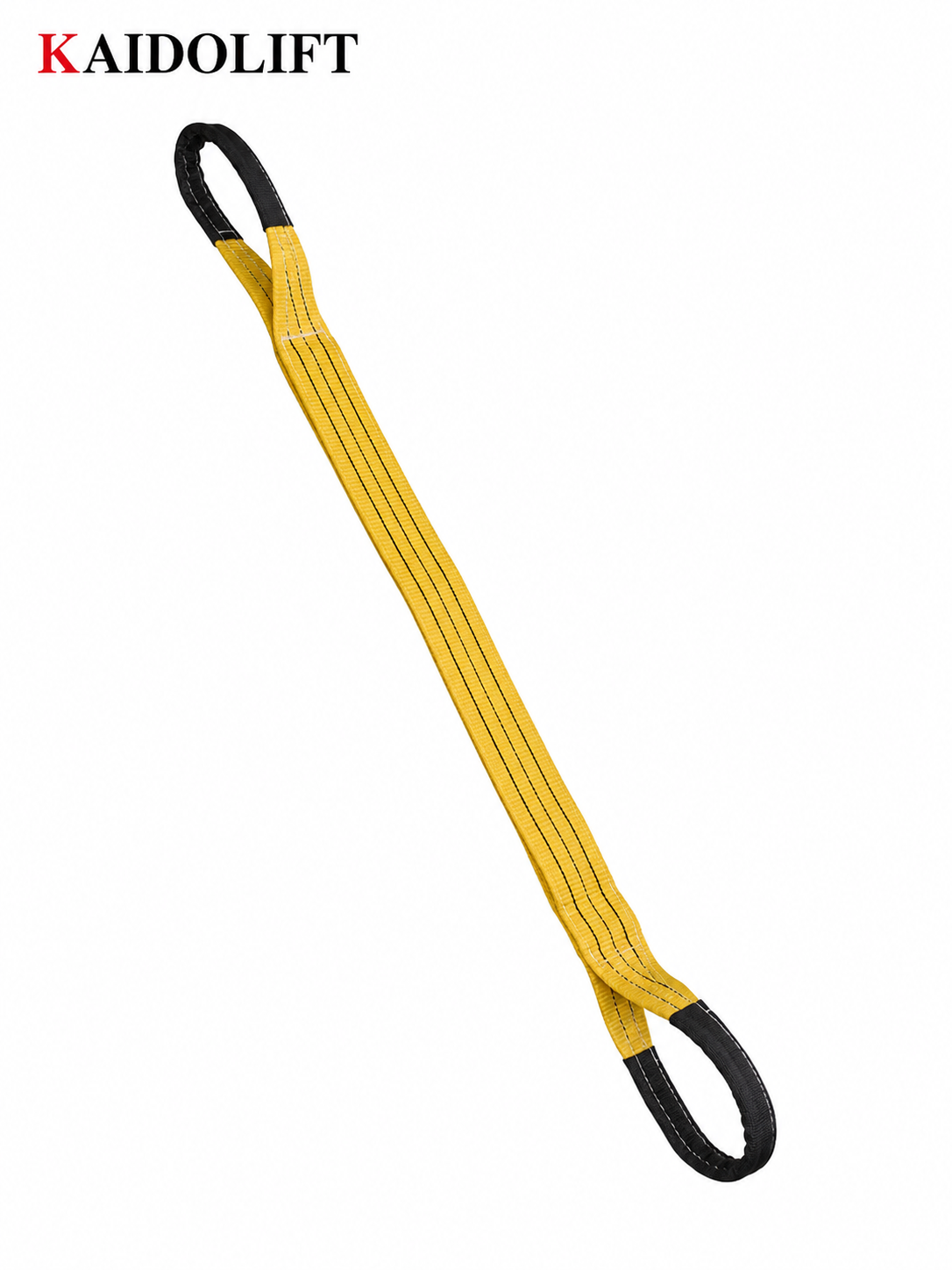
Webbing Sling EB (Eslinga Plana) | 1T to 30T Flat Lifting Sling
Heavy-duty EB Webbing Sling certified to DIN-EN 1492-1 and 2006/42/EC. Made from 100% high-tensile polyester with safety factors up to 8:1. Wide, smooth flat lifting sling for LATAM logistics and industrial rigging.
3. The Angle Factor: How Rigging Methods Affect Actual Capacity
A sling’s rated WLL only applies to a direct vertical pull. Once you introduce angles, the physics change drastically. The way you configure the hitch—vertical, choker, or basket—directly multiplies or divides your safe load.
| Rigging Method | Efficiency Factor | Impact on a 2T Rated Sling |
|---|---|---|
| Vertical Hitch | 1.00 (Full capacity) | 2.0 Tons |
| Choker Hitch | 0.80 (20% reduction) | 1.6 Tons |
| Basket Hitch (Straight lift) | 2.00 (Double capacity) | 4.0 Tons |
However, the danger lies in the Basket Hitch. The table above assumes the two legs are perfectly vertical. In reality, the legs diverge to fit around the load. As the included angle between the two legs increases, the stress on each leg skyrockets.
The Standard Rigging Formula for Basket Hitches:
For a basket configuration, the actual Safe Working Load is calculated using the angle (θ) between the vertical axis and each sling leg:
WLL (at angle) = WLL (Vertical) × 2 × Cos(θ)
Example:
For a 2T green sling used in a basket hitch with a 45° angle from vertical:
2T × 2 × Cos(45°) = 2T × 2 × 0.707 = 2.8T Safe Working Load.
⚠️ CRITICAL SAFETY NOTICE: If the angle from vertical exceeds 60°, the Cos(θ) drops below 0.5. This drastically compromises the structural integrity of the lift and alternative rigging configurations must be deployed immediately.
The Overlooked Derating Factor: Edge Protection
Even if your tonnage and angle calculations are flawless, sharp corners will destroy a synthetic sling. The webbing’s tensile strength relies on intact fibers. A sharp steel edge can slice through the outer stitching, reducing the sling’s actual WLL by 50% or more per ASME B30.9 recommendations—regardless of the printed safety factor.
🔧 MANDATORY PRACTICE: Whenever the load presents sharp, abrasive, or hot edges, edge protection (corner protectors or wear sleeves) is not optional—it is mandatory. Factoring this “wear-and-tear” derating into your initial selection process is the hallmark of a mature safety culture.
Conclusion & What’s Next in This Series
This overview establishes the groundwork for any rigging operation. By diligently evaluating the precise tonnage, calculating the effective length for your specific headroom, and respecting how angle configurations (and sharp edges) alter the physics of the lift, you ensure full compliance with both international standards and local LatAm safety mandates.
Keep an eye out for Part 2 of our series, where we will shift focus to Periodic Inspection Criteria, Storage Best Practices, and Determining End-of-Life for Synthetic Slings.
⚡ Need an Onsite Sizing Quick-Card for Your Supervisors?
Contact our technical support team to get a high-resolution, LatAm-compliant PDF reference chart that includes color codes, angle factor tables, and derating checklists—perfect for your shop floor or field crews.